SAN DIEGO — John Fogerty, a member of the Rock & Roll Hall of Fame and the creative force behind Creedence Clearwater Revival, has a solid explanation for why he initially considered honoring Taylor Swift by titling his newly released album of re-recorded Creedence classics “Taylor’s Version.”
I kind of pushed the people at my record label to name it ‘Taylor’s Version.’ That would grab a lot of attention, right?” said Fogerty. “I didn’t expect us to end up calling it ‘John’s Version,’ but that makes complete sense.
It definitely does on an album whose full title is: “Legacy: The Creedence Clearwater Revival Years — John’s Version.”
More than twenty years prior to Swift’s birth in 1989—and 41 years before she unknowingly handed her record label control of the master recordings from her first six studio albums in 2005—a young Fogerty faced a comparable, more discouraging setback in the mid-1960s.
At that time, he unknowingly transferred the rights and ownership of his music to Fantasy Records. As a result, he had no authority over “Proud Mary,” “Fortunate Son,” “Bad Moon Rising,” or any of the other iconic Creedence songs he composed, performed, arranged, and recorded while leading the band until it disbanded permanently in 1972. He also relinquished most of the rights to any new songs he would create for Fantasy in the future.
Numerous legal actions followed. Fogerty has remained distant from his former band members ever since. He did not issue any albums from 1975 to 1985, and avoided performing his Creedence classics for many years.
‘Eyes wide open’
When you’re young, everything feels fresh, much like a small puppy with wide-open eyes,” Fogerty mentioned in a 2015 interview with the San Diego Union-Tribune regarding his book, “Fortunate Son.
But as an adult, when tough, negative things occur, you hide them with temporary solutions, and this diminishes your creative power. I really wanted to become a good writer again, to be a genuine person once more … and to be able to face myself in the mirror, as I can now …
Swift only fully understood her situation in 2018, following the sale of the master recordings from her first six albums by her former manager for over $300 million. None of that money reached her.
From 2021 through late 2023, Taylor re-recorded and issued her initial four albums, each with the subtitle “Taylor’s Version.” It wasn’t until this year that she managed to reclaim ownership of the music from her first six albums, nearly twenty years after she had relinquished her rights at the age of 15, when she was just beginning her career as a singer-songwriter.
Fogerty’s struggle to regain ownership of his songs lasted far longer than expected. It took the 2005 Songwriters Hall of Fame inductee fifty years to recover control over the 69 tracks he composed and performed on the seven Creedence albums released between 1968 and 1972.
Or as he expressed in a victorious tweet at the start of 2023: “After 50 years, I am finally back with my songs.”
Fogerty expressed it more directly during his energetic San Diego concert in September at The Shell, addressing the crowd: “I outlived those bastards!”
It was an unusual outburst of swearing from the famous minstrel — and a perfectly understandable joyful one.
“I’m not much of a cussing person,” Fogerty, who celebrated his 80th birthday on May 28, said recently from his home in Los Angeles.
I’m no different from anyone else. When I’m driving, I might say: ‘That damn car got in my way.’ But I think using too much swearing just makes you seem uneducated and takes away its effect. So that ‘sons of…’ is the only curse I use on stage.
‘Honoring the songs’
His latest album, “Legacy: The Creedence Clearwater Revival Years — John’s Version,” represents his effort to honor the musical heritage he worked tirelessly to reclaim. It includes 20 tracks, featuring well-loved hits such as “Proud Mary,” “Lodi,” “Green River,” and “Who’ll Stop The Rain.”
Over a dozen of those tracks reached the Top 10 for Creedence between 1969 and 1971, with 10 of them selling over a million copies individually. Each one still feels as lively and relevant today as when they were originally released.
I’m celebrating the songs and the entire amazing journey I’ve been fortunate to experience since the start of my life, which is a blessing,” said Fogerty, who thanks his wife, Julie, for inspiring him to rediscover his Creedence collection on “Legacy.
I believe there’s a form of closure, a kind of realignment,” he added. “I truly think this album is excellent and I’m satisfied with it. This is who I am—and I can embrace it.
Fogerty released his new album featuring his classic songs with his touring band, which consists of his sons Shane and Tyler, along with some special guest musicians. They put in a lot of effort to recreate the same sound and essence on “Legacy” that made the original Creedence recordings so enduring.
Their meticulous craftsmanship is evident on an album that warmly honors, rather than reimagines, Fogerty’s iconic music.
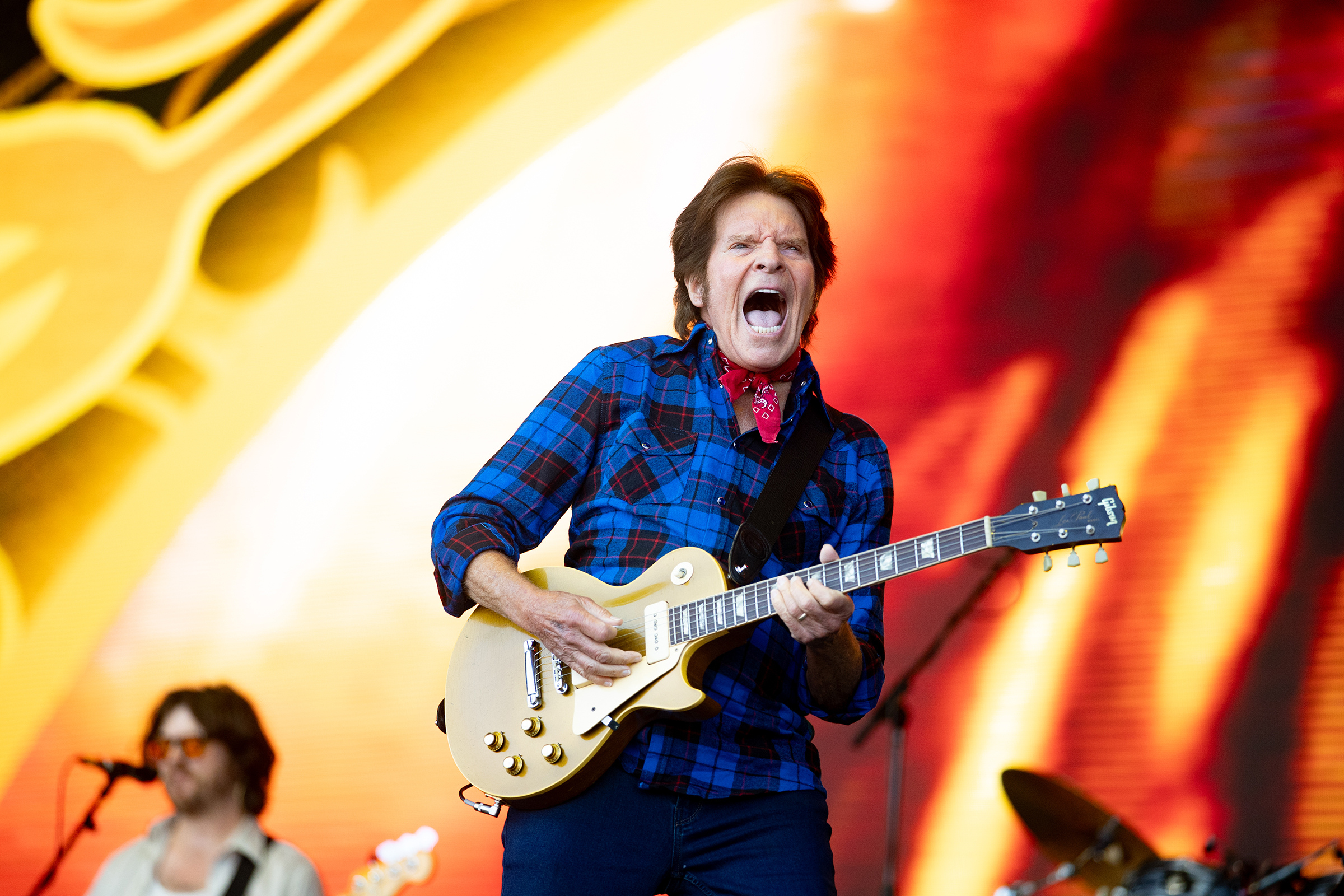
He uses the same Rickenbacker Fireglo 325 guitar he played during the initial recordings. The song arrangements remain almost identical, showcasing his keen insight that there’s no reason or advantage in altering music that has withstood the test of time and — for numerous fans — has become an integral part of their auditory experience.
What stands out is that Fogerty performs these classic songs with the same strength he had when he was young, in the same keys and with the same intensity as he did over 50 years ago.
We’re essentially aiming to stay true to the original recordings I made with Creedence in the late ’60s,” he stated. “That means there’s a specific level of high energy on ‘Legacy.’
What specific factors enable an 80-year-old musician to maintain the same vocal power and skill as when he was in his early or mid-20s?
Fogerty chuckled.
You know, I just look after myself,” he said. “I’ve been a runner my whole life, but I’m not running right now. I go hiking instead. And it’s more challenging to achieve the same level of exertion from two hours of walking or hiking as you did when it was only an hour and a half of running.
I follow a diet but I’m not overly strict, so I occasionally treat myself to a hamburger and enjoy the usual pleasures of life. However, I strive to maintain a balanced approach. During my tours, I avoid coffee and make sure to get enough rest.
He laughed once more while thinking about his life during the 1960s and early 1970s.
I smoked as well back then,” he said. “Goodness me! I made a lot of foolish choices in my 20s. And, naturally, smoking is a foolish thing to do. I hope to be able to sing well for as long as possible, and that really motivates me.
‘That guy is crazy!’
The image on the “Legacy” album cover features the 23-year-old Fogerty gazing directly into the camera — a deeply focused young individual with a strong commitment to his art.
The first time I saw that photo,” he remembered, “I looked at my wife and said, ‘Gosh, that guy is nuts!’ Honestly, what I was really seeing was that I was quite intense, and I suppose I was… I’m not angry there. I’m not confused. I’m definitely not drunk or high, or any of the other things musicians are often accused of.
I examine my face, particularly my eyes, in that photo and I appear very, very intense. And I suppose that (captures) the reality of what my music career represented to me.
Was it necessary to have that level of intensity in order to attain success and maintain it with Creedence?
Indeed,” Fogerty stated. “You’ve probably read about me for years and are aware of the circumstances surrounding me and my band, Creedence, as well as the record company. I believe what was truly overlooked is that all of that music originated from me.
I composed and performed all the songs, and I also created the musical arrangements. I provided the background vocals on most of the tracks. For the most part, I was deeply involved in music, striving to build as extensive a musical career as possible. I had been waiting my entire life for this opportunity.
Fogerty admits he was hesitant to re-record his Creedence hits when the suggestion was initially made by his wife, Julie. It took him a while to become comfortable with the idea.
“There was a kind of spiritual transformation that occurred,” he stated.
I wasn’t very excited about working on this album. I had my own musical idols and observed them re-recording songs. Often, those projects appeared to lack genuine enthusiasm, as if they were just going through the motions, which was disappointing. I’m referring to people I admire — I won’t mention any names — so I was worried about ending up in the same situation.
Julie had this idea that this (album) would be filled with happiness for me to rerecord my old songs. Now that the album is complete, I’m wondering: Did Julie know, all those years ago, that we would regain (ownership of) my songs? She’s a manifestor, as you can see, and she managed to get my songs back. Everyone said: ‘They aren’t for sale and you’ll never get them back,’ but somehow, she did.
A cathartic album
Although “Legacy” wasn’t his original concept, Fogerty has found it therapeutic to re-record songs that have become closely associated with his name.
If someone had asked me years ago about creating an album like this, I would have said ‘No,’ and maybe even felt a bit offended,” he stated. “With all honesty, I am proud of completing this record and have no regrets.
However, creating “Legacy” was not an easy task.
After re-recording his iconic song, “Proud Mary,” Fogerty noticed that his vocals were lacking a crucial element.
“It was good. I stayed in tune. However, it didn’t match the quality of the other music on the track,” he said.
As I listened, I asked, “What’s going on? Why is it this way?” Eventually, I realized that when I was a child and performed “Proud Mary,” it was the first really good—excellent—song I had composed. It was the first time I felt I had entered the realm of exceptional songwriters I looked up to. It was the first time I could stand side by side with them and believe that I had written a song just as valuable as theirs.
I understood what was different was that, when I performed ‘Proud Mary’ before, it felt like a matter of life and death. So, I told myself: ‘John, you need to sing this again and get yourself back to that point where it sounds like a matter of life and death.’ And I did.
He applies the same determined passion to the album’s new/old rendition of “Fortunate Son,” his 1969 Creedence classic, which remains one of the most impactful and unforgettable protest songs from the Vietnam War period.
In earlier interviews, Fogerty has mentioned that the actions of former President Richard M. Nixon and his government were a major influence on the song “Fortunate Son.” In 2002, to Fogerty’s disappointment, the track—which strongly criticized hypocrisy and privilege—was acquired by Fantasy Records for a Wrangler’s blue jeans advertisement.
Even more troubling, the Wrangler’s advertisement utilized only the first two lines of the song to fabricate an illusion of patriotism:Some people are born destined to wave the flag/ Ooh, they’re red, white, and blue.
Currently, the United States appears to be more divided than it was when Fogerty composed “Fortunate Son” in 1969. As improbable as it might have once been, could he now feel a sense of longing for Nixon?
Oh, wow!” Fogerty remarked. “You know, (he) would definitely be a nice substitute — a very mild substitute — for what’s happening now…
I mean, Richard Nixon was definitely a scoundrel. He deceived the American public, and that’s what led to his downfall. However, I think there was some sense of shame in Nixon, which might seem unusual. I believe he acknowledged those feelings. I think he was somewhat more grounded in what happened, compared to the current situation.
Having re-examined and brought his musical history back to life, Fogerty is now eager to write another part of his story.
I’m really excited about composing new songs and producing fresh music,” he stated. “There’s a great atmosphere I share with my sons and the other members of the band, who are all around the same age as my children. I don’t have a specific deadline or anything set in stone. However, I can say that I’m really eager to get started on this new music, so that’s how I’m feeling right now.
You didn’t inquire, but many people have asked me: ‘Are you going to retire or stop making music?’ I’ve already done that a long time ago. During the difficult period (after Creedence), I was out of the music scene for several years and I didn’t like it. I didn’t enjoy being away from music. Working on ‘Legacy’ was essential for me to reach where I am today.
©2025 The San Diego Union-Tribune. Go to sandiegouniontribune.com. Provided by Tribune Content Agency, LLC.