By the end of the previous decade and the start of the current one, a number of significant planning decisions and proposals were expected to reshape Belfast City Centre.
These “revolutionary” major advancements were celebrated as a significant milestone, aiming to revitalize neglected streets and empty structures, and infuse energy into barren areas.
As the decade began, the atmosphere at City Hall, the Belfast Chamber of Commerce, and the business areas was filled with hope, following the negative impact of the Primark fire. This optimism mirrored the political enthusiasm of the New Decade, New Approach initiative, the agreement signed in January 2020 that brought back the Northern Ireland Executive after a three-year break.
Planning permissions including the Tribeca Development, which sought to revitalize the deteriorated regions in the Cathedral Quarter, the Sirocco project, which intended to create an entirely new neighborhood on vacant land in the Waterside area, and the newGrand Central Stationand the Weaver’s Cross project would transform the city, as its supporters believed.
Yet, additional economic difficulties and personal misfortunes followed due to the Covid pandemic, and the city center remained in the news for all the wrong reasons, as problems with cleanliness, homelessness, and anti-social behavior drove people away.
Business and construction throughout the city gradually began to rebound from the initial impacts at the start of the decade, while initiatives focused on revitalizing streets and the ongoing approval of new student housing and hotel developments actively transformed the city center, both in terms of visual appearance and the skyline.
But what about the “game-changing” advancements that were supposed to make the city unrecognizable by 2030? Now that we’ve passed the halfway mark of the decade, it could be a good moment to check in on how these major development projects in Belfast are progressing, or not.
The Tribeca Development
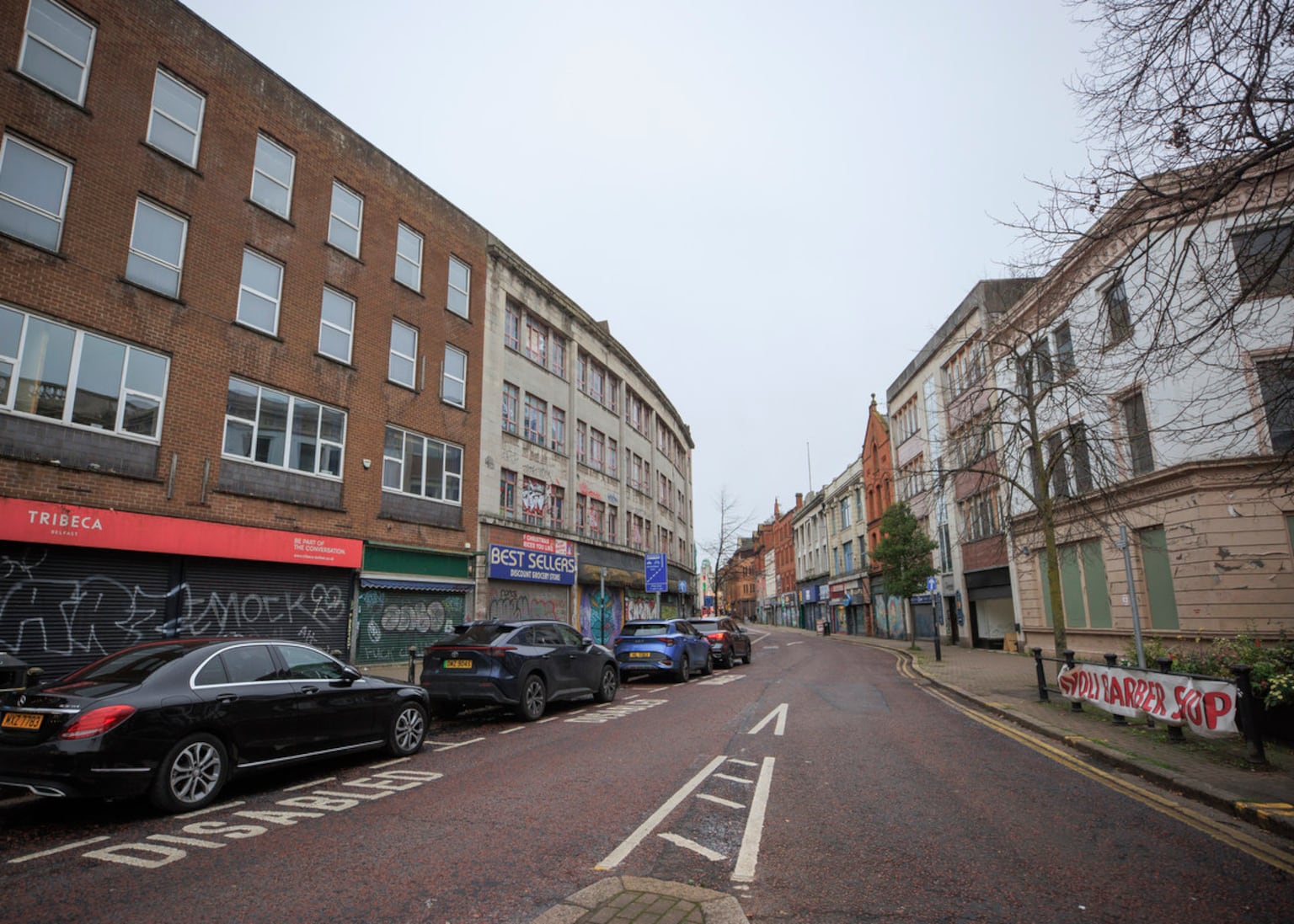
Tribeca, referred to as the biggest renewal initiative the city has experienced in a generation, has actually turned into the most contentious planning proposal in a generation, and not a single shovel has been moved since the £500m urban renewal project was ultimately approved by Belfast City Council in January 2020.
The proposal from the London-based firm Castlebrooke Investments involves a 12-acre area situated next to St Anne’s Cathedral, with boundaries including Royal Avenue, Donegall Street, Lower Garfield Street, and Rosemary Street.
The proposals involve making North Street pedestrian-only, constructing a new North Street Arcade, building a ten-story office building, cutting the size of Writer’s Square by more than half, and adding new streets and green areas. The project was intended to feature residential, business, and commercial spaces, with complete demolitions of non-listed buildings planned on Rosemary Street, North Street, Temple Court, St Anne’s Court, and Donegall Street.
After five and a half years, these streets now exhibit even higher rates of abandonment and decay, continuing to reflect a sorrowful remnant of their past condition. Local politicians, especially those from the Green Party, the SDLP, and People Before Profit—groups that opposed the development—have strongly spoken out against the developer, with some alleging that the company is engaging in “land-banking,” which refers to purchasing and keeping land with the aim of developing or selling it later when its value has risen.
Following extensive debate about the slow progress during both public and private meetings, Belfast Council stated it would initiate procedures to take ownership of the lands held by Castlebrooke, meaning to assume control of the property. In January 2024, the council’s chief executive, John Walsh, revealed that the local authority would be considering the purchase of a large area of abandoned property in Belfast City Centre from Castlebrooke Investments.
Vesting, also known as “compulsory purchase,” refers to the process of acquiring land without the owner’s consent, and the council might be granted the authority to take over the site by the Stormont Department for Communities. Powers of compulsory purchase can aid in implementing various development, renewal, and infrastructure projects that serve the public good.
Following this announcement, the council has decided to proceed with buying the historic Assembly Rooms, a step initially supported by the Alliance Party.
Belfast Council mentioned in their most recent update: “During a special session of the Strategic Policy and Resources Committee on July 9, 2025, elected officials decided that the council should acquire the Assembly Rooms along with the surrounding property.
The committee approved the council’s ability to present an offer to the landowner, Castlebrooke Investments. The properties involved consist of a portion of the Donegall Street car park, 5-9 North Street (previously known as the Laffin Travel building), and Braddell’s Building, a Grade B1 listed structure located at 11 North Street. This choice is still pending approval during the council’s next full meeting on Monday, 1 September.
The committee is still dedicated to taking every possible action to advance the broader Tribeca area and continues to communicate with the property owner, along with the appropriate government agencies that have regeneration authority, in this matter.
Grand Central Station/Weaver’s Cross
While the Grand Central StationDevelopment has attracted its share of debate and demonstrations, yet it’s undeniable that it has advanced at a swift rate.
The new hub was launched in the autumn of 2024, with Translink reporting that tens of thousands more passenger trips have already taken place since then. The public transport organization’s website mentions: “More individuals are experiencing the advantages of bus and train travel after the opening of Belfast Grand Central Station.”
“A transformative force for all of Northern Ireland, it’s redefining how people commute to create a better, more inclusive, and eco-friendly future for future generations,” says Translink, noting that user feedback indicates a 96 percent satisfaction rate.
The project involved activities nearby, including the demolition of the Boyne Bridge, which has led to ongoing protests from local residents and concerns from the Orange Order. Meanwhile, the station’s opening caused significant disruption to traffic in the city center during the critical period before Christmas, with Durham Street and Glengall Street closed to vehicles. Business owners in Sandy Row claimed the road closures have severely impacted an area that was already struggling.
Translink’s latest update mentions: “Progress on the public space project near Belfast Grand Central Station is going smoothly. As part of this initiative, there will be new areas for passengers to board and alight. We hope to announce a reopening date for Durham Street shortly.”
During the summer this year, the old Europa bus station located on Glengall Street was taken over by HALT, a trendy new “meanwhile-use” venue offering entertainment, street food, art, and live music. This marks the initial phase of the “Weaver’s Cross” part of the project.
The Weaver’s Cross initiative aims to revitalize areas made available due to the shutdown of the Europa Bus Station and the Great Victoria Street train station, along with other empty properties owned by Translink. The plan is outlined by the applicant, the government-owned Northern Ireland Transport Holding Company, as a “transport-oriented regeneration” emphasizing “creating places and public spaces, environmental sustainability, and generating economic and social benefits.”
In September 2022, the Planning Committee of Belfast City Council gave unanimous approval for “outline” permission for this significant regeneration project. The mixed-use development will be situated to the east and west of Durham Street, south of Grosvenor Road, extending up to Sandy Row, and includes new office areas, residential units, and a hotel.
New public area space, active transportation options, hospitality, and community facilities are also planned. Approximately one-fifth of this area is intended for housing, with a fifth of the residential space allocated for social or affordable housing. To date, no on-site work has commenced at Weaver’s Cross, although more detailed planning applications are anticipated.
Sirocco Works/Waterside development
The Waterside development project, located on the former Sirocco Works site, has followed a similar path to Tribeca, but without the controversy and media attention. Over the past six years since its approval by Belfast City Council, there remains little visible progress on the site.
In June 2019, the council’s Planning Committee gave approval to a £450 million project, proposed by developers Osborne and Co, who are also based in England, for the development of 675 homes, office spaces, a hotel, and a creative center on a 16-acre plot located along the Lagan River. The area has remained unused since 1999.
In 2024, Osborne and Co stated they were still “dedicated” to their project despite rumors that another group proposed a basketball arena idea for the former Sirocco location. The area is still empty.
Belfast Stories
A £100 million initiative called Belfast Stories was revealed in December 2021, aiming to establish a major new tourist destination, creative center, and community area. This endeavor is a key component of the tourism and renewal aspect of the Belfast Region City Deal and is expected to launch in 2030.
A portion of the new tourist destination will be located within one of Belfast’s most cherished historic structures, the art deco former Bank of Ireland building on Royal Avenue, which was purchased by Belfast City Council together with the adjacent 5,000 square meter area.
The council conducted two public consultations regarding the project’s content. The 77-page initial consultation report was released in summer 2023 and featured interviews with more than 680 individuals. A second consultation took place from December 2024 to April 2025, involving market testing through focus groups, collaboration with tour operators, and online surveys targeting both international and domestic consumers in Northern Ireland, Great Britain, Ireland, the USA, France, and Germany.
A report from the council regarding the second consultation mentions: “Nearly three-quarters (74 percent) of those who participated in the survey would be interested in visiting the Belfast Stories experience, 83 percent of respondents overall found the Belfast Stories experience to be exciting, and 63 percent believed it was distinctive. Among the three main components of the Belfast Stories experience, public areas were most frequently ranked as the top choice in terms of appeal, followed by the primary paid exhibition, and then the creative hub.”
The sustainability potential of Belfast Stories is backed by these early findings. Notably, there is significant interest in the variety of offerings and from various markets, both local and global, including day-trippers.
Those who want to learn more about the initiative can take guided visits to the former Bank of Ireland structure on Royal Avenue during the European Heritage Open Days in September.
Cathedral Gardens
In February of this year, the Planning Committee of Belfast Council approved proposals to convert Cathedral Gardens in the city center into a distinctive public area featuring a plaza for small gatherings, an urban forest or woodland garden section, and a children’s play area equipped with digital art installations.
With updated lighting, landscaping, and benches, along with improvements to the public space, the plans will also feature a new memorial dedicated to honoring the World War II Belfast Blitz, created in collaboration with the Northern Ireland War Memorial Museum.
The council aims to hire a contractor in November 2025, with work on the site expected to begin during the winter of 2025-2026. It is expected that the building process will last between 12 and 15 months.
Other projects
Belfast Council has also highlighted additional projects promoted by City Hall aimed at improving residential life in the city center. In December, as part of an effort to boost living in the city center and housing renewal throughout the city, the council revealed that it had chosen the construction and civil engineering firm GRAHAM as its long-term collaborator to implement residential-focused, mixed-use, eco-friendly developments across several locations.
The council stated, “With a total development potential of £630 million, this first stage of the partnership utilizes strategic council-owned sites in the city center, valued at £280 million, to create a variety of housing options that will address the needs of people wanting to reside in the city. This new method will support the advancement of city center living and housing-focused regeneration throughout the area.”
In May of this year, Belfast Council stated that its three-year initiative called Vacant to Vibrant City Centre, aimed at encouraging the use of empty spaces, would produce more than £3.5 million in rates. This represents a return of nearly £4 for every £1 provided in grants. Entities and businesses that received benefits from the program include Another World, ArtsEkta, Bodega Bagels, Golden Thread Gallery, High Society, Michele International Hairdressing, Neighbourhood Café, Sloan’s Gym, Vault Artist Studios, and Verona Bridal.
Out of 48 grants given out, 23 have contributed to or are in the process of restoring a historic structure or one of significance. For instance, Round House Bakery plans to utilize their grant to introduce handmade sourdough breads, pastries, and pizza to a unit within Cathedral Buildings, which was nearly lost to a fire three years back. While the city center funding has been completely distributed and the program is now closed, the council is currently accepting more applications for its citywide Vacant to Vibrant initiative.
The council is also advancing a project titled “Under the Bridges” in collaboration with Belfast Harbour, aimed at enhancing the public area in the City Quays/Sailortown region. The initiative includes facilities for active transportation and the revitalization of unused areas beneath the M3 bridges. Additionally, there are proposals for a new pedestrian and cycling bridge connecting Sailortown to Queen’s Island.
Donegall Place/Royal Avenue
The Belfast One Business Improvement District has stated that the city center’s key shopping street, Donegall Place, is currently in excellent condition and anticipates reaching full occupancy by the end of the summer, representing a significant achievement for the group’s efforts to revitalize retail in the city center.
Several brands are either opening or planning to expand in Belfast’s city center this summer and in the upcoming months, featuring significant projects like Victoria’s Secret at Donegall Place and LEGO along with Bershka in Victoria Square.
Belfast One’s most recent data shows that the Belfast city center is going through a significant period of expansion, with pedestrian traffic increasing by 6.5 percent so far this year. Royal Avenue has shown exceptional results, experiencing a 22 percent rise compared to the same period last year, while Donegall Place has seen a seven percent growth.
Martina Connolly, CEO of Belfast One BID, stated: “We are excited to see Donegall Place returning to full occupancy. There have been multiple empty spaces in recent years, and although, like any city, there is still progress needed to enhance the city center, this achievement shows a strong sign of Belfast’s continuous development and change, as we observe more people moving through the city center.”
The hoarding at one store is being removed this week, while the hoarding right across the street has been raised, illustrating one instance of the major shifts occurring in Belfast’s retail scene. Several ongoing projects are also taking place in other parts of the city center to expand retail areas.” She adds: “Stay tuned.