
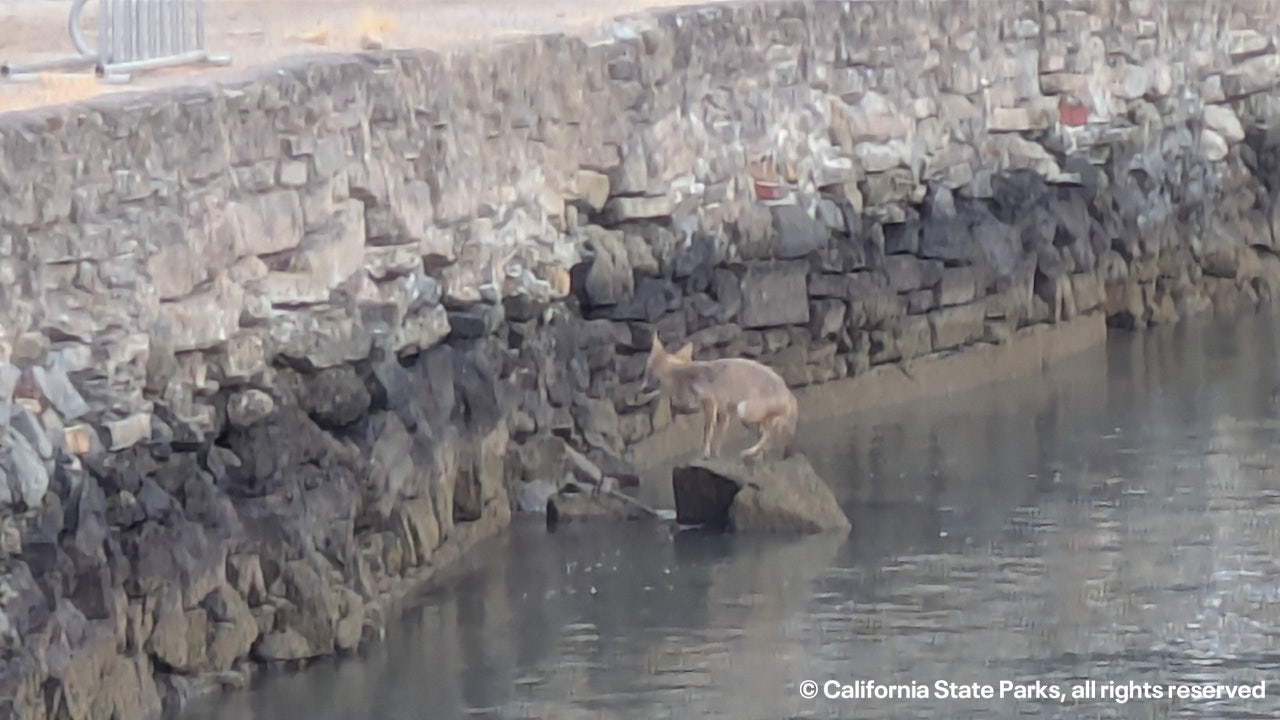
Coyote on the Bay: A Surprising Swim to Angel Island
A recent sighting in the San Francisco Bay has captured the attention of wildlife enthusiasts and park officials alike: a coyote swimming determinedly toward Angel Island. The unusual event, caught on video, raises fascinating questions about the island’s coyote population and their behavior.
The Aquatic Coyote
The video, recorded on August 29th, shows the coyote navigating Raccoon Strait, approximately a quarter of a mile from Angel Island’s shore. Experts from California State Parks believe the coyote was journeying back to its home on the island after a swim from Tiburon, a distance of roughly one mile.
“That’s no small feat for any critter,” remarked Bill Miller, an environmental scientist with California State Parks. He expressed his surprise, stating it was the first time he had witnessed such an event in his extensive career. Despite the challenge, coyotes are known to be capable swimmers, and this particular animal successfully reached the shore.
A Relatively New Island Resident
While now a familiar sight on Angel Island, coyotes are relatively recent arrivals. Prior to 2017, there was no evidence of their presence on the island, despite its 10,000-year history. The initial sighting marked the beginning of a new chapter for the island’s ecosystem.
The population has since grown, starting with a single coyote that was spotted in 2017. That lone coyote was soon joined by another, and eventually, they produced a litter. Today, the estimated coyote population on Angel Island is around 14 or 15 individuals.
A Family Affair
According to park officials, the entire coyote population on Angel Island appears to be descended from a single female. DNA analysis has confirmed that the animals are closely related, forming a family tree spanning approximately three generations. It is believed that the original mother and grandmother of this family line have since passed away.
Studying the Island Coyotes
The Angel Island coyotes are currently the subject of a five-year study, now in its second year, led by the California Department of Fish and Wildlife. This research aims to understand various aspects of their lives, including their diet, behavior, and relationships within the population.
The study employs various methods, including wildlife cameras and the collection of scat samples from both coyotes and deer. This allows researchers to analyze their diets and understand the dynamics between the two species. The goal is to build a comprehensive “family tree” to map out the relationships between the coyotes.
Impact on the Island Ecosystem
Coyotes are primarily carnivores, and their diet includes deer and other mammals. In the past, Angel Island faced an overpopulation of deer, with numbers reaching into the hundreds in the 1970s and 80s. Culling efforts were implemented to manage the deer population, and today, the island is home to approximately 43 deer.
Researchers are also investigating how the presence of coyotes is affecting other species on Angel Island. One particular focus is the Angel Island mole, a species endemic to the island. Scientists are keen to determine if the coyotes are having any impact on the mole population.
Coexisting with Coyotes: What You Can Do
Evidence suggests that the coyotes on Angel Island have also consumed pig and chicken, likely obtained from human sources. This has prompted park officials to urge visitors to be responsible with their food and avoid feeding the coyotes under any circumstances.
Leaving behind food scraps or deliberately feeding wildlife can lead to negative interactions and alter their natural behaviors. Park officials emphasize the importance of preventing such interactions.
In the event of a coyote encounter, it is crucial to prioritize safety. Rather than reaching for a phone to take pictures, experts advise taking steps to “haze” or scare the coyote away. This can involve speaking loudly, making noise, or making yourself appear larger by waving your arms.
Unanswered Questions and Continuing Intrigue
The video of the swimming coyote has sparked considerable curiosity about these relatively new inhabitants of Angel Island. The initial reason for the first coyote’s arrival remains a mystery. One theory suggests that the coyote saw an opportunity on the island and decided to swim across. It’s also possible that her howling attracted other coyotes to the island.
The fact that coyotes have only recently colonized Angel Island, despite its long history, suggests that the initial colonization event was a rare occurrence. However, the frequency with which coyotes may be traveling to and from the island remains unknown. The swimming coyote may have simply been exploring new territory, given the island’s limited size of about one square mile.
Despite the remaining questions, the presence of coyotes in the Bay Area highlights the region’s ability to support diverse wildlife populations. The open spaces and quality habitat allow coyotes, bears, and other species to thrive. As the region becomes increasingly urbanized, learning to coexist with wildlife is essential.