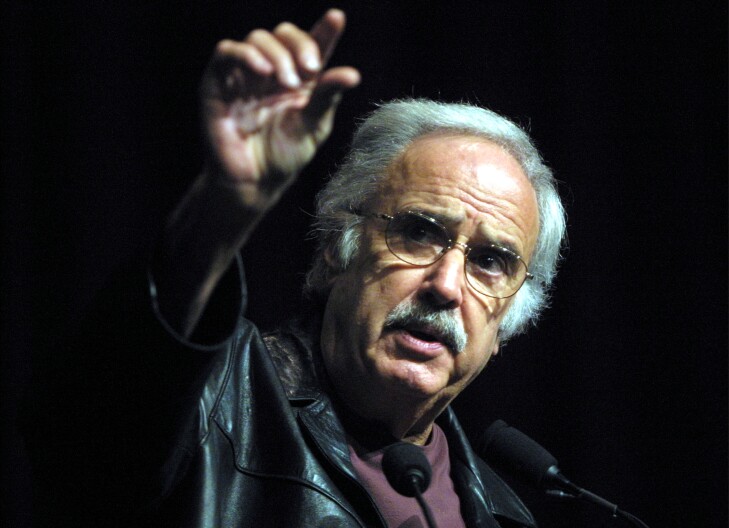
John Burton, a towering figure in California politics known for his unwavering commitment to the working class and his often colorful language, passed away on Sunday at the age of 92. He had been in declining health for several years. Together with his late brother Phillip, Burton built a formidable political force that dominated San Francisco and California for decades, often referred to as the “Burton machine.”
A Champion for the Underdog
Throughout his long career in both Sacramento and Washington, D.C., Burton established a reputation for his direct, unvarnished style, frequently punctuated with expletives. However, this bluntness was always in service of his passionate advocacy for labor unions and the working class. As he stepped down as chair of the California Democratic Party in 2017, Burton emphasized the importance of fighting for those without power, stating, “There’s a lot of people out there that if we don’t fight for them, nobody’s going to fight for them because they don’t have any power.”
His dedication and effectiveness were widely recognized. Representative Nancy Pelosi, a former protegé, acknowledged his sometimes-salty language but emphasized his sincerity and undeniable impact. Former Lieutenant Governor Gavin Newsom, in a 2017 tribute, highlighted the profound improvements to the Bay Area, California politics, and the nation that resulted from the Burton family’s influence. Former Governor Jerry Brown credited Burton with giving “life and structure and success to the California Democratic Party.” In 2014, the California Democratic Party honored Burton by naming its new Sacramento office the John L. Burton Democratic Headquarters.
Overcoming Adversity
Former State Senator Patrick Johnston, a colleague of Burton’s in both the Assembly and Senate, noted that Burton overcame personal struggles, including drug addiction, to focus on serving those in need. Johnston described Burton as someone who “forever chased, [but] kept outrunning his own demons.” He likened Burton’s management of the State Senate to that of a point guard with a ticking clock, arguing, cajoling, yelling, begging, and inspiring his colleagues to pass legislation. For Burton, the most important bills were those that helped the poor, the elderly, and foster children.
Political consultant Shawnda Westly, who worked with Burton for many years, described him as an unapologetic liberal, recalling his insistence on being identified as a liberal rather than a progressive. Despite his gruff exterior, Westly emphasized that Burton had a softer side, saying, “His bark was worse than his bite.”
Reaching Across the Aisle
Despite his staunch Democratic beliefs, Burton often collaborated with Republican governors and legislators, maintaining friendships with many Republicans, albeit a different kind of Republicanism than is seen today. In a 2018 interview, he praised former Governor Ronald Reagan for signing a relatively liberal abortion bill and former Governor Pete Wilson for raising taxes to balance the budget, giving Wilson “a great amount of credit for that.”
Wilson, who served alongside Burton in the Legislature and as governor, expressed admiration for his former political opponent. He lauded the combination of Burton and Willie Brown negotiating budget and policy solutions during a time of crisis, calling it “some of the finest policy and political talent California has ever seen.” Wilson added that even though they disagreed on nearly every policy issue, they were able to find common ground when the state required it.
However, Burton was not afraid to challenge members of his own party. He publicly disagreed with Governor Gray Davis’s assertion that the Legislature was “there to implement my vision,” countering with, “I have an absolutely different view. I believe in checks and balances.”
The Rise of a Political Dynasty
Born in Cincinnati, Ohio, during the Great Depression, Burton spent his formative years in San Francisco. He entered politics in 1964, winning election to the California Assembly, the same year his friend and ally Jerry Brown joined the Assembly. His brother Phil also won a seat in Congress representing San Francisco.
While John rose through the ranks in California, Phil Burton became a force in Washington, D.C., mastering the art of reapportionment to benefit Democrats. The “Burton machine” brought together organized labor, Black churches, Asian Americans, and the LGBTQ+ community, creating a powerful coalition that dominated California politics for decades.
In 1974, amidst the Watergate scandal, Burton was elected to Congress, representing San Francisco and part of Marin County. He served until 1982, when he resigned to address his cocaine addiction. Phil Burton, who narrowly missed becoming Democratic majority leader in Congress in 1976, died suddenly of a heart attack in 1983. His widow, Sala Burton, succeeded him and designated Pelosi as her successor before passing away from cancer in 1987.
After overcoming his addiction, Burton returned to the Assembly in 1988. In 1996, he won a seat in the State Senate, eventually becoming president pro tem until term limits forced his departure in 2004.
He is survived by his daughter, Kimiko Burton, and her two children, Mikala and Juan. Kimiko also pursued a career in politics, serving as San Francisco’s public defender after being appointed by Brown in 2001, although she later lost an election to retain the position.
A Complex Legacy
Although he served in the Army, Burton was a staunch opponent of war throughout his political career. In addition to his advocacy for the working class, he played a significant role in opposing the Vietnam War and fighting against apartheid in South Africa. His legacy includes civil rights laws, environmental protection policies, and legislation supporting children in the foster care system.
After leaving the Legislature, he chaired the California Democratic Party from 2009 to 2017. He also established the John Burton Foundation for Children Without Homes. In 2008, the foundation’s executive director, Kathleen Driscoll, filed a lawsuit against him, alleging repeated sexual harassment. The case was settled under confidential terms.
Westly defended Burton against the allegations. She emphasized his positive impact on others, stating, “He gave me my spine. When I worked with him, he helped me believe in myself and the values I had and to stick to them. He always used to say, ‘Women are the ones who get shit done.'”
Throughout his political career, Burton mentored younger staff members, including Barbara Boxer, who worked in his Marin County district office while he was in Congress. When Burton chose not to run for re-election in 1982, Boxer won his seat. A decade later, she joined Dianne Feinstein in the U.S. Senate during what was dubbed the “Year of the Woman.”
Boxer described Burton as “the most authentic elected official I have ever met in my 40 years in public service.” She credited him with teaching her to “never betray my conscience and to stand up against the most powerful to help those without a voice.” She added that he was “uncensored and unbending in his advocacy for the powerless.”
Like any long-serving politician, Burton faced criticism. Some Democrats were uncomfortable with his profanity-laced language or his acceptance of contributions from industries considered to be at odds with liberal principles. However, as chair of the California Democratic Party, he helped build a substantial majority in the Legislature. His legacy includes the candidates he supported and his unwavering defense of traditional liberal politics – championing women, the working class, farmworkers, and other marginalized Californians, while collaborating with Republicans when necessary to advance his agenda.