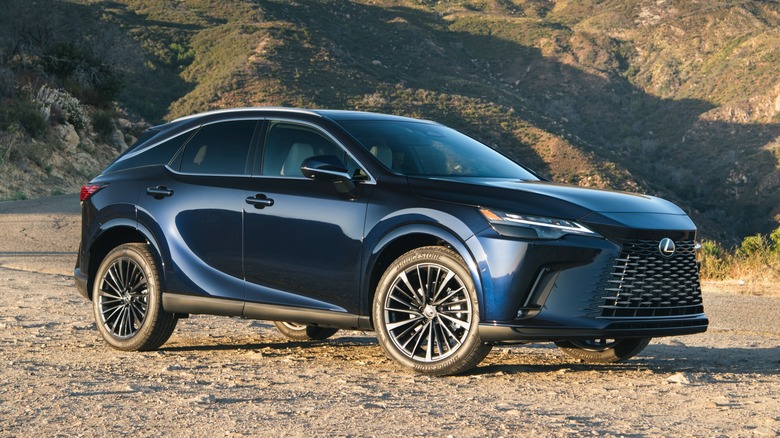
Lexus offers a range of vehicles that seem like a mix of letters, including the LX, LS, GX, and RZ. Two models, the RX and NX, are the brand’s top-selling options and share many similarities, as both are two-row unibody crossovers with comparable design and features. However, the RX and NX are positioned differently within Lexus’ lineup and offer distinct capabilities and pricing. We’ll examine the differences between the RX and NX, which could be useful if you’re considering a Lexus SUV or already own one.
Making its debut for the 1998 model year, the RX (which represents Radiant Crossover) marked Lexus’ initial foray into the crossover market and one of the earliest offerings in the midsize luxury SUV category. The model swiftly rose on the brand’s sales rankings, ultimately turning into the company’s top-selling vehicle as of 2025. Although mainly recognized as a two-row crossover, the RX was also offered in a three-row configuration (the RX L) from 2017 to 2022, within the fourth generation. The fifth-generation RX was introduced for the 2023 model year and remains available through 2025.
With compact rivals such as the Acura RDX and BMW X3 making inroads into the luxury segment, Lexus launched the NX (Nimble Crossover) for the 2015 model year. The NX adopted a design similar to the RX but provided buyers with a more budget-friendly Lexus SUV. Currently, the NX is the second-highest selling Lexus model. Before the 2019 launch of the subcompact UX, the NX served as the brand’s base crossover. Now in its second generation, the NX continues to be offered exclusively as a two-row vehicle.
Read more: 10 Automobile Manufacturers Known for Their Most Comfortable Cabin Designs
Lexus RX Compared to NX: Dimensions and Power
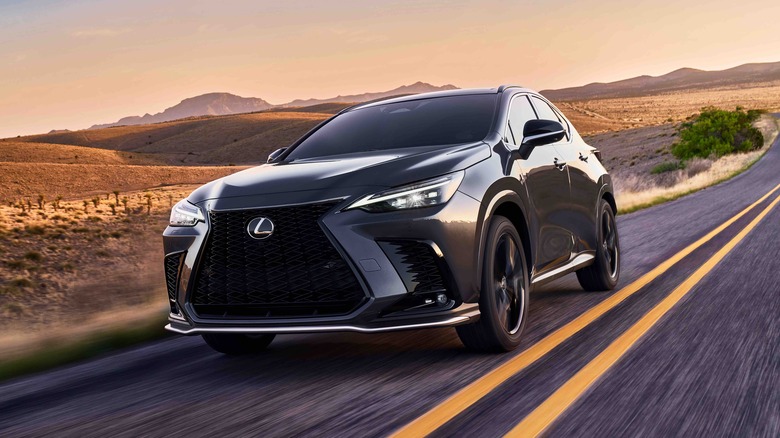
Although the U.S. EPA categorizes both 2025 model year vehicles as compact SUVs, the classification might not be entirely accurate. The RX measures 192.5 inches in length with a 112-inch wheelbase, providing it with a size advantage over the NX, which is 183.5 inches long and has a 105.9-inch wheelbase. Inside, the difference is less pronounced, as both models offer approximately 41 inches of front legroom. Rear passengers enjoy 37.4 inches of space in the RX compared to 36.1 inches in the NX. When it comes to cargo area behind the rear seats, the RX offers more room (29.6 cubic feet) than the NX (22.7 cubic feet), but the NX provides slightly more storage when the seats are folded down (46.9 cubic feet versus 46.2 cubic feet in the RX).
The RX 350 base model features a turbocharged 2.4-liter four-cylinder engine that delivers 275 horsepower, whereas the NX 250 comes with a naturally aspirated 2.5-liter four-cylinder generating 203 horsepower. An AWD RX 350 reaches 60 mph in 7.2 seconds, while an AWD NX 250 takes 8.6 seconds to do the same. Moving up to the NX 350 introduces the turbocharged 2.4-liter engine found in the RX 350. The hybrid variants, RX 350h and NX 350h, both utilize an electrified 2.5-liter four-cylinder, producing 246 and 240 horsepower respectively, with 0-60 mph times of 7.4 and 7.2 seconds.
Both models are available in a 450h+ plug-in hybrid configuration featuring a 2.4-liter engine that produces 304 horsepower. In this setup, the NX can accelerate to 60 mph in 6.0 seconds, which is 0.2 seconds quicker than the RX. There is no top-of-the-line NX variant.RX 500h F Sport Edition, which integrates hybrid technology and turbocharging to produce 366 horsepower and achieve a 0-60 mph acceleration in 5.9 seconds.
Lexus RX Compared to NX: Cost and Specifications
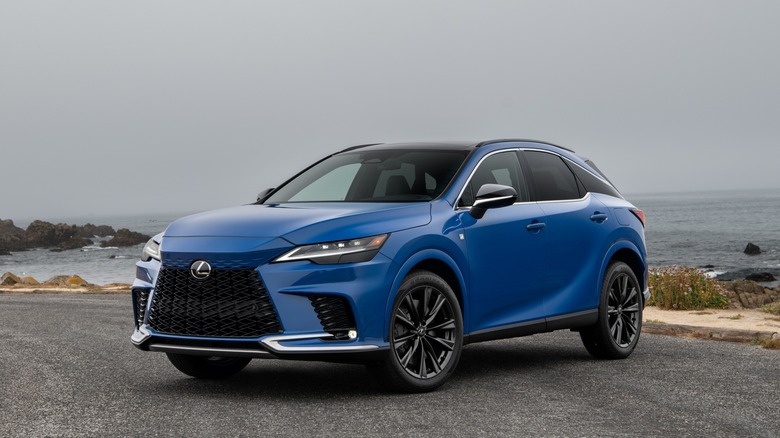
The base RX 350 with front-wheel drive is priced at $50,575, and adding all-wheel drive brings the total to $52,175 (both figures include a $1,450 delivery fee). In comparison, the most affordable NX model, the FWD NX 250, has a sticker price of $42,260. Moving up to the NX 350, which comes with standard all-wheel drive and the same engine as the RX 350, costs $46,020 (both prices include a $1,295 delivery fee), resulting in a $6,155 discount compared to its RX counterpart. Understanding the…difference between the NX 250 and NX 350 modelscan assist in determining if the latter is worthwhile.
You’ll face a higher cost for fuel-efficient hybrid models. The most affordable RX hybrid (RX 350h) is priced at $52,875, whereas the NX’s hybrid base model (NX 350h) is available for $46,720. Plug-in hybrids come with an even steeper price tag: the RX 450h+ Luxury starts at $72,710, which is notably more than the NX 450h+ Luxury’s $62,535. The most budget-friendly RX 500h (which doesn’t have an NX equivalent) is priced at $66,250. All prices include destination charges.
The RX and NX come equipped with Lexus Safety System 3.0, which includes features like automatic emergency braking and lane departure warning. Both vehicles also have similar infotainment systems. The base trims of both models include a 9.8-inch display, with a 14-inch option available (and standard in higher trim levels). Additionally, the more upscale trims of each model offer largely similar features. For instance, the RX 350 Premium and NX 250 Premium both feature a driver seat memory function and heated and cooled front seats. A key distinction is that the RX comes with 19-inch alloy wheels, whereas the NX starts with 18-inch wheels.
Looking for the newest developments in technology and automotive trends?Sign up for our complimentary newsletterFor the most recent news, professional advice, and step-by-step instructions, delivered one email at a time.
Read the original article on Muara Digital Team.