
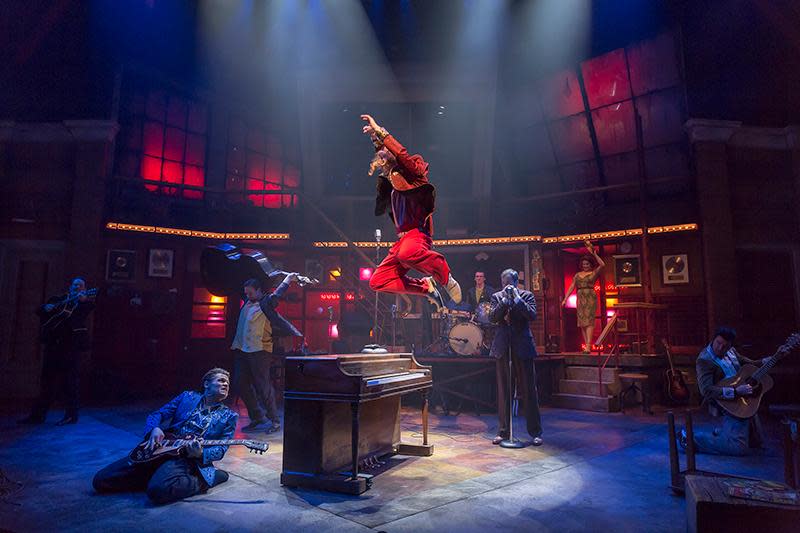
“Million Dollar Quartet”is a jukebox musical sensation that, in contrast to many other pop musical biographies, does not focus on the life of one particular star or band but instead brings together four renowned rockers, allowing them to engage dynamically both as musicians and as individuals.
Playhouse on Park is presenting a new version of the musical until October 19, offering Connecticut another opportunity to see a production that has traveled throughout the state multiple times.
This highly popular, high-energy performance is inspired by a real recording session at Sun Studios on December 4, 1956, when Carl Perkins, known for “Blue Suede Shoes,” was working on what would become one of his most famous tracks, “Matchbox.” The studio’s owner and producer, Sam Phillips, invited one of the label’s new artists, Jerry Lee Lewis, to contribute his unique piano skills to the song. Another Sun Records performer, Johnny Cash, stopped by to socialize. Later, Elvis Presley arrived with a female companion to visit Phillips, and a jam session began.
An unexpected rock star gathering was featured in the Memphis newspapers the following day, but the “Million Dollar Quartet” recordings remained unavailable to the public until 1981. These recordings primarily include gospel songs, classic pop numbers, a few rockabilly hits that they all were familiar with, and some holiday tunes. In the stage play, however, the performers compete by showcasing their most popular songs from that era, ranging from Perkins’ “Blue Suede Shoes” to Cash’s “I Walk the Line” to Elvis’ “That’s All Right,” culminating in an energetic finale of Lewis’ “Whole Lotta Shakin’.” In reality, the woman Elvis brought to the studio was his then-girlfriend, Marilyn Evans. In the musical, she is portrayed as a character named Dyanne who sings along with the group.
The story revolves around the ups and downs of success. Perkins’ era of creating hits appears to be ending. Lewis is gaining momentum, but he has his own issues. Although Elvis has achieved extraordinary success in pop culture as both a music star and a Hollywood actor, he feels unfulfilled and is trying to bring his former mentor Phillips back to RCA Records to work together again. Phillips is conflicted about leaving the Sun Studios empire he built from scratch, particularly since he’s about to renew the contract of his newest successful artist, Cash. What Phillips isn’t aware of is that Cash has already decided to leave Sun for Columbia Records.
Each of these career challenges, along with the personal struggles that drive them, creates an energetic evening where more than 20 vibrant roots rock songs are mixed with stories of difficult childhoods, financial troubles, tour mishaps, inappropriate relationships, and other experiences.
The production was created in Florida in 2006, followed by a run in Chicago in 2008 where it quickly became a success and remained in that city for more than seven years. It made its debut on Broadway in 2010 and lasted over a year before moving to an off-Broadway venue, where it continued for almost another year. However, “Million Dollar Quartet” was just beginning to gain momentum. A London version of the show was produced, along with a seasonal “Million Dollar Quartet Christmas” edition. The show started touring in 2011 and, including the Christmas version, continued to tour intermittently for the next twelve years. Meanwhile, separate concert performances featuring the same songs and imitating the same artists, as well as former cast members of “Million Dollar Quartet” who formed their own roots rock bands, began to fill theaters and clubs.
Now, Presley, Lewis, Cash, and Perkins have made their energetic return to the regional theater scene. In Connecticut, Seven Angels in Waterbury presented “Million Dollar Quartet” in 2017 when the production was still on the road. Ivoryton Playhouse staged it in 2023, ACT of CT did so in 2024, and Sharon Playhouse brought it to life this past June.
Not every performance of “Million Dollar Quartet” is the same. The show features classic rock songs that you are familiar with and cherish, but fans who have enjoyed these tracks for years understand that there are numerous ways to interpret them, and the artists often reimagined them in various styles throughout their careers.
The general impression of this scene is that it’s neat. The music studio is plain, white, and free of clutter. The desk where Phillips is seated is positioned at the edge of the stage, as far away as possible from the studio area, enhancing the sterile atmosphere. Because the performers are using body microphones, the microphone stands are merely for show, and there are no cables to stumble over. The musicians appear well-groomed — even Lewis’ messy long hair looks meticulously kept.
At Playhouse on Park, Alex Burnett, who portrays Lewis, has previously climbed onto his piano six times, including at Sharon Playhouse. He performs all the typical Lewis actions — messing with his hair, placing his feet high on the piano, knocking over the bench, and so on. He especially enjoys the way “The Killer” would sweep the right-hand keys as if cleaning a bar counter with a cloth.
This is the fourth time Brian Steinberg has portrayed Elvis in “Million Dollar Quartet,” and he also appeared in a production titled “Elvis: A Musical Revolution.” He accurately captures the mid-1950s version of Elvis in his performance, while subtly hinting at the decline that would follow over the next two decades before his passing in 1977.
This is the sixth “Million Dollar Quartet” for Chris Colley, who has typically been part of the backing bands but now takes center stage as Perkins and also acts as the music director for this production. It’s not a significant issue that he doesn’t resemble Perkins, as his acting is strong. Unlike many who have taken on this role, Colley subtly portrays Perkins’ alcoholism, depicting him as a constant drinker whose decline is internal rather than exaggerated through physical outbursts. This is a wise decision, particularly for a show that maintains a steady pace and reserves its dramatic moments for the conclusion.
Even director Alessandro Gian Viviano was once a performer in “Million Dollar Quartet” and has portrayed Elvis on twelve occasions — including at ACT of CT in Ridgefield. Gian Viviano views the show as a tribute act where getting the songs accurate is crucial, but also as a well-crafted, emotional drama centered on male friendship, moral dilemmas, competitive drive, artistic challenges, and the longing to succeed.
Among the four primary actors, only Kendall McShane appears to have not previously performed in the show, which is surprising since he possesses the perfect voice, intense gaze, and gradual demeanor required to portray Cash. His somber nature contrasts with Burnett’s Lewis’ playful energy, and his deep, rough voice enhances the group’s harmonies each time they perform together.
John Elliott portrays Phillips, the promoter who assembled this group. This performance includes an unexpected twist as the Phillips character becomes part of the band towards the conclusion, although we won’t disclose which instrument he plays.
In the unappreciated position of sidekick, Dyanne, Paloma D’Auria gains the boys’ admiration and participates in important songs without overshadowing them. There are also two supporting characters who primarily serve as musicians, Joey Nuhfer as Perkins’ bassist brother Jay Perkins and Jeffrey Kelly as drummer W.S. “Fluke” Holland. It’s difficult to picture any production of “Million Dollar Quartet” where the upright bass player doesn’t perform tricks with that large instrument, and Nuhfer has some unique ones.
“Million Dollar Quartet” at Playhouse on Park maintains a polished theatrical style within its neat setting, yet ultimately turns chaotic and messy towards the end as the show transforms into a tribute band performance with multiple encores. You exit the theater feeling energized and having gained some insight into the humble beginnings of certain rock legends. There’s certainly a lot of shaking happening.
“Million Dollar Quartet” is playing until Oct. 19 at Playhouse on Park, located at 244 Park Road in West Hartford. Shows take place on Tuesdays at 2 p.m., Wednesdays and Thursdays at 7:30 p.m., Fridays at 8 p.m., Saturdays at 2 and 8 p.m., and Sundays at 2 p.m. There will also be a special morning performance on Oct. 10 at 10:30 a.m. Ticket prices range from $48.50 to $58.50; $46 to $56 for seniors, students, and military personnel; and $28.50 for the morning show.playhouseonpark.org.
©2025 Hartford Courant. Go to courant.com. Distributed by Tribune Content Agency, LLC.