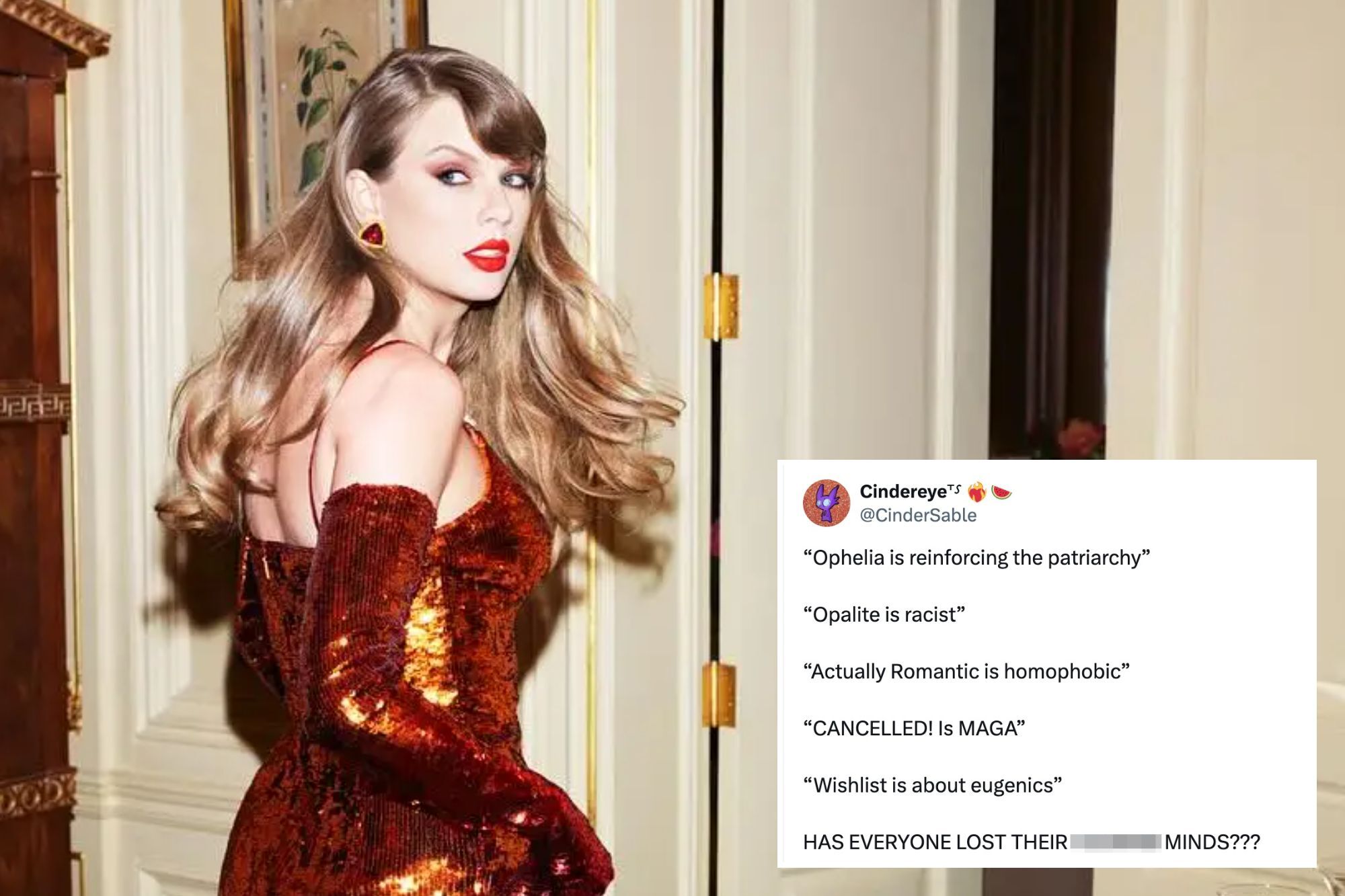
Taylor Swift’s latest album, “The Life of a Showgirl,” has only been available for a few days, yet it has already sparked intense scrutiny from critics who claim to find offensive content where none exists. The backlash has come swiftly, with some online commentators asserting that the album is rife with racism, homophobia, and even veiled support for the patriarchy, eugenics, and former President Donald Trump.
These so-called “forensic investigations” have uncovered supposed “dog-whistles,” but only those with a specific agenda seem capable of hearing them. Either Taylor is secretly an alt-right figure, or her young critics have been conditioned to see oppression in every corner, even when it’s not present.
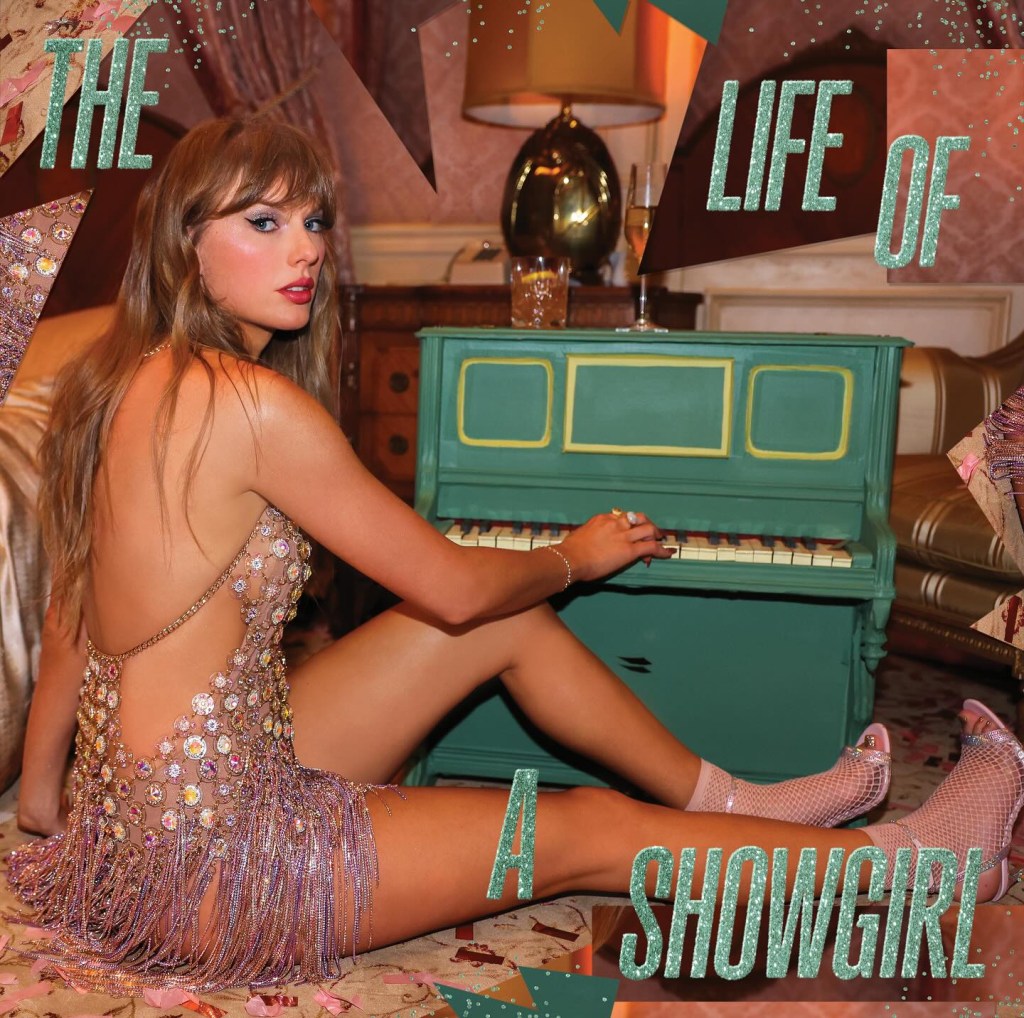
Every track on the album, released on Friday, has been subjected to intense analysis for potential “offensive” content. For instance, the song “Opalite” has been labeled everything from a “white supremacist anthem” to a “cryptic declaration” that Swift is a “lily white queen.” Meanwhile, the track “CANCELLED!” has faced criticism for allegedly supporting the MAGA movement, despite Swift’s long-standing Democratic affiliations.
One particularly popular tweet, which has garnered nearly 100,000 likes, states, “‘CANCELLED!’ is the most tone-deaf lyric a white billionaire with MAGA friends could release in this climate.” This kind of interpretation highlights how easily lyrics can be twisted to fit preconceived narratives.
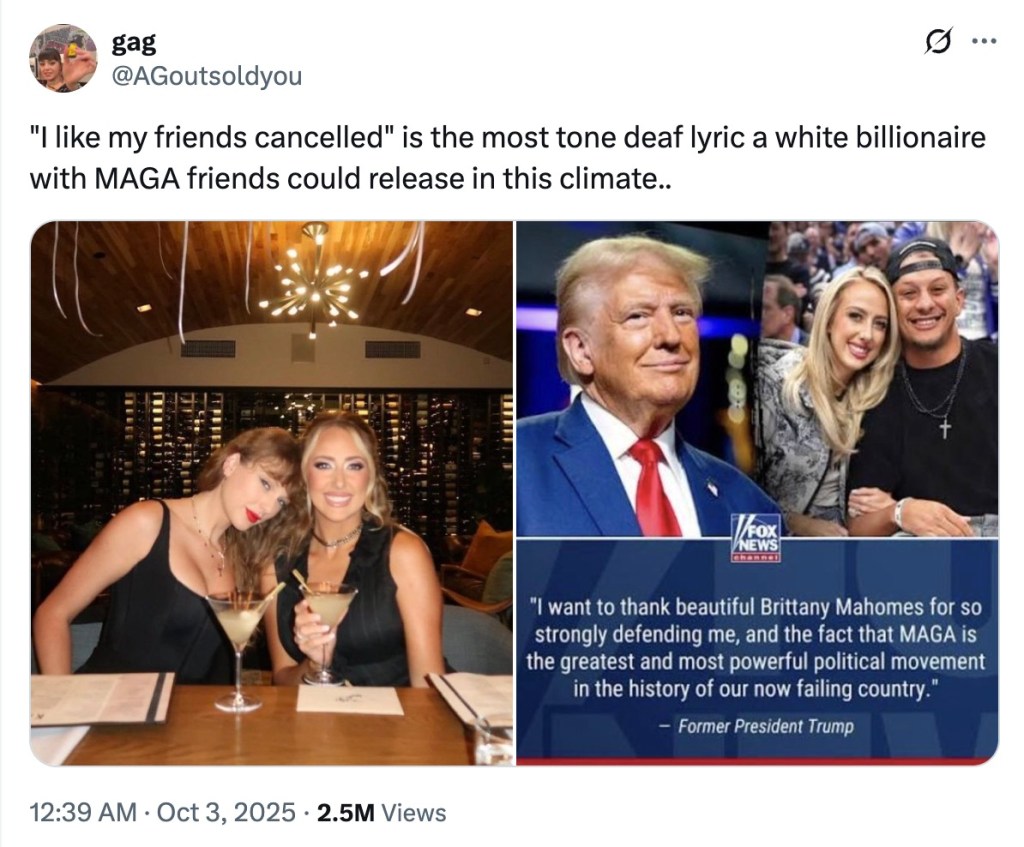
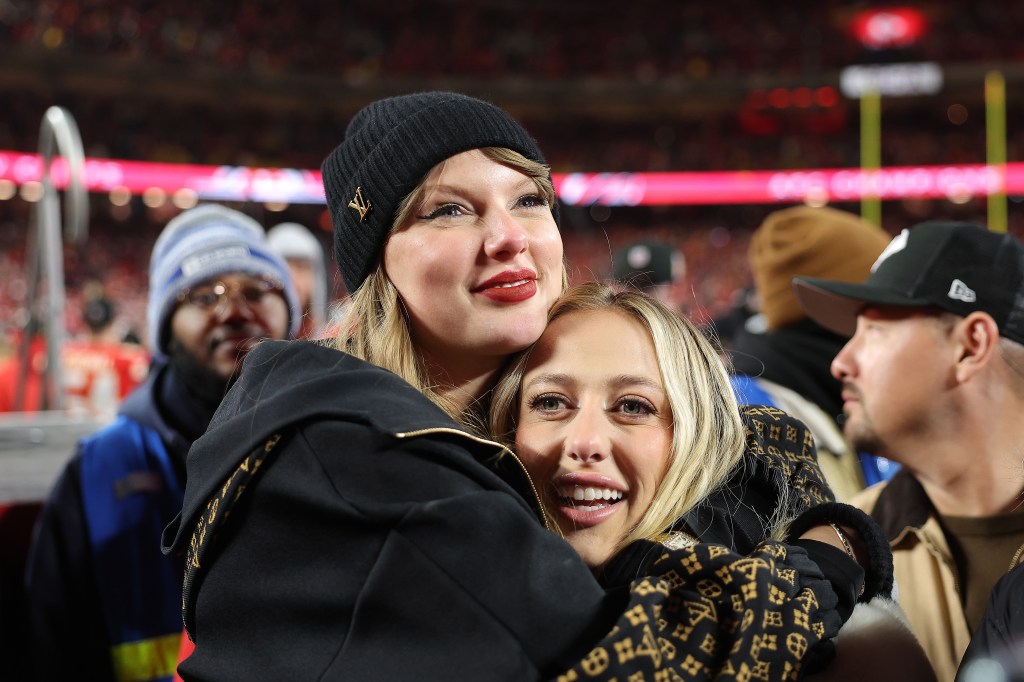
Swift has also faced backlash for maintaining a friendship with Brittany Mahomes, the wife of NFL star Patrick Mahomes. Mahomes controversially liked an Instagram post about the 2024 GOP platform. While Swift endorsed Kamala Harris, she did not publicly disavow her friend, who is presumably conservative.
Critics argue that this shows Swift is failing to demonstrate that friendships can transcend political lines. What a terrible lesson, they say!
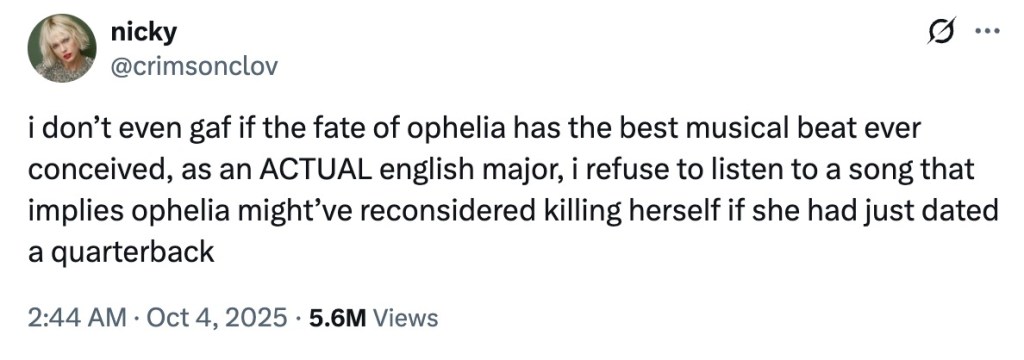
In another instance, the song “Ophelia,” which reimagines the tragic Shakespeare character from “Hamlet” with a happier ending, was criticized for supposedly reinforcing the patriarchy. A self-proclaimed English major on X claimed, “I refuse to listen to a song that implies Ophelia might’ve reconsidered killing herself if she had just dated a quarterback.” While the individual may hold a degree, their interpretation seems overly simplistic.
In the song “Wishlist,” Swift expresses her desire to have children and “the whole block lookin’ like you.” Some critics took this as an allusion to eugenics, claiming that Swift wants to have “your white babies” and create a racially homogenous neighborhood. One TikToker suggested that Swift is implying she will soon have kids and mock those who are childless.
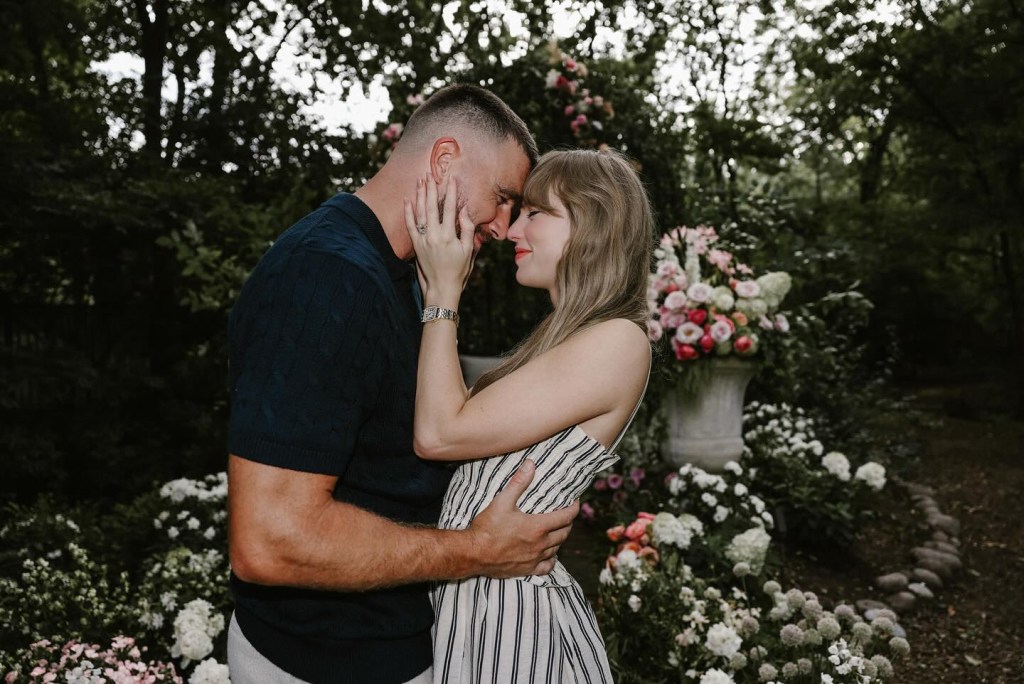
This interpretation is baffling, given that Swift is a woman who has openly discussed her personal life and relationships. Her expression of excitement about starting a family with her fiancé is being twisted into a call for a white ethno-state, which is nothing short of absurd.
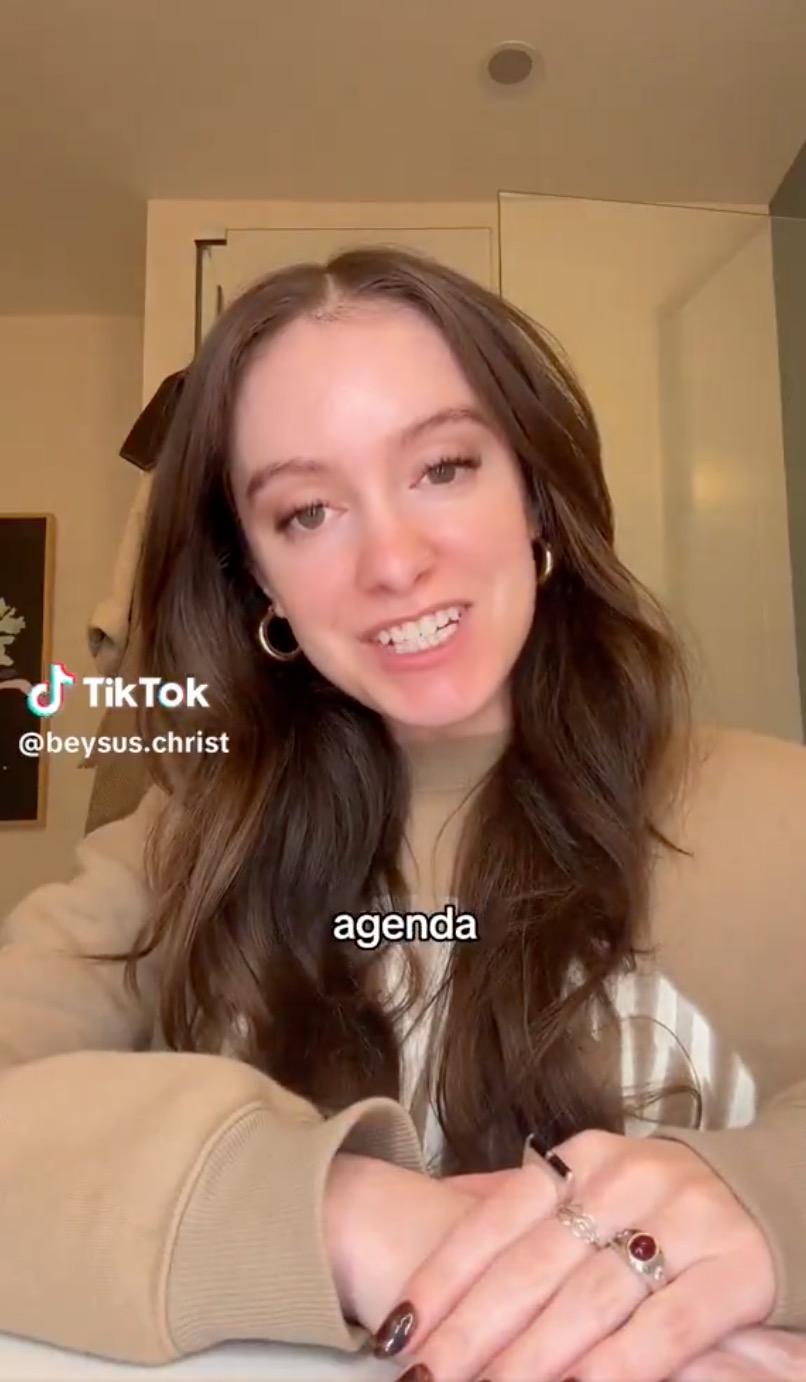
Another fan-turned-critic noted, “She is free to put out a song about wanting a husband and children and a basketball hoop and a house and a cul-de-sac, [but] she has to accept the context that, if she puts that out right now, it’s going to feel like propaganda.”
Since when is having a family a provocative political statement? This critic compared the album to a bad lunch date, saying, “If you are out to lunch with a friend, and you are unemployed, you are struggling to put food on the table, you are worried about not having access to your healthcare, and all they do is chatter on and on about how lucky they are, how rich they are, how wonderful their boyfriend is, it’s going to be a little exhausting.”
They continued, “Considering how much Taylor has benefitted [from] and marketed on that parasocial relationship with her fans, it would have been nice to get some acknowledgment of the problems that most of us are struggling with right now.”
For these critics, everything is personal, and nothing can be taken at face value. However, many of these individuals sound more like teenage keyboard warriors who never grew up.
This isn’t new for Swift. Throughout her decades-long career, she has been accused of releasing racist music videos, speaking to the “lowercase kkk,” and being a Nazi icon. All of these claims are baseless and ridiculous.
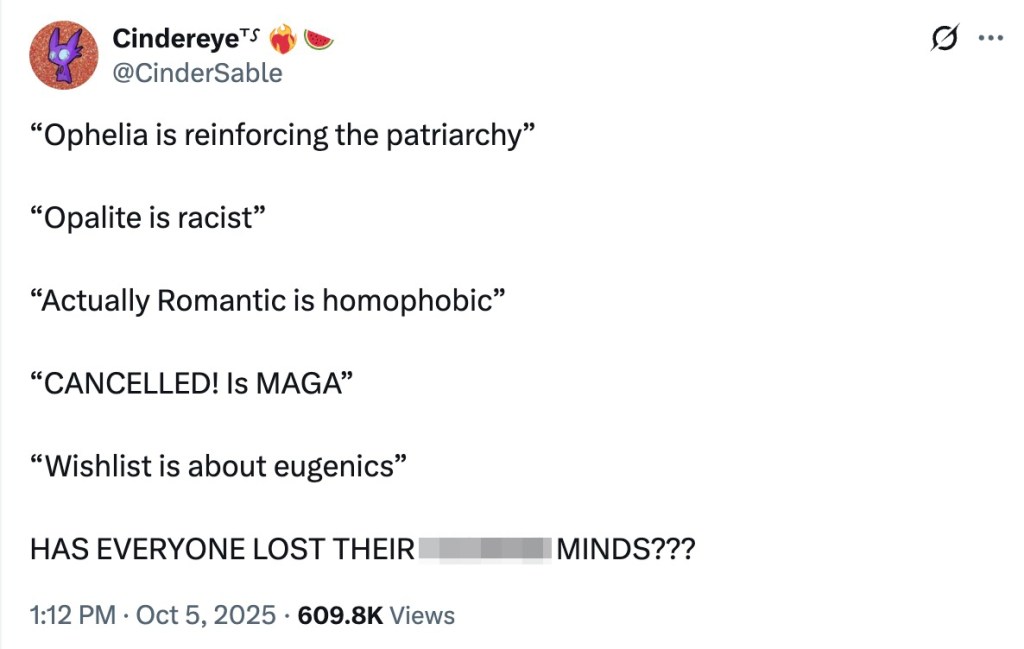
The years-long effort to find bigotry where there is none and to take offense when none is intended is a sad reflection on our society. Young people, in particular, have been taught that there’s social currency in identifying oppression. Bonus points if you can find it hiding in plain sight, even if that requires middle school-level textual analysis.
There is certainly bigotry in our society, but searching for it in pop songs creates a false sense that the world is far more hateful and dangerous than it really is.
In a time of historical political polarization, a Taylor Swift album should be an apolitical moment of cultural unity. Unfortunately, even benign tracks about her fiancé are being used as an excuse to pull us further apart.