WASHINGTON – At Union Station, the familiar flow of tourists and travelers fresh off trains and buses poured out of the colonnaded entrance blocks from the Capitol building.
There was one new presence – dozens of National Guard troops in camouflage fatigues.
Soldiers patrolled for hours outside the main station in Washington, D.C., on Aug. 14, just days after President Donald Trump announced a military and law enforcement clampdown on “out of control” crime in a city where crime has statistically declined.
Start the day smarter. Get all the news you need in your inbox each morning.
Earlier this week, Trump seized control of local law enforcement and deployed 800 National Guardsmen from the District of Columbia in response to what he framed as a public safety emergency for the city. Advocates, lawmakers and many residents have pushed back on that characterization, which defies crime data.
In the rest of the country, the president cannot deploy troops in a policing capacity without the consent of the state’s governor. Washington is an exception – Trump has the green light to deploy troops to take on law enforcement functions under his sole command. The Army has said the troops have been tasked with guarding National Park Service property, such as the National Mall, and to help law enforcement with administrative duties and transportation. They are unarmed, but officials told USA TODAY that soldiers could be ordered to carry weapons if their assignment changes.
Around a third of the 2,400 National Guard troops in Washington, D.C., have been tapped for Trump’s mission. Those who live close enough can return home to sleep, while others, whose civilian homes are farther from the capital, will stay in base facilities and hotels.
One soldier standing next to an idling Humvee outside Union Station, who lives too far away to sleep at home, said he had received no indication how long he would be deployed. Like his peers, he was not authorized to speak on the record. He told USA TODAY he would go home after this assignment ended.
National Guard patrol provokes insults, approvals
National Guardsmen first appeared on this deployment in front of the Washington Monument on Aug. 12, according to photos posted by commanders and news reports. Two days later, they turned up at Union Station and stayed for much longer in the baking heat alongside, rotating in and out with bevies of law enforcement from multiple agencies sweeping the area.
As the morning crawled on and temperatures rose to the high 80s, several more sage-green Humvees filled with soldiers pulled up to join the four already parked at the corners of the station’s outside plaza. The military vehicles, known for transporting troops across desert terrain in Iraq and Afghanistan, now squeezed through congested traffic alongside taxis and Ubers dropping off commuters and tourists.
At one point, some troops rushed towards a traffic kerfuffle on the side of the square. An unresponsive driver had run her car onto the curb and struck a street sign, according to a man who witnessed the incident. By then, the driver who hit the sign had fled the scene. The man fist-bumped several guardsmen and drove away.
Police cars cruised past regularly. At another moment, a parking security attendant was injured by a passing motorist. A firetruck arrived, then an ambulance, then another one. A group of police on bikes rushed to the station entrance, only to realize the shouting they were responding to was coming from a traffic attendant urging cars forward. “Oh, it’s the security guard shouting,” one said before they rushed away. The drone of sirens in the distance was near constant.
The National Guard troops checked in with the injured security person, but eventually returned to their posts.
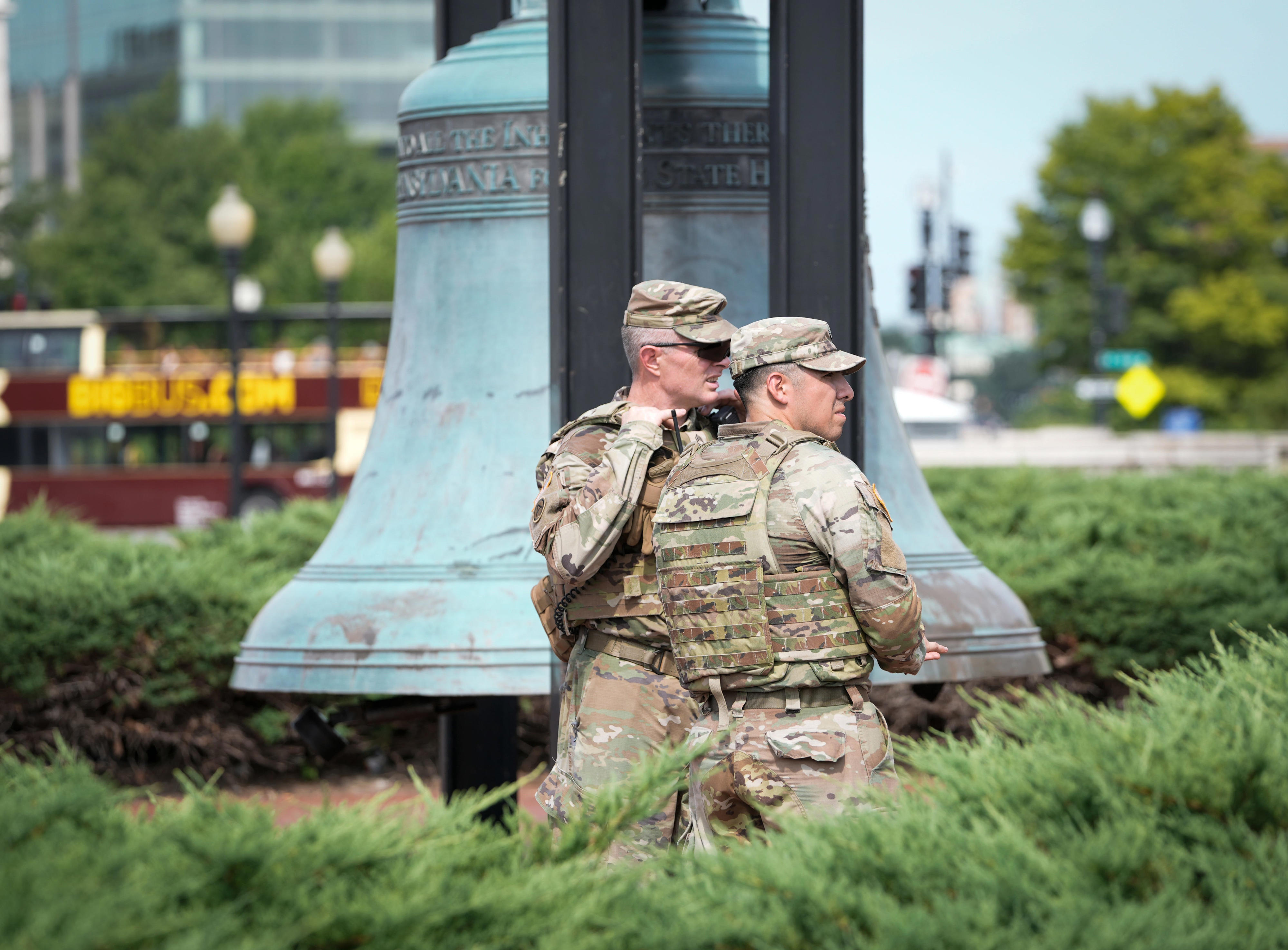
As travelers awaited rides, suitcases in hand, some snapped pictures of the troops. A few posed with them for a photo.
The majority of passersby turned a curious eye toward the soldiers. Others shared their opinions directly.
“Shame on you,” one woman yelled. “I’m sorry you have to do this.”
“Talk about a waste of resources,” another shouted.
Others shared approval – a passing jogger gave a thumbs up and a smile.
“I’m scared. I’m afraid,” said Nick Roelofs, 67, an American expat who lives in Stockholm, as he stood outside the station. “I don’t want to live in a police state, and I worry that’s what it’s become.”
“It’s a waste of time and the people’s money,” said Lela Leonard, a 38-year-old Pittsburgh native visiting family in the capital. “They’re just standing there.”
Others expressed faith in the administration. “Maybe he sees something that we don’t see,” Mohammed Osman, 25, said of Trump’s justification for deploying the troops. “It’s America. Nothing is going to happen to us.”
Union Station central to DC crime debate
Union Station, the turn-of-the-century train hub, has become a flashpoint in heated debates over crime rates in Washington.
The Trump administration has argued that crime, linked to homelessness and errant teenagers, is a city-wide crisis. Critics point out that crime rates are down this year compared with last.
“Greatness is a choice,” the Department of Homeland Security captioned an Aug. 12 post to its official X account of a 1940s-era illustration of the station showing trolley cars and colorful cars outside a neat and unpopulated station.
Union Station reached its zenith in the 1940s, when train travel was booming. Its self-described “low point came in 1981,” when pieces of the roof crashed into the main waiting room during a heavy rain, according to its website.
In recent years, the station has been the site of overdoses and assaults and it lost more than half its stores within two decades, according to a 2022 Washington Post report. A man was fatally shot at the station in February. Six teenage girls were arrested in connection with the violent attack of a woman outside the station the same month.
With the National Guard standing close by on Aug. 14, some travelers said they were more concerned about the military presence than what it was meant to prevent.
“There’s no crime that should need a military base in Washington, D.C.,” Osman said.
This article originally appeared on USA TODAY: National Guard patrolling DC’s Union Station draw heckles, photo ops and little action