Every summer, a unique tradition unfolds in Hong Kong. Hundreds of construction workers and engineers make a pilgrimage to Ching Lin Terrace in Kennedy Town. Their destination is a temple dedicated to Lo Pan, the legendary Chinese carpenter from the Zhou dynasty. Lo Pan isn’t just a historical figure; he’s the patron saint of builders and contractors, revered as a master craftsman.
Despite the oppressive heat, the workers gather in the temple’s small, incense-filled foyer. They carry incense sticks and candles, bowing respectfully as they chant slogans honoring Lo Pan’s birthday. Their prayers are simple: they seek a year of stable work and prosperity in their trade.
Lawrence Ng, president of the Hong Kong Construction Sub-Contractors Association, emphasizes Lo Pan’s significance. “I always tell people that Lo Pan is like our Michelangelo. He is a designer, an architect, and an engineer,” he explains. “We must pay respects to the workers who came before us, and Lo Pan is our ‘sifu’ (master).”
In the current economic climate, worshipping Lo Pan holds even greater importance. The construction industry has faced challenges since the start of the Covid-19 pandemic, with fewer large-scale projects and less consistent employment for many laborers. This includes the city’s “spidermen,” skilled workers who specialize in the ancient art of bamboo scaffolding.
The Ubiquitous Bamboo Scaffolding
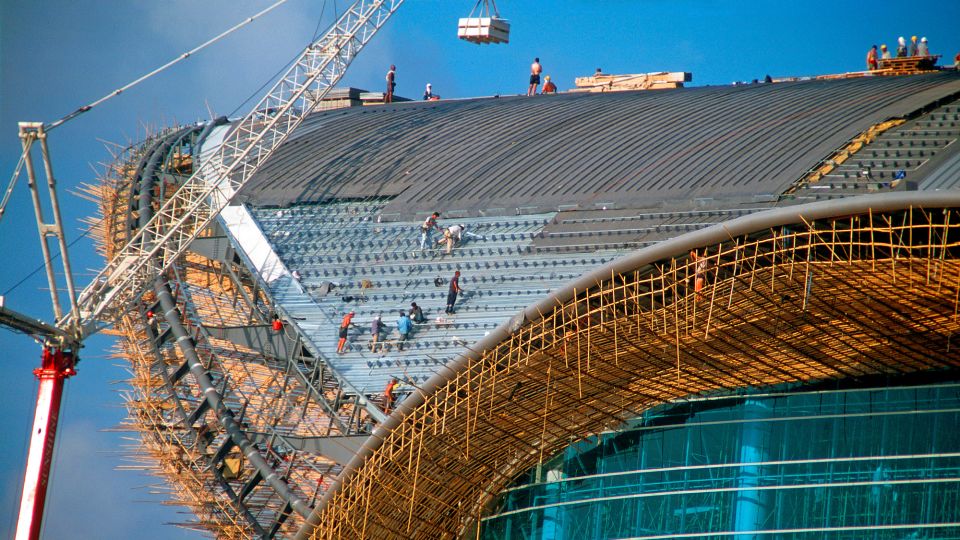
Bamboo scaffolding is an integral part of Hong Kong’s visual identity. These intricate structures, made from bamboo poles fastened with nylon ties, are a common sight across the city. They adorn skyscrapers, reaching hundreds of feet into the air, often covered in colorful safety nets. Smaller bamboo structures can also be seen protruding from windows, or covering air conditioning units and balconies.
Bamboo scaffolding is used for both new construction and the renovation of existing buildings, including the historic “tong lau” tenements. This technique has been popular in Hong Kong for over a century, with roots in Chinese construction dating back approximately 2,000 years to the Han dynasty. While mainland China has largely shifted to steel and aluminum scaffolding, bamboo remains the preferred material in Hong Kong. It has even been used to construct some of the city’s most iconic skyscrapers, such as the HSBC headquarters and parts of the International Finance Centre.
Beyond modern construction, bamboo plays a vital role in creating temporary Cantonese opera theaters for special occasions like deity birthdays and the Hungry Ghost Festival. These theaters are built entirely from bamboo, showcasing the material’s versatility.
Bamboo vs. Steel: A Matter of Craftsmanship
The prevalence of bamboo scaffolding has made it a defining element of Hong Kong’s urban landscape. Its lightweight nature, adaptability, and affordability set it apart from steel, the more conventional choice in other regions.
Goman Ho, a structural engineer at Arup, explains the advantages of bamboo. “Steel is relatively stiff and strong, but it’s less flexible than bamboo,” he says. “Bamboo, on the other hand, has its own craftsmanship. You can build a lot of beautiful scaffolding in ways you’d never think of.”
Working with bamboo requires specialized skills and a deep understanding of the material. It can take years to master the art of erecting these structures. Ho Ping-Tak, Chairman of the Hong Kong and Kowloon Bamboo Scaffolding Workers Union, notes, “Sometimes people spend one, two, three, or even four years learning bamboo scaffolding and may not become masters. But with metal, the technical requirements are lower. If you have the strength, you can generally meet the requirements in a much shorter time.”
Preserving a Cultural Heritage
Despite its advantages, bamboo does have limitations. It’s combustible, susceptible to deterioration, and weaker in wet conditions. However, proponents of bamboo scaffolding argue that these challenges can be overcome. Arup’s Ho suggests coating the poles with epoxy or plastic to protect them from the elements.
“It’s culture we need to maintain,” Ho emphasizes.
However, preserving this tradition is not without its difficulties. The bamboo scaffolding industry faces an aging workforce, with many experienced workers nearing retirement. Attracting young talent to the field is also a challenge. Ng points out, “Young people in Hong Kong don’t want to do physically demanding work, or work that gives them an identity they feel uncomfortable with.”
Government Regulations and Public Concerns
Recent government regulations have sparked debate about the future of bamboo scaffolding. The Development Bureau announced that 50% of new public building projects would use metal scaffolding to enhance worker safety and align with international construction standards.
While the policy is expected to affect only a limited number of projects initially, it has raised concerns among some residents who fear it signals the decline of bamboo scaffolding. Social media has been filled with posts lamenting the potential loss of this unique aspect of Hong Kong’s identity.
Despite these concerns, the artistry of bamboo scaffolding was showcased at the Venice Biennale, the world’s largest architecture exhibition. A bamboo scaffold was erected in the courtyard of Campo della Tana, highlighting the diverse and often contrasting elements of public space in Hong Kong.
Ying Zhou, an architect and curator of the Hong Kong pavilion, noted the timing of the government’s announcement. “We were a bit shocked, to say the least, because we had planned for this without knowing (the government’s announcement) was coming,” she said. “So immediately, we were like, ‘Oh what does our thing now say?’ It takes on a whole different kind of importance, especially when we bring it to a place like Venice.”
Eleven bamboo masters traveled to Venice to construct the scaffold. Their Italian counterparts were impressed by the speed and precision with which the structure was assembled. “These pre-modern technologies are never recognized in a standardized world, because you have steel, you have concrete, you have numbers that are calculable,” Zhou explained. “And here we have something that even the Italians are like, ‘Oh, we need your structural engineer to certify (it).'”
Addressing Safety Concerns
Safety is a primary concern in the debate surrounding bamboo scaffolding. Recent discussions about accidents on construction sites have led to increased government scrutiny. According to Hong Kong’s Labour Department, there were 24 deaths related to bamboo scaffolding between January 2018 and August 2025.
Over Chan, a bamboo scaffold worker, believes that these discussions have prompted greater government intervention. “When I was starting out as a worker, we didn’t even have to wear shirts, but now, we’re required to wear our uniform, have good manners, and so on –– this ultimately allows us to rise above the competition.”
Ho, the chairman of the workers’ union, stresses that bamboo scaffolding is not inherently unsafe, emphasizing the importance of workers using proper safety equipment. “It’s fine to use metal scaffolding –– we’re not saying that metal scaffolding is a competing technique, but if (the government) makes an announcement without much explanation…it gives the public the wrong impression that bamboo is unsafe, which has huge implications.”
The Development Bureau has clarified that adopting metal scaffolding is just one aspect of improving site safety. “Provided relevant legislative requirements on bamboo scaffolds and metal scaffolds are fulfilled, both types of scaffolds are safe,” the bureau stated, adding that the government has “no intention to phase out the adoption of bamboo scaffolds.”
Many construction projects in Hong Kong already utilize a hybrid approach, combining bamboo and steel scaffolding. Ho estimates that 80% of scaffolds are currently made from bamboo, while 20% use metal or a combination of materials.
Chan remains optimistic about the future of bamboo scaffolding and has even begun taking courses on metal scaffolding to broaden his skills. “Over the past few years, there’s been this feeling in Hong Kong about needing to preserve what’s left of the city’s identity,” he says.