Christina Hunger spent the morning arguing with her dog.
Stella isn’t an ordinary pup. The Blue Heeler/Catahoula mix doesn’t just whine and bark. She uses her words to communicate her frustration to Hunger, who told her it was time to come inside to start the work day.
“Play outside,” Stella “said” by pushing a button on a mat programmed with various words. Hunger told Stella no. “Play outside,” the dog repeated, then tried a different approach, offering “bed outside.”
Start the day smarter. Get all the news you need in your inbox each morning.
“Do bed outside later,” Hunger told her.
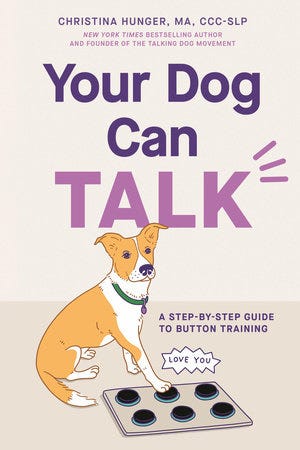
Stella is among the first of the viral “talking dogs” who have sparked curiosity and speculation across social media. In 2018, Hunger, a speech pathologist, wondered if the button mat, a form of assistive language technology, that she used working with nonverbal children could help her dog communicate too. A little over a year later, Stella had learned almost 30 words. Now, she’s bringing a practical guide to pet owners through her book, “Your Dog Can Talk” (out now from Ten Speed Press).
A homegrown global phenomena: Meet Stella, the talking dog

Teaching Stella to talk started as a passion project. Hunger applied the techniques she did with her patients by looking at the ways her dog was already communicating and pairing a word with it. Stella would paw at her water dish when it was empty. The next time she did it, Hunger paired it with a button that barked out the word “water.”
She started with basic needs, and when Stella knew over 10 words, she started combining them. Hunger included buttons with her and her husband’s names and phrases like “love you.” Eventually, she taught Stella to communicate emotions like “mad” and “happy.”
“Friends would come over and be spooked by what she was saying,” Hunger said. She knew it could be bigger than just Stella, so she started blogging about her experience in 2019. Six years later, she’s part of a global movement and has inspired several studies. The largest one, an ongoing project out of the University of California San Diego, involves participants from 47 countries and aims to determine whether dogs are actually communicating or behaving only to secure treats.
Many social media users are skeptical. But an initial study from UCSD showed that dogs can comprehend specific words and produce contextually relevant responses.
“The most interesting part has been seeing it take on a life of its own beyond me and Stella,” Hunger tells USA TODAY. “It started as something so personal in our home, and now it’s global.”
Why you should teach your dog to talk
Any dog can learn to talk, at any age, Hunger says. Your dogs already pick up on vocal and visual cues. With my dog, we have to spell out the word “walk” and “treat” when we speak so she doesn’t get too excited.
Expanding an animal’s mode of communication “opens up so many doors for understanding” to deepen the pet-owner relationship, Hunger says.
“The majority of dog owners have had that feeling of ‘What are you thinking?’ Or, they’ve seen their dog whining at them, they know they’ve been outside, they’re fed, but what do they want? What are they trying to communicate to you?” Hunger says. “First, it’s just really reducing the communication breakdowns and any sort of frustration from your dog’s end and your end.”
Hunger’s first book, “How Stella Learned to Talk,” was closer to a memoir. With “Your Dog Can Talk,” Hunger instead shares an interactive guidebook with step-by-step instructions and open space for pet parents to write notes. Hunger was inspired by baby books that track milestones like walking or talking.
“I kept hearing from pet parents and talking to pet parents who were trying this, and they just really needed more information and more prescriptive guidance,” Hunger says. “I had so many more strategies to give, tips to give. … I really just wanted to create a very accessible resource that could be by someone’s side the entire time that they’re teaching.”
How to teach your dog to talk
Before you even start with buttons, Hunger recommends taking stock of your dog’s communication patterns. “Your Dog Can Talk” has accessible prompts for this so owners can narrate their dog’s actions and intentions. This could be as simple as your dog standing by the back door when they want to go outside.
After that, pick four to six basic words to represent these activities. Hunger recommends words like “outside,” “eat,” “walk,” “love you,” “water” and “play.” If you see your dog standing by the door, ask “Do you want to go outside?” and press the button at the same time you say the word “outside.” Repeat this a few times, then pause and give your dog time to process. Hunger says pausing is “the most underrated” tool in teaching your dog to talk.
“Dogs process words a bit slower than humans, and actually communicate at a rate a bit slower than humans, even through their natural vocalizations and barks,” Hunger says. “So really slow it down. Give them some quiet time to think about what’s happening and then go ahead and execute. It just helps actually give them a chance to catch up to speed and decide what they want to say.”
Words like “outside” are just the beginning. In her book, Hunger includes practical tips for getting over learning hurdles and ensuring your dog is communicating, not just repeating words to get a desired action, like a treat. Stella doesn’t just use the buttons to communicate her needs, she observes the world around her. When her husband leaves, she asks Hunger where he went. In one recent video, Stella sniffs Mia’s infant daughter and then presses the button for her name.
Not every dog will learn the same, so it’s important pet parents don’t get discouraged, Hunger says.
“Figuring out your dog’s learning style is key,” she says.
Having worked with other button-training dogs, Hunger can break it down to two categories. “Explorers” have an immediate curiosity and want to play with the buttons. “Observer” dogs take a bit more time to watch how you use them before they start experimenting on their own. But if your dog is having a hard time catching on, Hunger’s “Your Dog Can Talk” has tips, including increasing pause time, adjusting vocabulary, changing the physical location of buttons, adjusting verbal and visual cues and modeling words in new contexts.
Button training isn’t one-size-fits-all, but every dog can learn it, Hunger says, and every pet parent can become a “great teacher.”
“I’ve been blown away seeing how many times Stella has just talked about exactly what we’re doing or what’s going to happen next that she’s already anticipating,” Hunger says. “It’s just really cool to see all the different things that are going through your dog’s mind.”
Clare Mulroy is USA TODAY’s Books Reporter, where she covers buzzy releases, chats with authors and dives into the culture of reading. Find her on Instagram, subscribe to our weekly Books newsletter or tell her what you’re reading atcmulroy@Muara Digital Team.
This article originally appeared on USA TODAY: Can you really teach your dog to talk? What to know about ‘button training.’