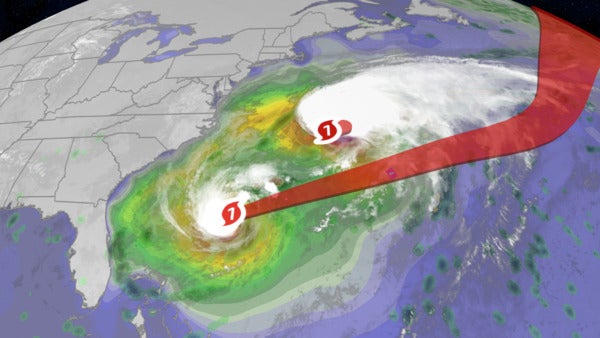
The most powerful hurricanes in the Atlantic Basin are classified as Category 5. Historical data over a century reveals they tend to occur in specific areas and during certain seasons, although there have been exceptions, particularly in recent times.
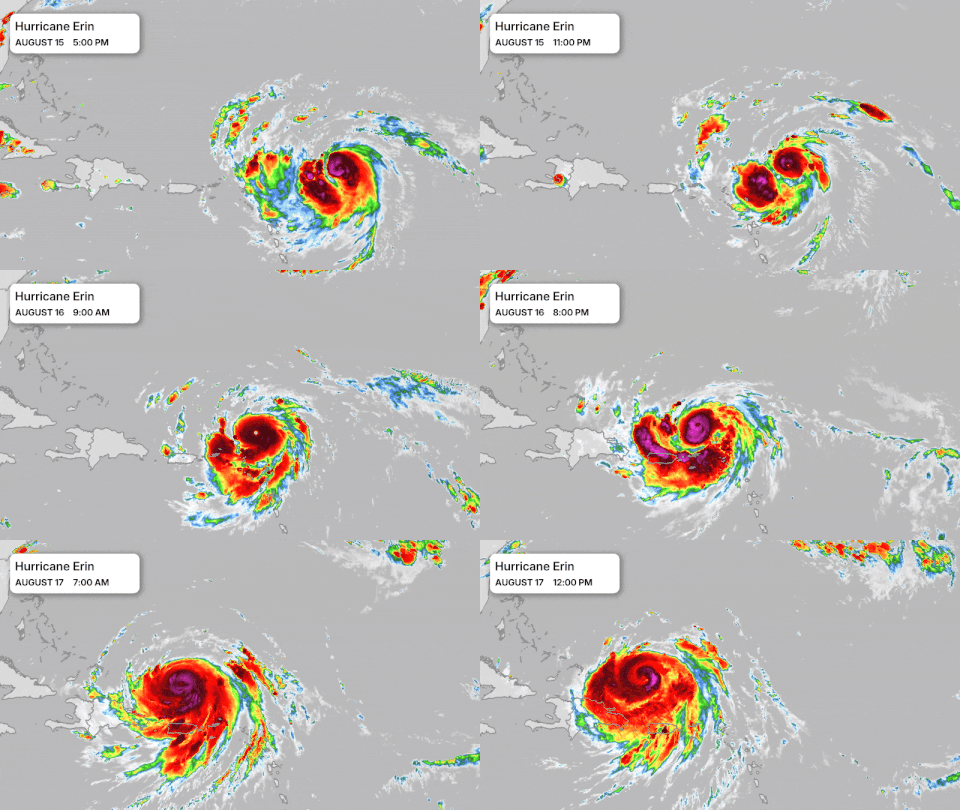
Erin and Humberto are now on the list this year:Erin’s strength fluctuated as it moved over the Atlantic, but on August 16, 2025, it intensified to a Category 5 storm near the northern part of the Virgin Islands.
Erin did not stay at Category 5 for very long. Soon after reaching its peak strength, the storm changed in structure and gradually lost power.
Humberto achieved Category 5 status on September 27, 2025, when it was approximately 300 miles northeast of the Leeward Islands.
The day before, Humberto experienced a quick increase, with its highest sustained winds rising from 65 mph to 145 in just 24 hours.
The fifth category represents the most severe level a hurricane can achieve:Maximum continuous winds of 157 mph or more on theSaffir-Simpson Hurricane Wind Scaleare necessary for a hurricane to achieve this level of strength. If you are more familiar with theEF scale for tornadoes, which is comparable to wind speeds found in an EF3 tornado or higher.
Before Humberto, there were only 42 Category 5 hurricanes in the Atlantic Basin since 1924, as recorded in NOAA’s historical database.
Fourth consecutive year:The 2025 season represents the fourth consecutive year with at least one Category 5 Atlantic hurricane.
Beryl and Milton each reached Category 5 status in the Caribbean and Gulf, respectively, at some point in 2024.
In September 2023, Hurricane Leereached Cat 5 levels briefly east of the Lesser Antilles in the central Atlantic Ocean.
And the previous September, Hurricane Ianagain quickly reached Category 5 strength before making landfall in southwest Florida as a powerful Category 4 with 150 mph winds just seven hours later.
Twelve Category 5 Atlantic hurricanes have occurred since 2016:In addition to Humberto, Erin, Milton, Beryl, Lee, and Ian, the latest series of Category 5 Atlantic hurricanes also features Dorian and Lorenzo in 2019, Michael in 2018, Maria and Irma in 2017, and Matthew in 2016.
The four-year span from 2016 to 2019, which included at least one Category 5 hurricane each year, was the longest consecutive period ever recorded. We have now matched this record with the years 2022 through 2025.
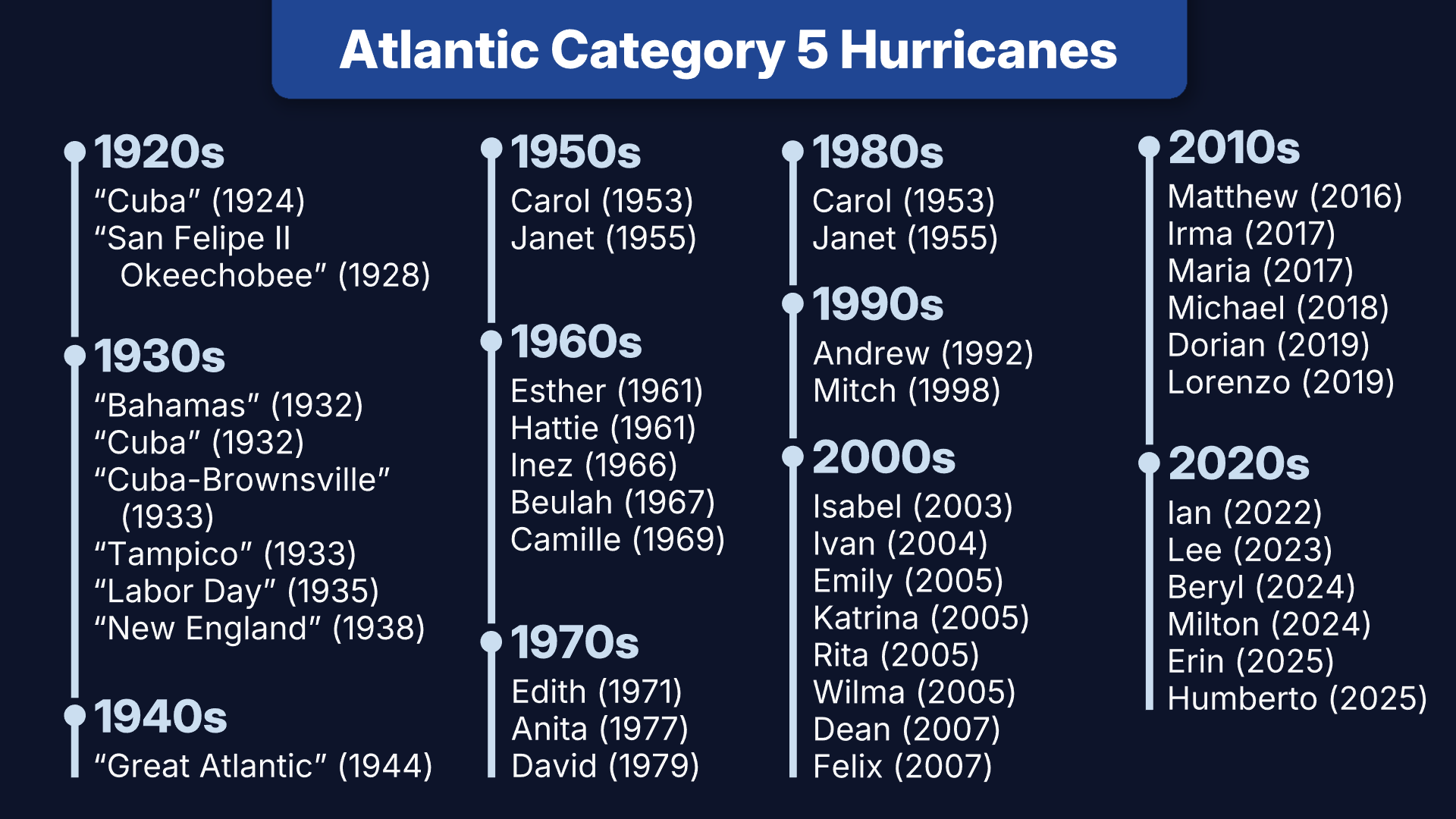
There have also been extended periods of little activity:Before the 2016 storm named Matthew, the Atlantic experienced eight straight hurricane seasons without a Category 5 storm. There was also an eight-year period between the hurricanes known as Allen and Gilbert, spanning from 1980 to 1988.
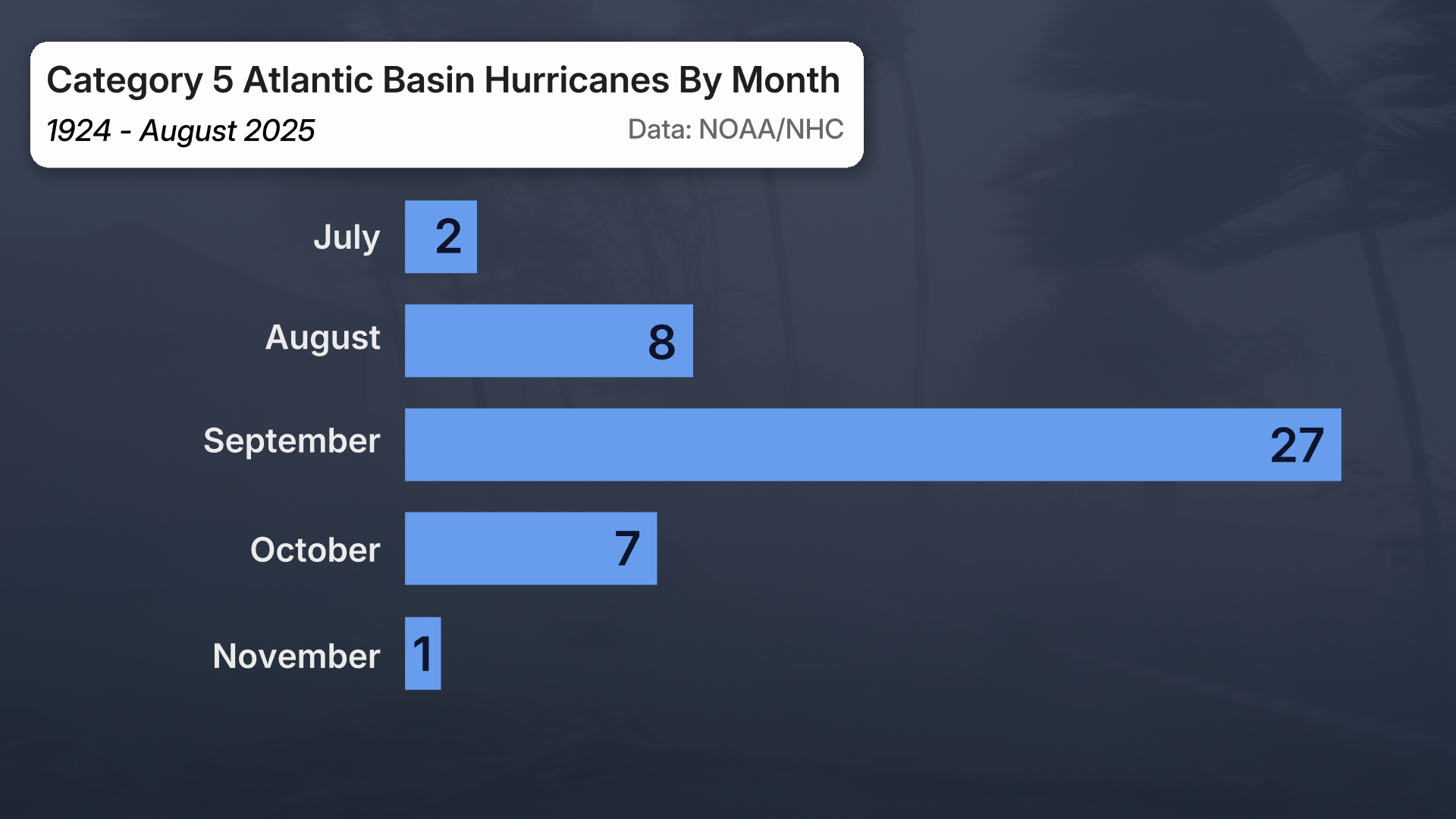
They occur most frequently during the height of hurricane season:September is the month when Category 5 hurricanes have been most frequently recorded. However, they have also occurred at least six times each in August and October.
This encompasses the most intense time of the hurricane season. This is due to the fact that all the positive conditions and elements necessary for growth are probably found together across a wide region of the Atlantic Basin.
Hurricane Beryl was the first Category 5 storm to be recorded in July 2024. The 1932 Cuba hurricane holds the record for the latest Category 5 storm of the season, occurring in November (November 5-8).
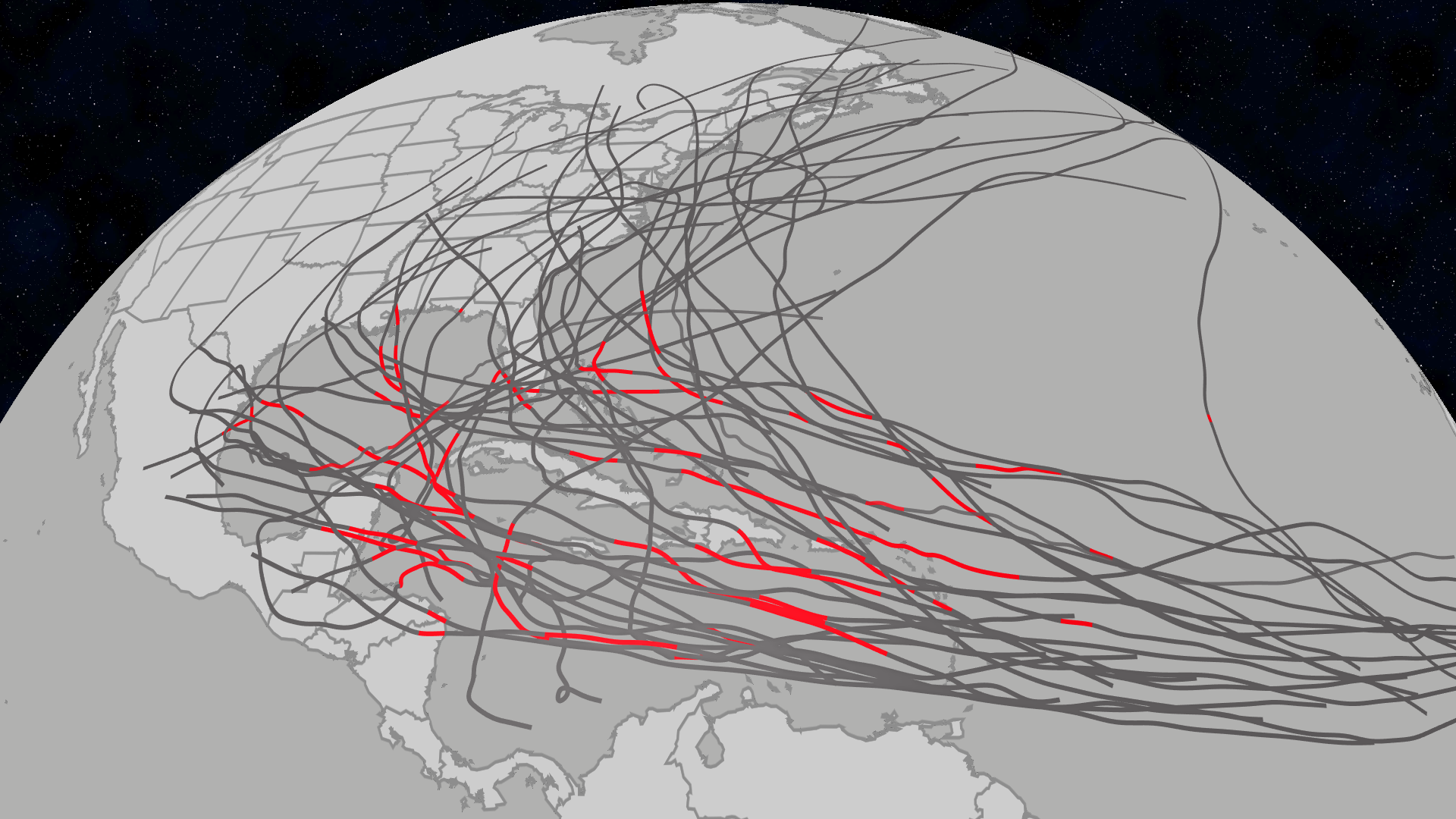
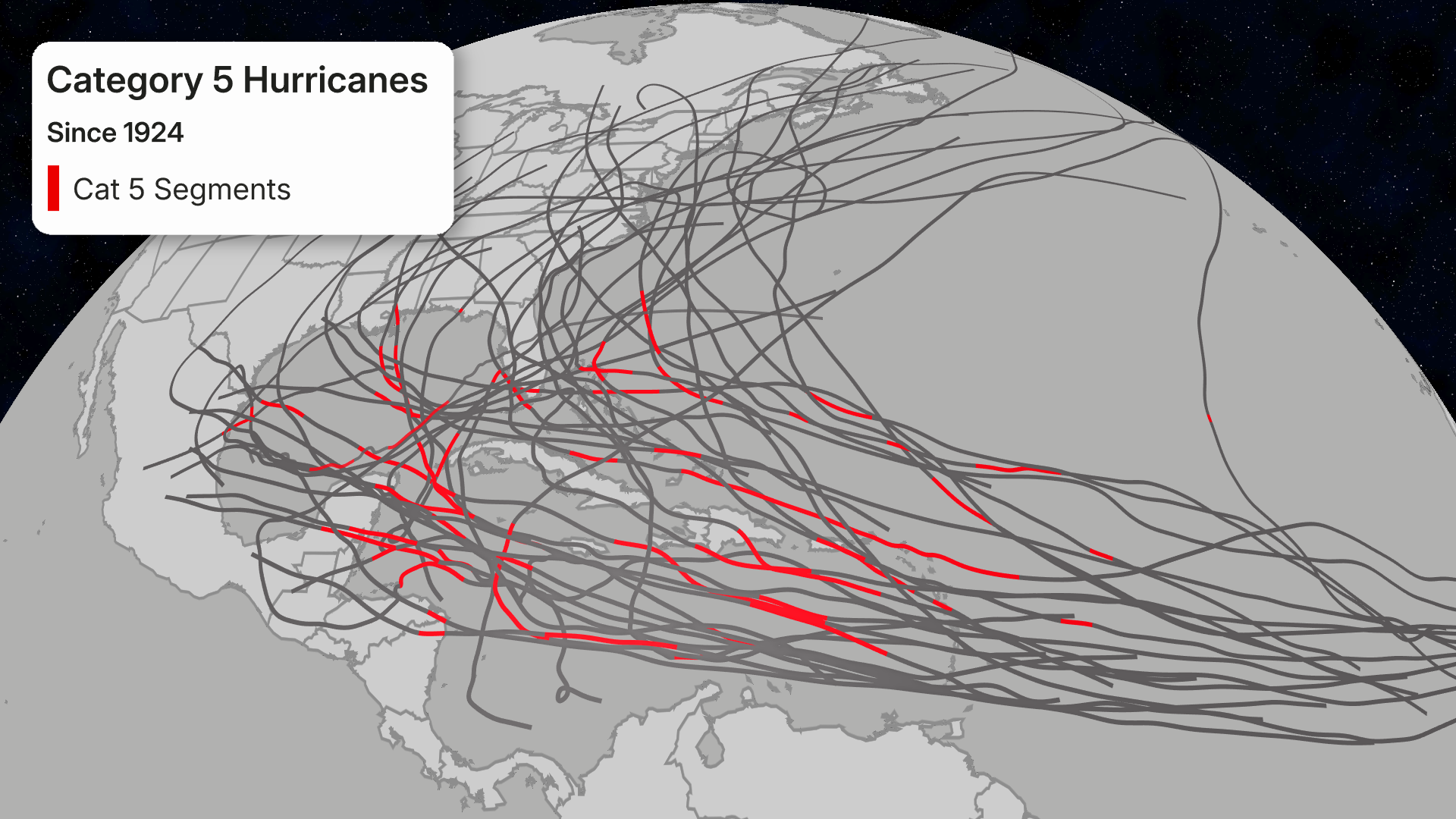
This is where they typically gather in the Atlantic:The chart below highlights areas where hurricanes have achieved Category 5 strength in red lines, including Hurricane Beryl.
Apart from the unusual case of 2019’s Hurricane Lorenzo in the easternmost part of the Atlantic, you’ll observe that nearly all of them occur in a similar region, stretching from the southwest Atlantic Ocean, north of the Lesser Antilles, into the Caribbean Sea and Gulf.
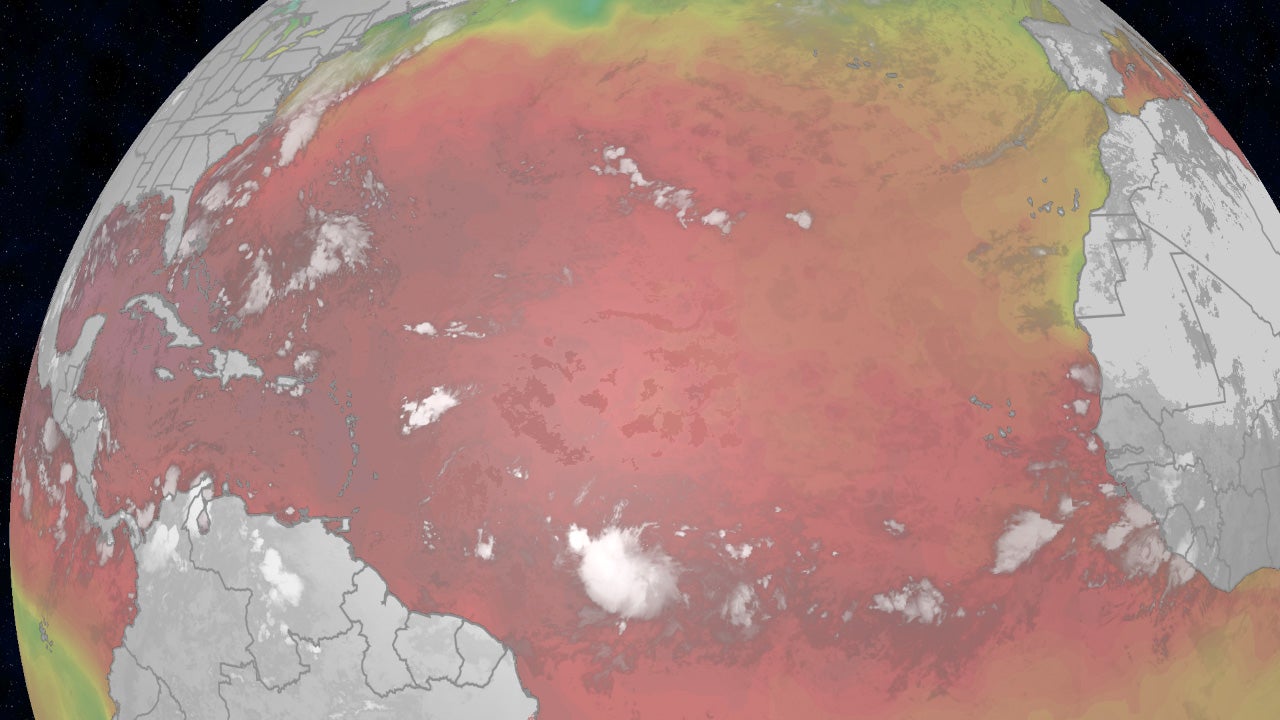
These regions are highly favorable for enhancement due to the availability of deep, warm ocean water, absence of hostile shearing winds during the peak of hurricane season, and the presence of a series of disturbances referred to astropical waves, which serve as starting points for growth. The availability of deep, warm ocean water that acts as a source of energy for hurricanes ismost significant in the Atlantic Basin in these regions, especially the Caribbean Sea.
Hurricanes rarely maintain Category 5 strength for an extended period:On average, a hurricane remains at Category 5 level for slightly less than a day.
That’s because powerful storms usually experience one or moreeyewall replacement cyclesDuring one of these events, the hurricane’s powerful band of thunderstorms surrounding its eye is encircled by a new outer ring.
When this occurs, the hurricane’s wind strength decreases temporarily because the old eyewall is restricted. It typically becomes stronger again once the new outer eyewall moves inward, resulting in a bigger hurricane.
Multiple Category 5 hurricanes achieved that level of strength on more than one occasion throughout their existence.
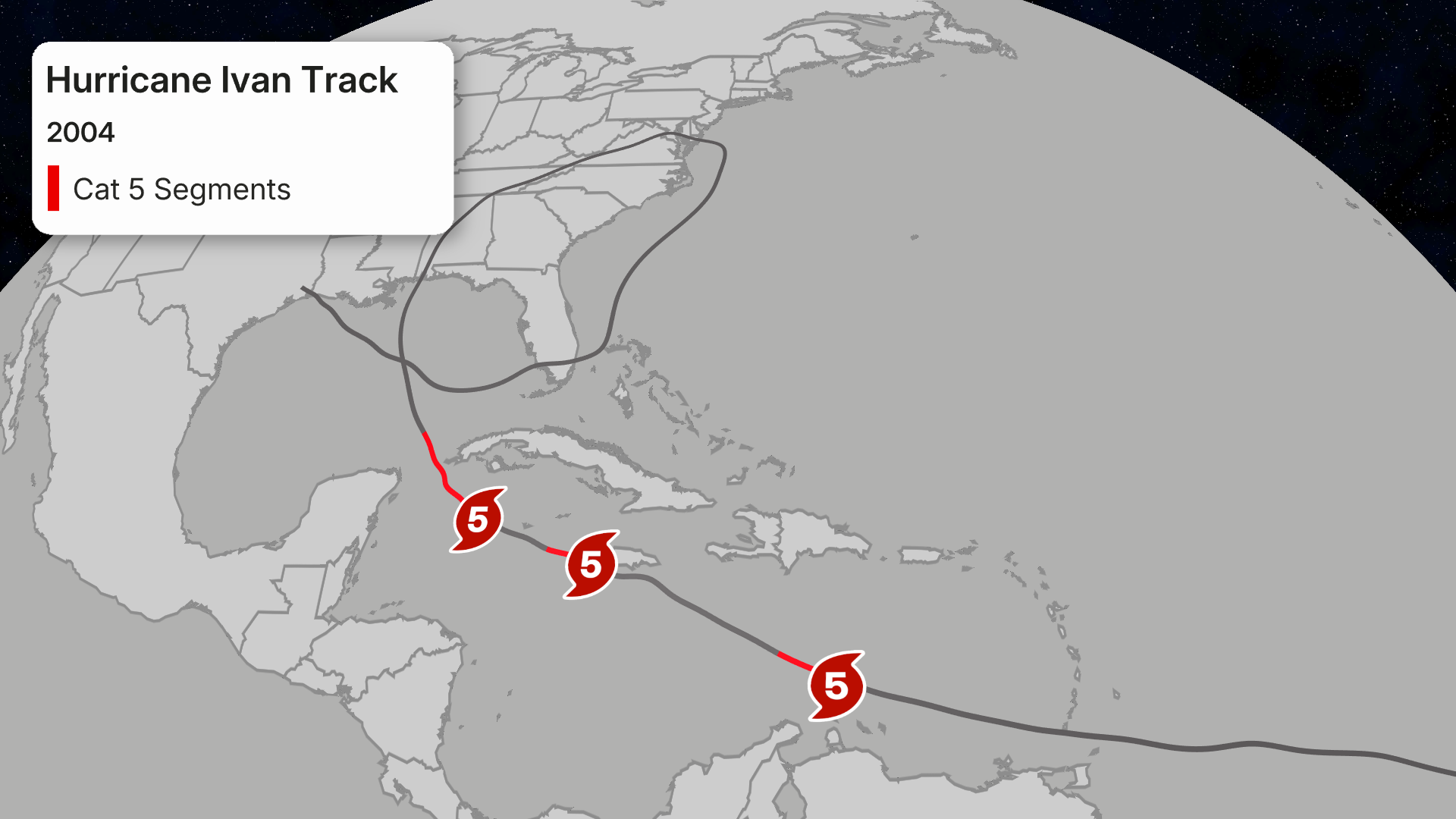
Hurricanes Allen (1980), Isabel (2003), and Ivan (2004) each reached Category 5 strength on three different occasions during their paths.
The November 1932 Cuba storm (78 hours) and Hurricane Irma in 2007 (77 hours) had the most cumulative time at Category 5 intensity, as per NOAA’s records.
Only four hurricanes in history have struck the continental United States with Category 5 strength:The latest of these wasHurricane Michaelin the Florida Panhandle during October 2018.
Other examples are Andrew in 1992 in South Florida, Camille in 1969 along the Mississippi Gulf Coast, and the 1935 Labor Day storm in the Florida Keys.
Hurricane Ian almost achieved that in 2022, but weakened to a powerful Category 4 storm as it hit land.