
A Day in the Life of a Dedicated Child Care Provider
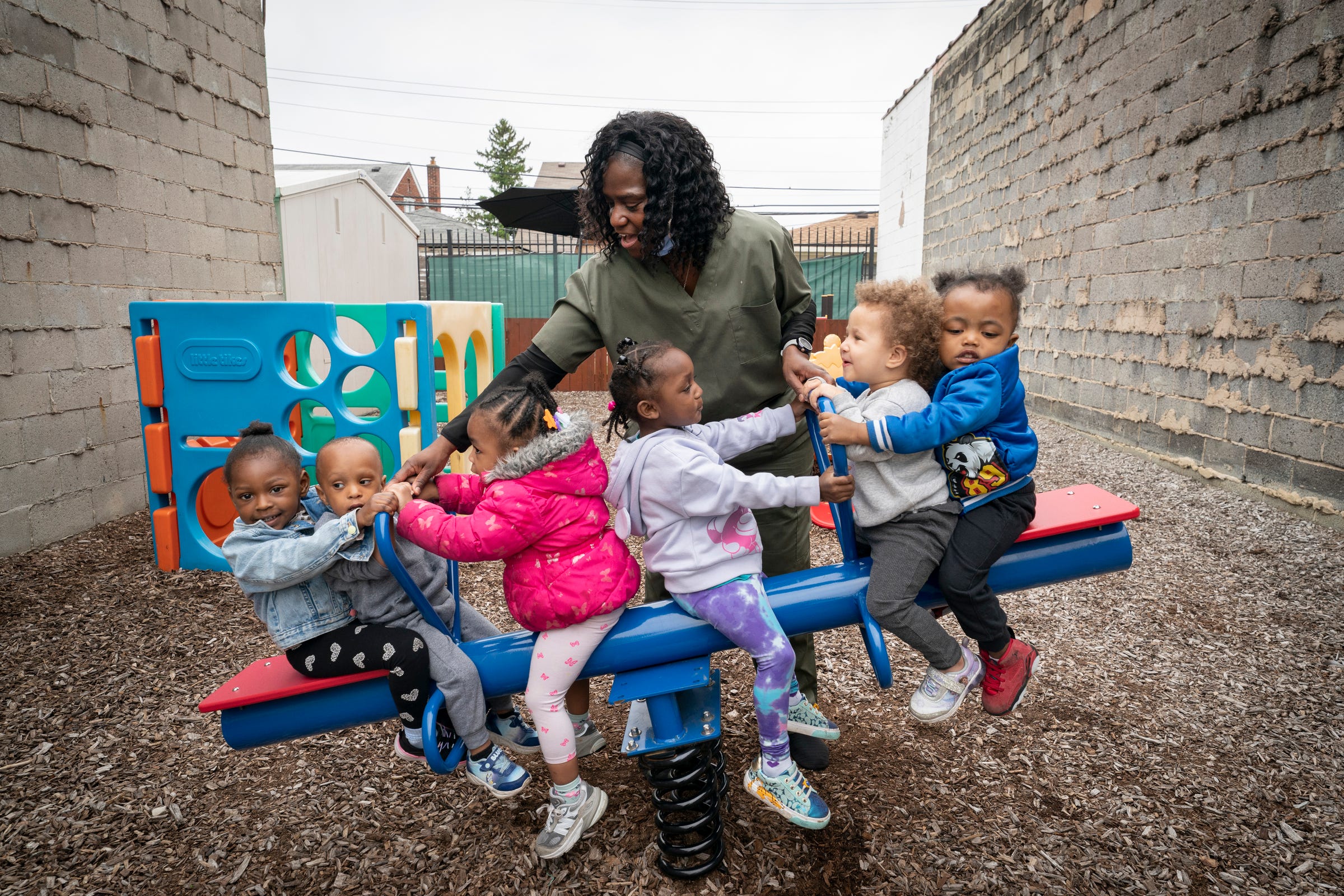
Carla Brown starts her day at 7:30 a.m., often an hour before the children arrive, to prepare for the day ahead. As a toddler teacher at Above and Beyond Learning Childcare Center in Detroit’s northeast side, she meticulously organizes activities for her young students, who are between the ages of 2 and 3. Her morning routine includes setting up materials like water bowls for finger painting, sponges cut from the Dollar Store, and Tupperware filled with small toys to help kids recognize letters and words.
Brown’s work is more than just a job — it’s a commitment to shaping the future of her students. She believes that early childhood education is crucial for brain development, and her role as a caregiver and educator is foundational to their learning and success. Born and raised on Detroit’s west side, Brown has been taking care of children since she was 11 years old. “I’ve always been an old soul,” she says. “People used to have me watching their 6-month-old children when I was only 12.”
Her dedication extends beyond the classroom. On weekends, she creates new curriculum, such as crafting a sheep out of Q-tips for a fine motor skills game tailored to a nonverbal student. Friends often have to remind her to take breaks, as she is constantly focused on her work.
Despite her passion and hard work, Brown earns only $15 an hour — a wage that is barely enough to cover her expenses. Many child care workers in Michigan, like Brown, rely on Medicaid, and most lack access to employer-sponsored benefits such as health care or retirement plans. The cost of living in Wayne County requires a minimum of $20 to $55 per hour for a single adult, depending on household size.
The state’s investment in child care does not match the high stakes of the job. While Governor Gretchen Whitmer’s administration has expanded pre-K programs, funding for infant and toddler care remains significantly lower. According to a 2024 report by the Michigan League for Public Policy, the state spends only $210 on early childhood care for every $1,000 spent on school-age children. Most of this funding goes toward state-funded pre-K programs, leaving little support for the youngest children.
At Above and Beyond Learning Childcare Center, director Nina Hodge is able to pay GSRP teachers a minimum of $30 an hour due to state funding, but she struggles to offer fair wages to non-GSRP staff like Brown. The state reimburses Hodge only $6 to $7 per hour per child, which is far below what she spends on care. This disparity leads to high turnover among staff, with Brown being one of the few long-term employees.
The Complexity of Infant and Toddler Care
Child care workers like Brown are not just babysitters — they are skilled educators. Barb Newkumerat, a lead infant teacher at It’s a Small World Daycare, emphasizes that infant and toddler care requires intentional teaching. “We’re not just watching kids; we’re helping them develop cognitively, physically, and emotionally,” she explains.
Developmental scientist Holly Brophy-Herb notes that the work is complex, especially for infants and toddlers, who often have vastly different developmental levels. Teachers must make hundreds of decisions each moment to meet individual needs and ensure children stay on track with developmental milestones.
For Brown, the rewards of her work are evident. She has seen many of her students progress from being nonverbal to speaking and even singing. One student, Makenzee, now speaks fluently and can count to 10, thanks to Brown’s guidance. Makenzee’s mother, Brittany Christian, credits Brown for her daughter’s rapid development, which she describes as “stunning.”
Despite the challenges, Brown remains committed to her job. She loves working with children and finds joy in seeing their growth. However, she acknowledges that financial concerns sometimes make her consider leaving the profession. “As soon as you pay the bills, it’s time to pay again,” she says.
The Need for Change
Experts and advocates argue that the state must invest more in infant and toddler care to support both providers and families. Increasing reimbursement rates for the Child Development and Care subsidy could allow providers to pay fair wages, reduce staff turnover, and improve access to quality child care.
While some policies, like Tri-Share, aim to lower costs for families, experts say more comprehensive solutions are needed. These include increasing funding for special needs children, improving teacher training, and adjusting state ratios to better accommodate children with developmental disabilities.
For now, Brown continues her daily routine, balancing the demands of her job with the love she has for her students. Whether she stays in toddler care or pursues other opportunities, she knows that her work has a lasting impact on the lives of the children she teaches.