The Trump administration, on Monday, included Colombia in a list of countries not cooperating in the drug war for the first time in nearly three decades, marking a significant criticism of a long-standing U.S. ally. This move highlights a recent increase in cocaine production and the deteriorating relationship between the White House and the nation’s leftist president.
Although it concluded that Colombia had not met its international counterdrug responsibilities, the Trump administration granted a sanctions exemption that would have led to significant aid reductions, citing crucial U.S. national interests.
Nevertheless, it marks a significant move against one of the United States’ most steadfast allies in Latin America, according to analysts, which could negatively impact the economy and hinder efforts to regain security in rural areas.
President Gustavo Petro, who has frequently claimed that whiskey causes more deaths than cocaine, expressed his disappointment over Trump’s decision during a televised cabinet meeting on Monday. He stated that Colombia was punished after risking the lives of “dozens of police officers, soldiers, and ordinary citizens” in an effort to prevent cocaine from entering the United States.
“What we have been doing isn’t truly connected to the Colombian people,” he stated regarding the country’s anti-drug initiatives. “It’s about preventing North American society from getting its noses dirty” with cocaine.
The United States last included Colombia on the list via a procedure called decertification in 1997, when the country’s drug cartels — using threats of violence and financial influence — had corrupted many of the nation’s institutions.
Decertification is a harsh measure and a major source of tension in bilateral relations that extends far beyond drug-related matters, making collaboration difficult across various areas,” said Adam Isacson, a security analyst with the Washington Office on Latin America. “That’s why it’s used so infrequently.
The leader during that period, Ernesto Samper, was dealing with serious allegations of receiving illegal campaign funds from the former Cali cartel, and a plane he was supposed to use for a journey to New York to participate in the U.N. General Assembly meeting was discovered to have 4 kilograms of heroin on board.
A significant change started after Samper left office. Subsequent U.S. governments — including both Republican and Democratic administrations — provided billions in foreign aid to Colombia to eliminate illegal coca plants, bolster its military in the battle against drug-related rebels, and offer economic opportunities for impoverished farmers who are at the bottom of the cocaine trade.
Cocaine production surges
That partnership, a rare achievement in U.S. foreign policy within Latin America, began to fall apart after the suspension ten years ago of aerial spraying of coca fields using glyphosate. This came after a Colombian high court decided that the U.S.-supported program could be damaging to the environment and farmers.
A 2016 peace agreement with the Revolutionary Armed Forces of Colombia, the country’s biggest rebel organization referred to as FARC, also pledged Colombia to reversing harsh policies similar to the U.S. use of Agent Orange in the Vietnam War, opting instead for nation-building, rural growth, and voluntary crop replacement.
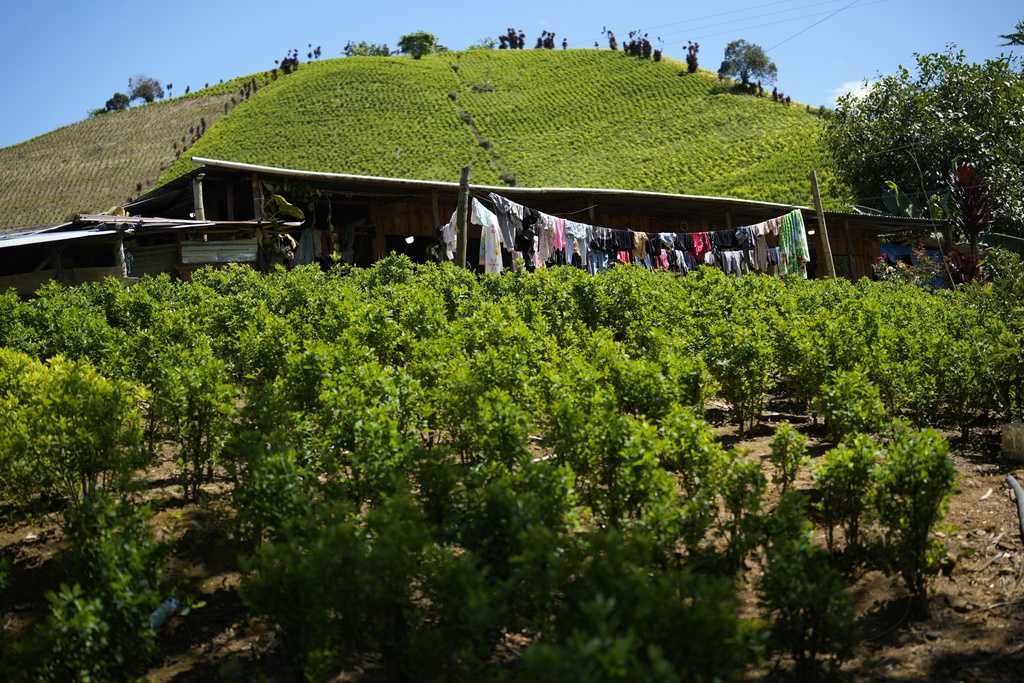
Since then, the production of cocaine has increased dramatically. The area used for growing coca, the primary component of cocaine, has nearly tripled over the last ten years, reaching a record 253,000 hectares in 2023, as reported by the most recent data from the U.N. Office on Drugs and Crime. This is almost three times the size of New York City.
In addition to production, drug confiscations have also increased to 654 metric tons this year. Colombia confiscated a new high of 884 metric tons in the previous year.
However, in contrast to previous administrations, the manual destruction of coca plants under Petro’s leadership has decreased, reaching only 5,048 hectares this year—significantly less than the 68,000 hectares removed during the last year of his conservative predecessor’s tenure and well below the government’s own target of 30,000 hectares.
A commentator critical of American policy
Petro, who was once a rebel, has also upset high-ranking U.S. officials by rejecting American requests for his extradition, along with speaking out against the Trump administration’s immigration enforcement and its initiatives to address drug trafficking in neighboring Venezuela.
“Under my leadership, Colombia does not participate in assassinations,” Petro stated on September 5, following a U.S. military attack on a small Venezuelan boat in the Caribbean, which the Trump administration claimed was carrying cocaine intended for the U.S.
Colombia’s inability to fulfill its drug control responsibilities in the past year is entirely due to its political leadership,” Trump stated in a presidential memo sent to Congress. “I will reconsider this designation if Colombia’s government takes more decisive steps to eliminate coca and decrease cocaine production and trafficking, as well as hold those involved in producing, trafficking, and profiting from cocaine accountable, including by enhancing cooperation with the United States to prosecute leaders of Colombian criminal organizations.
In accordance with U.S. legislation, the president is required each year to designate nations that have not fulfilled their responsibilities under global drug control treaties from the preceding 12-month period.
Besides Colombia, the Trump administration identified four additional countries — Afghanistan, Bolivia, Burma, and Venezuela — as part of the 23 primary drug trafficking or production nations that have not fulfilled their global commitments. Except for Afghanistan, the White House concluded that U.S. support for these nations is essential to national interests, and thus they would not face possible penalties.
The reclassification of Venezuela as a nation that has not sufficiently addressed the smuggling of narcotics from neighboring Colombia occurs amid a significant U.S. military expansion in the Caribbean, which has already resulted in two fatal attacks on small Venezuelan boats that the Trump administration claimed were carrying cocaine destined for the U.S.
In Venezuela, the criminal regime headed by indicted drug trafficker Nicolás Maduro operates one of the world’s largest cocaine trafficking networks, and the United States will keep working to hold Maduro and other individuals in his corrupt government accountable for their offenses,” the statement from Trump noted. “We will also focus on Venezuelan foreign terrorist groups like Tren de Aragua and remove them from our nation.
___
Suarez provided coverage from Bogota, Colombia. AP journalist Manuel Rueda helped with this report from Bogota.
READ MORE:The United States labels Colombia as not cooperating in the drug war for the first time in almost three decades.
CHECK OUT WPTZ:Access today’s newest updates from Plattsburgh and Burlington. View the top stories currently in the news, and stay informed with the latest weather information available online at any time.