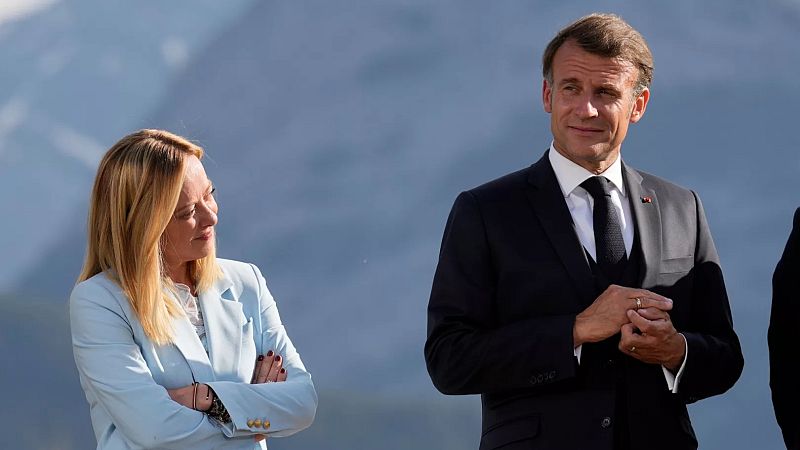
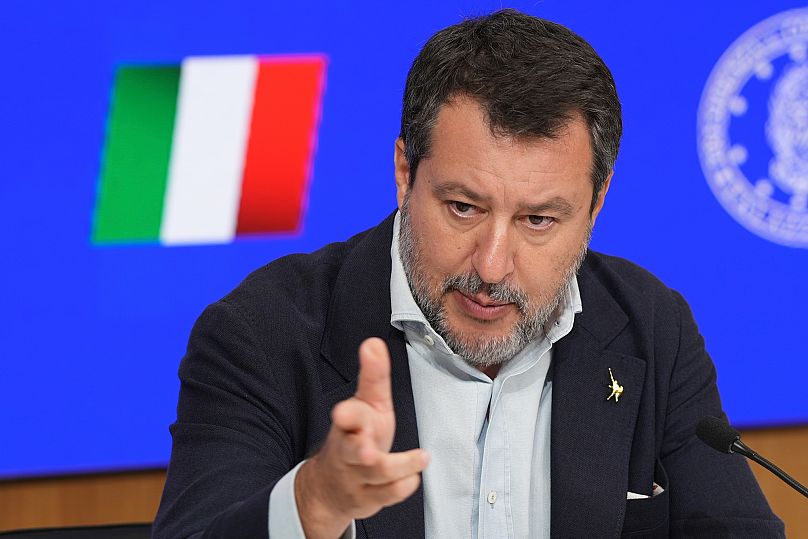
Italy’s Deputy Prime Minister Matteo Salvini’s remarks have sparked intense controversy between France and Italy.
France called in the Italian ambassador on Thursday following Salvini’s comments urging President Emmanuel Macron to wear a bulletproof vest and visit Ukraine personally, in sharp criticism of French backing for the potential deployment of European peacekeeping forces in post-war Ukraine.
“Go if you’re willing. Equip yourself with your helmet, firearm, and bulletproof vest, then head to Ukraine,” stated the far-right MP during comments made on Wednesday.
He also advised the French president to “hold on to the tram,” a phrase that is typically translated as “go to hell.”
Salvini once more launched into criticism on Saturday during a gathering for his Lega party, blaming Macron for leveraging the conflict in Ukraine to compensate for declining support back home in France.
“He has been talking endlessly about war, the nuclear shield, bazookas, missiles, and the European army for months! Do you know why? In my view, they’ve created all of this because Macron’s support at home is at its lowest point,” Salvini stated.
Security guarantees
This conflict underscores the variations among Europeans regarding the security assurances they are willing to offer Ukraine if a peace deal is reached to prevent any potential Russian aggression.
France and the United Kingdom are advocating for the establishment of a security assurance force that includes air, naval, and ground elements.
“This would not act as a neutral entity between the two sides, but rather support the Ukrainians, seeking to deter Russia from restarting its potential aggression against Ukraine by demonstrating that if it were to resume conflict, it would no longer be confronting just Ukraine, but a group of European nations,” Élie Tenenbaum, Director of the Centre for Security Studies at the French Institute of International Relations (IFRI), stated to the Muara Digital Team.
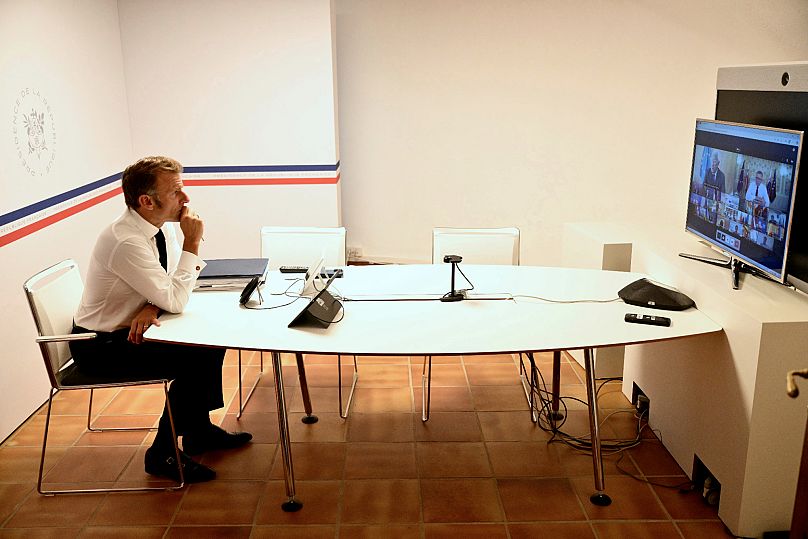
This force would not resemble a “peacekeeping or intervention operation along the front line,” but would instead be positioned “further upstream, behind the front line, alongside the Ukrainians,” he adds.
Macron is believed to have championed the concept of European strategic autonomy and the capacity of Europeans to protect themselves.
“Over time, particularly from 2023 and even more so in 2024 and 2025, Emmanuel Macron has addressed this matter and made security assurances for Ukraine a key part of his policy and his view of Europe,” Tenenbaum added.
He also rejected Salvini’s claims that the French leader was attempting to shift attention away from declining domestic support.
“I don’t believe that political analysts and advisors at the Élysée Palace view the Ukrainian matter as especially advantageous for domestic policy today, although it undoubtedly enhances the President’s standing,” he stated.
Italian opposition
Rome strongly objects to the use of Italian troops in Ukraine to prevent any intensification of tensions and casts doubt on the value of sending European forces if a peace deal is reached.
Rather, it promotes a group defense system based on Article 5 of the NATO agreement, where every nation would commit to supporting Ukraine if it faced an attack.
Italy “emphasizes that it should not be its own forces involved in a post-ceasefire situation in Ukraine,” Alberto Alemanno, a professor of European law at HEC Paris, stated to the Muara Digital Team.
Rather, it aims to “create a NATO Article 5 framework that would safeguard Ukraine without incorporating it into the global NATO structure, as we are aware that this is one of the boundaries Russia is being urged to establish,” he remarked.
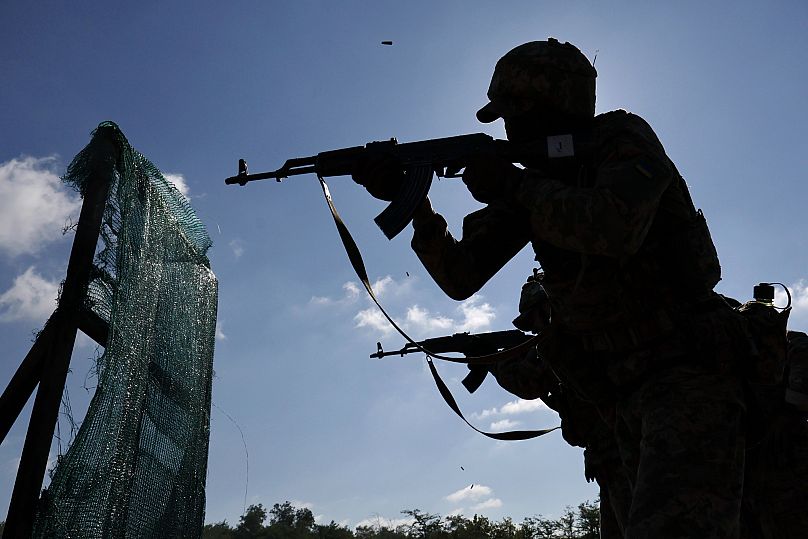
As per the expert, this discussion highlights the internal conflicts within the Italian coalition government. Prime Minister Giorgia Meloni backs Ukraine and has endorsed all sanctions directed at Russia. On the other hand, Matteo Salvini’s Lega, which has historical ties to the Kremlin, often opposes European aid to Ukraine.
The leader of Italy must also manage the resistance from her constituents.
“Giorgia Meloni is caught between a rock and a hard place. On one side, she must meet her European obligations and her stated backing of the NATO alliance; on the other, she also needs to address public sentiment, including many of her own supporters who are not particularly supportive or at least not very engaged with the notion of Italy playing a greater role in this conflict,” Alemanno said.
Nevertheless, Rome and Paris, which are both members of the so-called Coalition of the Willing, might come together to establish additional security assurances for Kyiv.
Although their language may vary, France and Italy are not significantly different in terms of their financial support for Ukraine.