
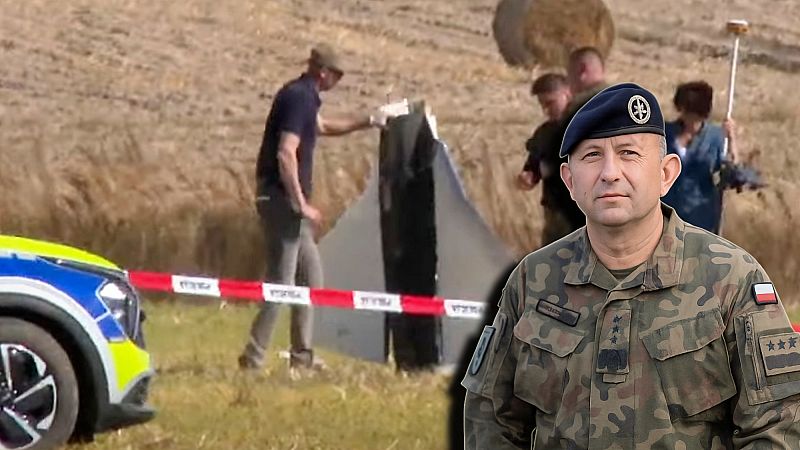
Escalation of Tensions in Poland
Poland found itself on the brink of an open conflict, a situation not seen since World War II, as Russian drones repeatedly entered its airspace. This incident led to the deployment of advanced NATO fighter jets, with a top Polish general describing the response as “shooting a cannon at a fly.” The coordinated attack highlighted significant vulnerabilities in NATO’s lower-altitude air defense systems, forcing the alliance to use costly advanced aircraft against relatively inexpensive unmanned targets.
Prime Minister Donald Tusk confirmed at least 19 incursions by Shahed-type drones near the Polish border. These attacks marked the first major test of Polish air defenses since Russia’s full-scale invasion of Ukraine began in early 2022. The incident was not just a physical assault but also involved sophisticated disinformation campaigns. Lieutenant General Jarosław Gromadziński noted that there was high-intensity spreading of false claims about drone locations near Warsaw.
Combined Hybrid Action
Gromadziński described the attack as a “combined hybrid action,” involving both the Shahed strike and media activity. He emphasized that this proved the action was clearly provocative, as the Russians were testing Polish reaction capabilities and response times. “This was extinguished in the morning, which means that our services started to counteract it. It was a big test of our capabilities,” he added.
The general expressed confidence in the Polish response, particularly the decision to close the airspace to civilian traffic and use NATO forces. “I support wholeheartedly the decision to allow military aircraft in, which eliminated the threat,” Gromadziński stated. He highlighted the importance of allied planes based in Poland, emphasizing the strength of NATO.
Diplomatic Response Needed
While US Ambassador to NATO Matthew Whitaker has asserted a readiness to defend “every inch of NATO territory,” the White House, US State Department, and Pentagon have remained silent on the violations. Former Polish Ambassador to the US Marek Magierowski criticized this silence as “ear-irritating.”
Gromadziński called for a coordinated response from NATO allies. “The allies must agree on everything behind the scenes and then make a statement with one voice,” he said. He stressed the importance of convincing the US and other allies to give a radical response. “This is where the whole package of actions is made,” he explained, suggesting increasing sanctions, blockades, or consequences for countries cooperating with Russia.
Military Preparedness and Defense Gaps
A critical assessment of the use of state-of-the-art fighter jets for drone warfare came from General Ben Hodges, former commander of US ground forces in Europe. He argued that using F-35s and F-22s against drones shows that NATO is not yet prepared. Gromadziński agreed, calling it “shooting a cannon at a fly.” He advocated for a multi-layered air defense system that includes both kinetic and jamming systems.
The problem with defending against drones became apparent two years ago when they were used en masse in Ukraine. “All countries discovered that they had a gap in this lower layer of defense,” Gromadziński admitted. He emphasized the need for reconnaissance elements at all levels along the border and the importance of integrating systems for effective defense.
Information Chaos and Strategic Communication
Gromadziński also pointed out another issue in the country’s defense structure: information chaos during a crisis. He urged that experts, not internet influencers, should be trusted. He criticized the lack of centralized information, noting that even local police stations were giving out unverified information. “There should be centralised information to avoid fake news,” he said. He stressed the importance of strategic communication during an information war, which Russia is particularly adept at.
In conclusion, the incident highlighted the need for improved air defense systems, coordinated diplomatic responses, and better strategic communication to address the growing threat posed by Russian drones.