
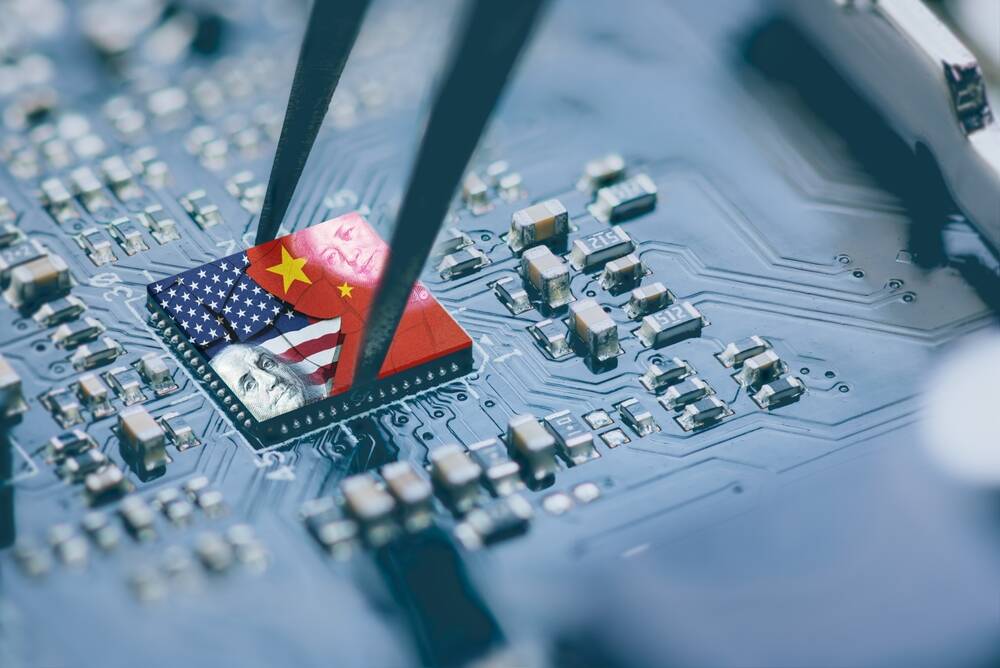
The Intersection of Technology and Geopolitics in AI Chip Development
The development of artificial intelligence (AI) has taken a dramatic turn, with national security concerns now playing a central role in the design and distribution of AI hardware. This shift has led to a new era of export controls that are reshaping the semiconductor industry in ways that were once unimaginable.
The Impact of US Export Controls on AI Chip Design
Traditionally, the design and performance of AI accelerators were driven by factors such as physics, manufacturing yields, and customer demands. However, recent changes in policy have introduced a new dimension: geopolitical considerations. The US Department of Commerce has imposed strict limits on how leading American technology companies, like Nvidia and AMD, design their AI chips. These restrictions target performance, memory bandwidth, and interconnect speeds, forcing companies to create specialized, downgraded versions of their flagship products to comply with regulations.
These China-only variants sacrifice capability to stay below the US export threshold. This trend highlights how government policies can directly influence chip schematics. Let’s explore how these export controls have affected chip design and the broader market, as well as the technical and geopolitical consequences.
Historical Context and Escalating Controls
During the Cold War, the United States sought to prevent the Soviet Union from acquiring advanced Western technology. However, when the US opened its technology to the world, the global technology ecosystem benefited significantly. Under the previous administration from 2017 to 2021, Donald Trump began repurposing Cold War tactics. While export controls on semiconductors had been in place for years, a new phase of escalated controls on China began in 2018, when Jeff Sessions, then US Attorney General, announced an initiative to combat what he described as “Chinese economic espionage.”
By 2019, the US was pressuring the Netherlands to halt the sale of ASML’s most advanced EUV lithography tools to China. The concern over China’s technological advancement intensified during the pandemic and the rise of generative AI. As demand for AI chips surged globally, companies like Nvidia became essential players in supporting this growing sector.
New Export Rules and Their Effects
In 2022, the US Department of Commerce’s Bureau of Industry and Security (BIS) introduced sweeping new export rules specifically targeting AI chips. These rules banned the export of top-tier GPUs, such as the Nvidia A100 and H100, as well as similar chips from AMD. The policy changes defined technical threshold criteria, with one key method being the throttling of interconnects and bandwidths.
High-speed chip-to-chip communication, crucial for scaling AI training across many GPUs, was an early target of US export controls. The October 2022 regulation prohibited the export of any GPUs with an aggregate interconnect bandwidth exceeding 600 GBps. This move aimed to restrict only the most advanced AI capabilities while allowing older technology to flow.
Nvidia quickly responded by developing a China-focused GPU, the A800, with reduced performance to meet the new limits. Similarly, when the next-gen H100 was banned, a China-specific H800 was introduced, featuring lower interconnect bandwidth. These modified chips also had slightly lower throughput and memory speeds, using firmware and clock adjustments.
Broader Implications and Market Reactions
Beyond interconnects, newer US rules emphasize total compute power. The 2023 BIS update set a total processing performance ceiling and even a performance density limit. Complying with these meant chip designers had to either disable functional units, lower clock frequencies, or otherwise cripple the chip’s peak throughput.
This shift means that the product key specifications of newer variants are determined by US export regulations rather than solely by engineering considerations. Such firmware-capped GPUs can be viewed as safety valves; they physically could run faster, but the vendor locks them down to produce export-compliant part numbers.
High-bandwidth memory stacks have also been throttled. For instance, the H800 uses slightly lower memory clock rates and delivers approximately 12 percent less memory bandwidth. This adjustment was likely made to reduce overall data throughput and model training performance.
However, after a series of regulatory updates, by late 2023, Nvidia H20 was the only high-end AI accelerator that complied with the export controls and slipped below the new limits.
Global Reactions and Supply Chain Diversification
The immediate effect of US chip export limits is that customers, particularly in large markets like China, are reevaluating their supply chains. Companies now anticipate that any given high-performance chip could suddenly become unavailable due to a policy change.
Initially, Chinese AI companies and cloud providers hoarded the supply while it lasted, as the bans expanded to cover even the downgraded substitutes. The Huawei Ascend 910 series AI accelerators experienced a sudden surge in orders.
The diversification push isn’t confined to China. European tech companies and research centers, also alarmed by US export decisions, are now seeking alternatives. A striking example came when the US announced in early 2025 that certain EU countries would face the same AI chip import limits as China.
European stakeholders responded by planning to de-Americanize parts of their supply chain. According to an analysis by the European Center for International Political Economy, EU companies that rely on Nvidia GPUs are now acknowledging their vulnerabilities. They are seeking alternative suppliers from South Korean, Taiwanese, or domestic European providers.
Ongoing Developments and Future Outlook
The US continued expanding its export controls. In late 2024 and January 2025, Washington proposed an “AI Diffusion Rule” to globally curb AI chip exports. The regime would have divided countries into tiers, allowing unrestricted export to a select 18 allies, but limiting AI chip sales to most other nations.
Facing pushback, the US withdrew the AI diffusion rule in mid-2025, opting instead for a more calibrated approach. By mid-2025, there were also signs of slight easing, for instance, the administration allowed Nvidia H20 and AMD MI308 to resume sales to China under special licenses.
The risk is fractured supply chains and weakened trust, even among US allies.
Long-Term Consequences and Lessons Learned
Export controls on AI chips have led to the downgrading of export-friendly models. This has had a range of consequences across the semiconductor and tech industries. Some of these outcomes were intended to slow a rival’s AI progress, while others are unintended side effects impacting businesses and innovation globally.
The change in approach from Chinese companies meant that millions of dollars that would have gone to Nvidia R&D are now funding Huawei’s advancement instead. In effect, US export controls created an opening for China’s nascent AI chipmakers to gain market share at home, as local buyers diversify their suppliers.
Perhaps the most profound long-term risk of aggressive export controls is that they can accelerate the emergence of a rival technology ecosystem. By attempting to slow a competitor’s progress, such controls may actually motivate them to innovate more quickly in alternative ways, ultimately reducing the controlling country’s leverage.
The story of export controls on AI chips shows the powerful and sometimes perverse interplay between technology and geopolitics. When policy, rather than physics, dictates chip specifications, innovation suffers. Engineers are optimizing to legal limits, not to the boundaries of what silicon could do.
Now China is racing to remove the dependency that makes it vulnerable in the first place, investing in homegrown chips and novel architectures. Export controls have become a double-edged sword, a tool to guard today’s advantage, but also a catalyst for competitors to find new paths for tomorrow.