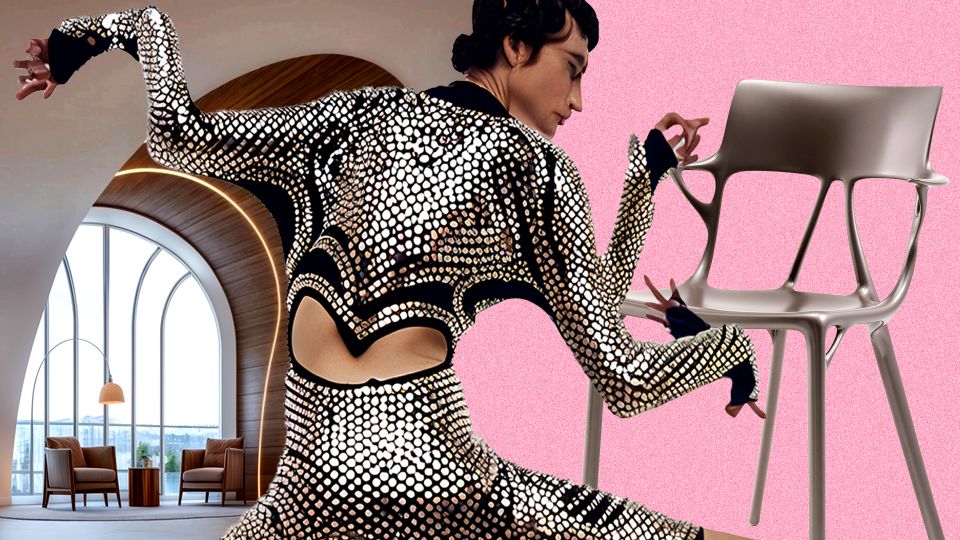
Design is a blend of creativity and technical knowledge. The balance between appearance and purpose is essential. Therefore, when it comes to integrating artificial intelligence, areas such as fashion, architecture, and interior design have reached a critical point.
Some people see design as primarily a creative activity, and they believe AI threatens the human element in their work. However, for others focused on increasing efficiency—such as generating ideas, minimizing waste, or improving manufacturing—the technology can support and enrich the creative process.
No matter your perspective on how much designers should adopt generative AI, one thing is evident: it is significantly transforming the built environment, the products available on store shelves, and the clothing in our wardrobes.
Here are three of the most notable early users of AI-powered design, spanning various creative fields, who talk about how the technology is changing their work:
Philippe Starck, industrial designer
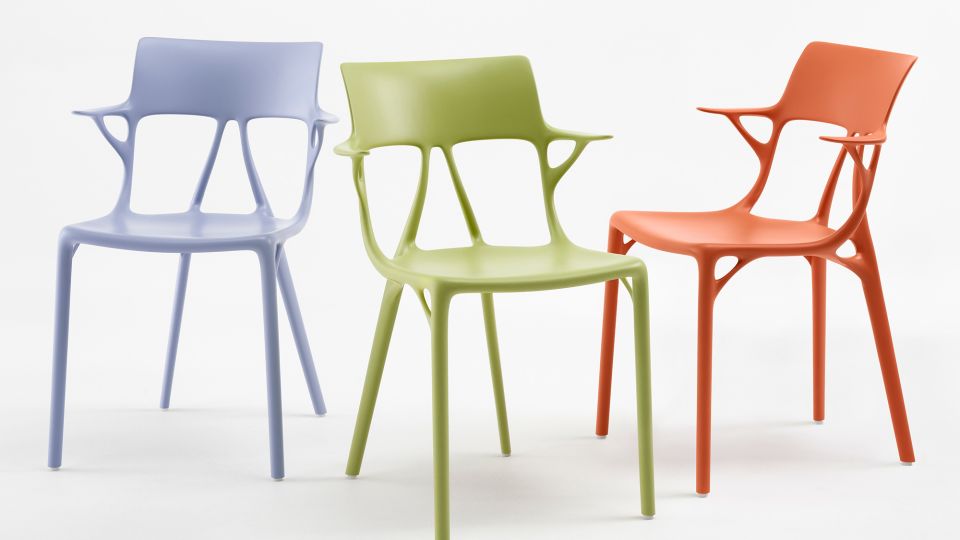
In 2019, my “AI chair” marked the debut of the first industrially produced furniture item developed using artificial intelligence. I introduced the collection in collaboration with an Italian furniture brand, Kartell, during Milan Design Week, and it became available for purchase that same year.
At that time, generative design was still in its early stages, but the chair’s origins date back a few years earlier. In 2017, I had started to feel somewhat bored with myself and my work. I wanted to venture into new areas free from human, cultural, or emotional influences, which led me to choose AI as my collaborator.
I began working with Autodesk, one of the first companies developing generative design software. They provided me with a specialized computer, and I posed it a straightforward question: “Can you assist me in resting my body while using the least amount of material and energy?”
The AI needed to comprehend what a human body was — and it had no knowledge of my culture, background, desires, or gender. The machine faced challenges for over two years, exchanging ideas with me and Autodesk’s engineers regarding the designs. It became stuck.
The answer came to me, in an indirect manner, when my close friend Henri Seydoux — the CEO of the French drone company Parrot — shared with me that the fingers of a fetus’ hand in the womb are not created by adding material but by removing it. (The hand starts as a paddle-shaped structure, and the fingers become visible when cells between the digits die off). I conveyed this information to the machine through the engineers, in an effort to shift the AI’s approach, and shortly after, it designed a chair.
Back then, it required three years for the machine to produce a chair. Now, it would likely take just a few seconds.
Artificial intelligence, by its very nature, is man-made. It isn’t real; it’s just speed. AI is an amazing tool, as it can save time and make connections. It performs the quickest calculations on a massive amount of data. It provides a mix.
The technology has already transformed how we work. We witness its remarkable capabilities daily. However, it is a power that still lacks a heart or a mind. As designers, our role involves communicating with AI, integrating it into technology, and managing AI. It is highly intelligent and becoming more independent, yet it continues to be based on what we code — on the choices we make for it. We still require that unique spark found within the human brain. And when I sketch using my pencil and paper, I am still quicker than AI.
I’m uncertain about the extent of creativity it can ever generate or mimic. There’s enchantment and beauty in genuine creativity, which I believe remains the domain of the human mind. AI is not yet the magnificent creator that we are. However, who can say what tomorrow will bring.
Currently, although AI is groundbreaking, it serves as a means to an end rather than an end in itself. It is simply another instrument. When the telephone was created, it wasn’t the device itself that was important, but the ability to communicate with one another. Therefore, I recommend that designers be cautious of the challenges (it’s a complex terrain) and, most importantly, remain true to your own perspective, nurture your subconscious, and trust your instincts and concepts. Only then should you allow AI to assist you slightly. At least, for the time being.
Norma Kamali, fashion designer
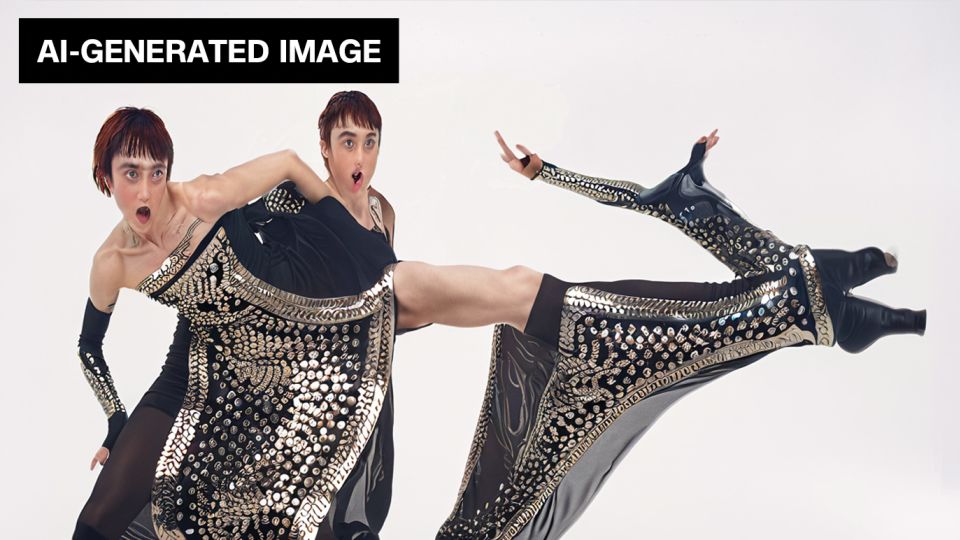
I’ve always had a strong interest in technology. During the 1960s, I started working at Northwest Orient Airlines and ended up spending my days at a UNIVAC computer. It provided me with details about flights, arrivals, and problems with the planes. From that point on, I felt very at ease with computers. I just thought, “Oh, I understand this.”
Several years ago, I attended a gathering in Abu Dhabi where an individual presented an e-commerce platform that was managed, created, and curated by artificial intelligence. A scientist at the event inquired if, since I was a designer, they could “download my brain.” I found the concept so intriguing that I considered doing it myself.
I possess a fashion archive that covers my 57-year career, which holds significant value for my brand. I wondered, “What if my expertise and creative perspective could be integrated into an AI experience? What if my archive could keep the brand alive even after I’m no longer around?” When Karl Lagerfeld joined Chanel, he carefully reused the label’s archive. He revived it. I believe AI could achieve the same for me.
I enrolled in a course at the Massachusetts Institute of Technology focused on AI, creating content, and crafting excellent prompts. It was quite challenging for me. There were 150 students, all much more intelligent than I am, and I prayed none of them had enough knowledge of fashion to identify me. However, I’m thankful I persisted. By the end, I was incredibly enthusiastic about the possibilities. It felt as if an entirely new world had been revealed to me.
Currently, I have an AI program that has organized my collection, utilizing tags based on silhouettes, necklines, and other design features. When I create a prompt, the AI scans my archive for comparable clothing items and provides design concepts that align with my previous creations.
For instance, I recently utilized AI to create a fresh version of a well-known semi-sheer black and beige striped dress from my collection. I had grown weary of it, as I had already developed numerous variations. I had already designed it as a mini-dress, a long dress, and a jumpsuit. However, when I saw Jessica Biel photographed in the dress last summer, I thought, “Oh no, I have to do it again.” She looked absolutely stunning.
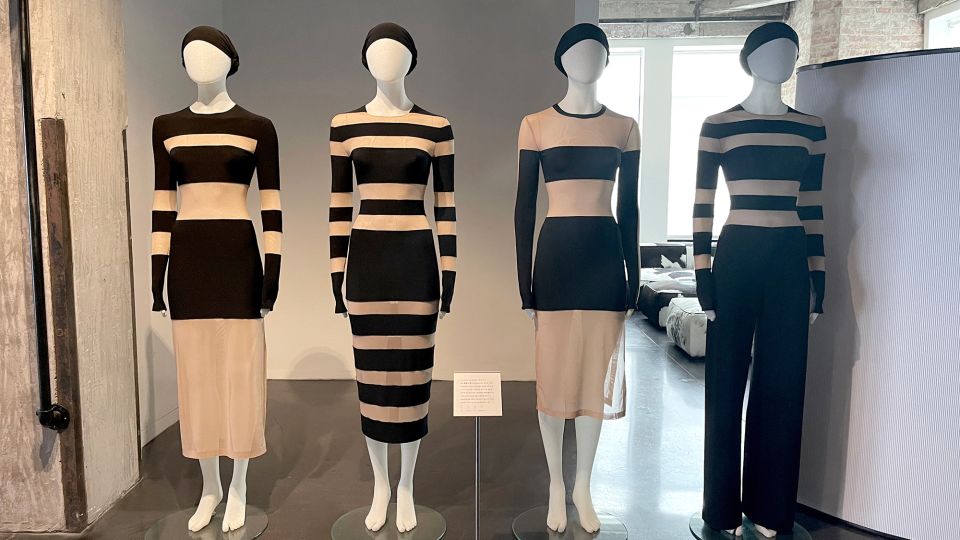
But I truly couldn’t come up with anything else to do. So, I took a photo of the original design and provided it to AI, asking for different versions. The AI altered the stripe pattern, making some lines thicker and rearranging the bands. Instead of the striped skirt, the AI proposed a sheer beige panel with a slit on the side. In one design, it added a collar. I selected a few of my favorites, and each one appeared as if I had made it myself. We launched a collection—some pieces designed by me, others by AI—on our website, clearly indicating which was which, but it didn’t matter. They sold at the same pace.
That’s the distinction with AI. I had an emotional connection to that image of Jessica — I don’t believe the dress ever looked better on anyone. It would have been challenging to discard the design and alter it. However, AI could take it in any direction and create something fresh.
Even though I share many of the concerns about AI — such as its potential to eliminate jobs and substitute human activities — I am convinced that it will also generate new employment opportunities, a new era, and a different approach to living. Acquiring as much knowledge as possible about AI, to observe how your creativity manifests in a fresh manner, is truly beneficial.
I continue to draw, create designs, and work with actual people as models. All these elements are part of my creative journey. However, I can’t picture not appreciating this new chance. Why would you let it go?
Tim Fu, architectural designer

Many people view AI in a superficial manner. However, in the field of architecture, it can help with everything ranging from mood boards and visualizations to examining various floor layout options.
Imagine we are creating a backyard design. We would give the AI the primary goals, visual examples, and some suitable construction materials. The AI then generates numerous top-notch options, which we evaluate and select from. We still have to link the door to the porch, and other similar tasks — meaning the main objectives of the architect stay consistent.
At Tim Fu Studio, our company has created AI toolkits focused on architectural and spatial efficiency. We identify elements that influence our designs—like increasing available space or enhancing natural light—and allow machine learning to experiment with various layouts according to these criteria. Evolutionary algorithms continuously test possibilities, improving over time, after which we select the most effective solutions.
We have recently revealed plans for a new resort located on Lake Bled in Slovenia, which will include seven luxury villas. We think this is the first completely AI-powered architectural initiative in the world.
We applied our AI tools to the floor plans, ensuring that each property offers optimal views of the lake, for example. Additionally, we directed a diffusion model to examine an image database featuring the region’s architecture, generating design concepts that align with local traditions and aesthetics. The generated results enabled us to re-imagine classic Slovenian design elements, like timber “rizalit” — vertical structures commonly seen extending from the facades of houses in the area — which we have transformed into glass-enclosed atriums that illuminate the villas with natural light.

What we truly refer to as “style,” in visual terms, is about connections. Artificial intelligence is capable of this: Diffusion functions by identifying the relationship among pixels, which is essentially how humans recognize patterns.
Sometimes we view AI like a calculator, allowing it to handle tasks because it’s significantly quicker than humans. However, architects often struggle to embrace changes that they perceive as challenging their creative independence. It’s quite challenging to set aside one’s ego and acknowledge, “Hey, there might be parts of my job where machines excel.” Our company’s philosophy is to stay humble when dealing with technology. AI speeds up all our processes. Our output becomes faster, and the quality improves. Yet, technology will only support, not take over, the role of architects. When recruiting for the studio, we assess not only candidates’ skills in using AI prompts and solving problems but also their ability to sketch. We draw by hand every day in the office.
Just like any groundbreaking development, there is hesitation in adopting AI and strong opposition from some individuals — particularly those who lack a true understanding of it. Many people hold incorrect beliefs about AI due to the overwhelming amount of misleading information available online. Some architectural firms have completely prohibited its use out of fear, which benefits us. This means our competitors are not rushing to embrace it.
The final outcome of architecture is the spaces we create and the experiences we develop, not merely the visual representations we generate. The most significant achievement will come when we no longer need to advocate for the use of this technology, but instead allow people to physically explore a space, experiencing it directly without knowing AI was involved. We are still awaiting the announcement of several major AI-powered projects — some located in the Middle East, including full urban master plans — and it’s thrilling.
As shared with the Muara Digital Team’s Oscar Holland and Leah Dolan. The interviews have been edited for brevity and clarity.
For additional updates from the Muara Digital Team, sign up for a membership atMuara Digital Team