Florida hunters bagged their biggest trophy in memory Aug. 13 when state wildlife officials voted to approve rules that will resume an annual black bear hunting season.
At the conclusion of more than two and half hours of public testimony nearly evenly divided between proponents and opponents, the Florida Fish and Wildlife Conservation Commission voted 5–0 to hold the state’s first black bear season in a decade. It’ll take place over 23 days in December.
But an attorney for wildlife group Bear Warriors United said she would immediately file a state administrative challenge to block the hunt.
County commissioners and sheriffs from Gulf, Liberty, Jackson, Bay and Franklin County led off public testimony, giving a thumbs up to the FWC’s plan to hold a bear season at the end of the year. They all said a growing bear population has become a problem, with bears increasingly wandering into neighborhoods.
Franklin County Commissioner Ottice Amison said residents in the coastal county on the edge of the Apalachicola National Forest sees bears as “pests and threats.”
“We’re getting calls about bears on porches, near schools, breaking into homes, and rummaging through garbage just feet from where our children play,” Amison said.
But bear hunt opponent Marsha Biggs countered that no evidence of an overpopulation of bears has been produced to justify a hunt.
“This hunt is unnecessary and cruel unless you show us scientific data. And just as disturbing is the inclusion of cruel (techniques) such as hounding, baiting, and archery. It’s just inhumane,” Biggs said.
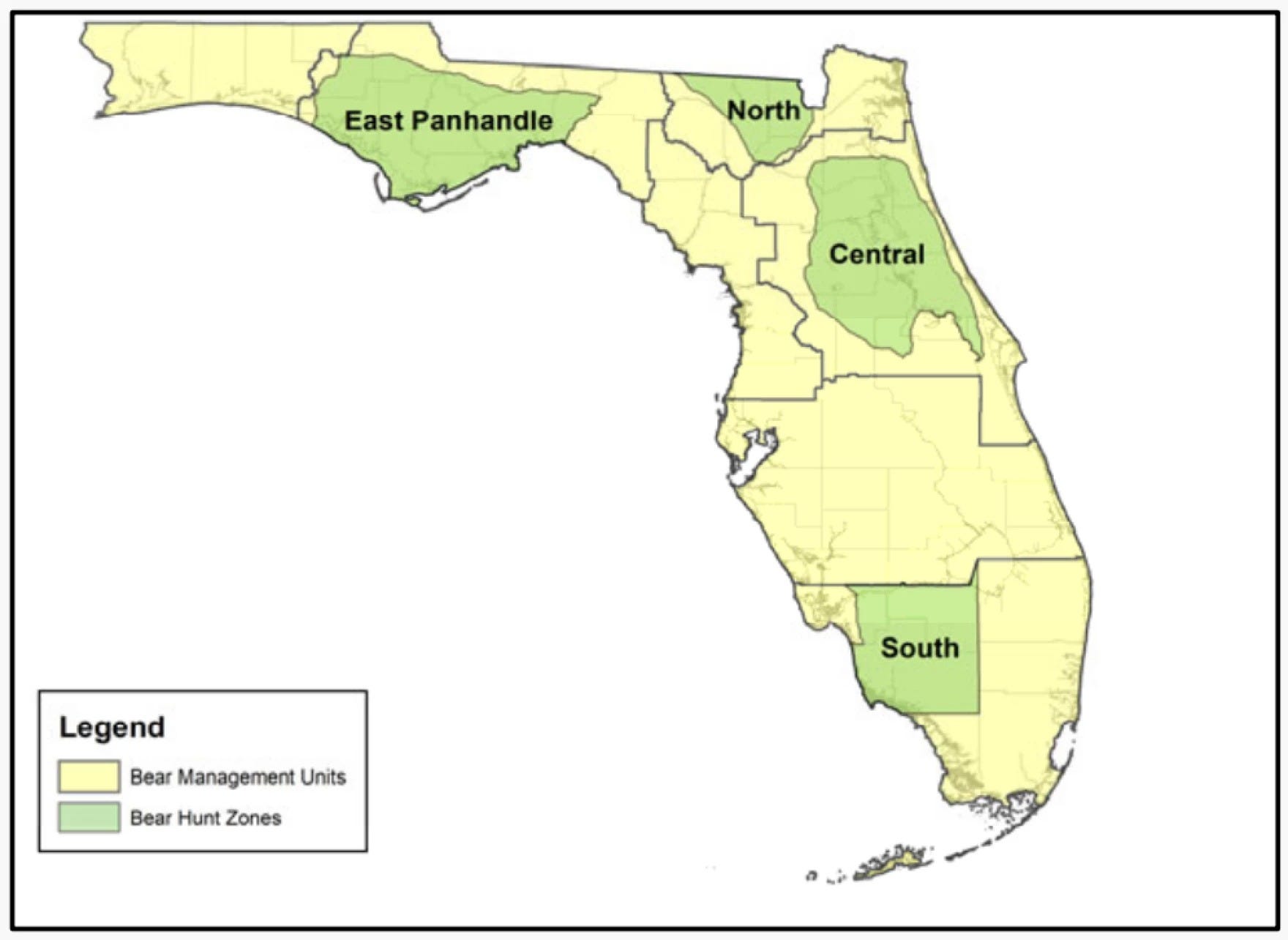
The FWC plans for this year’s hunt includes a lottery for 187 permits. The permit entitles the holder to harvest one bear from four bear management units (BMUs) that stretch over 31 counties.
If the state defeats the impending administrative challenge, dates, quotas, and locations for future hunting seasons will be decided annually.
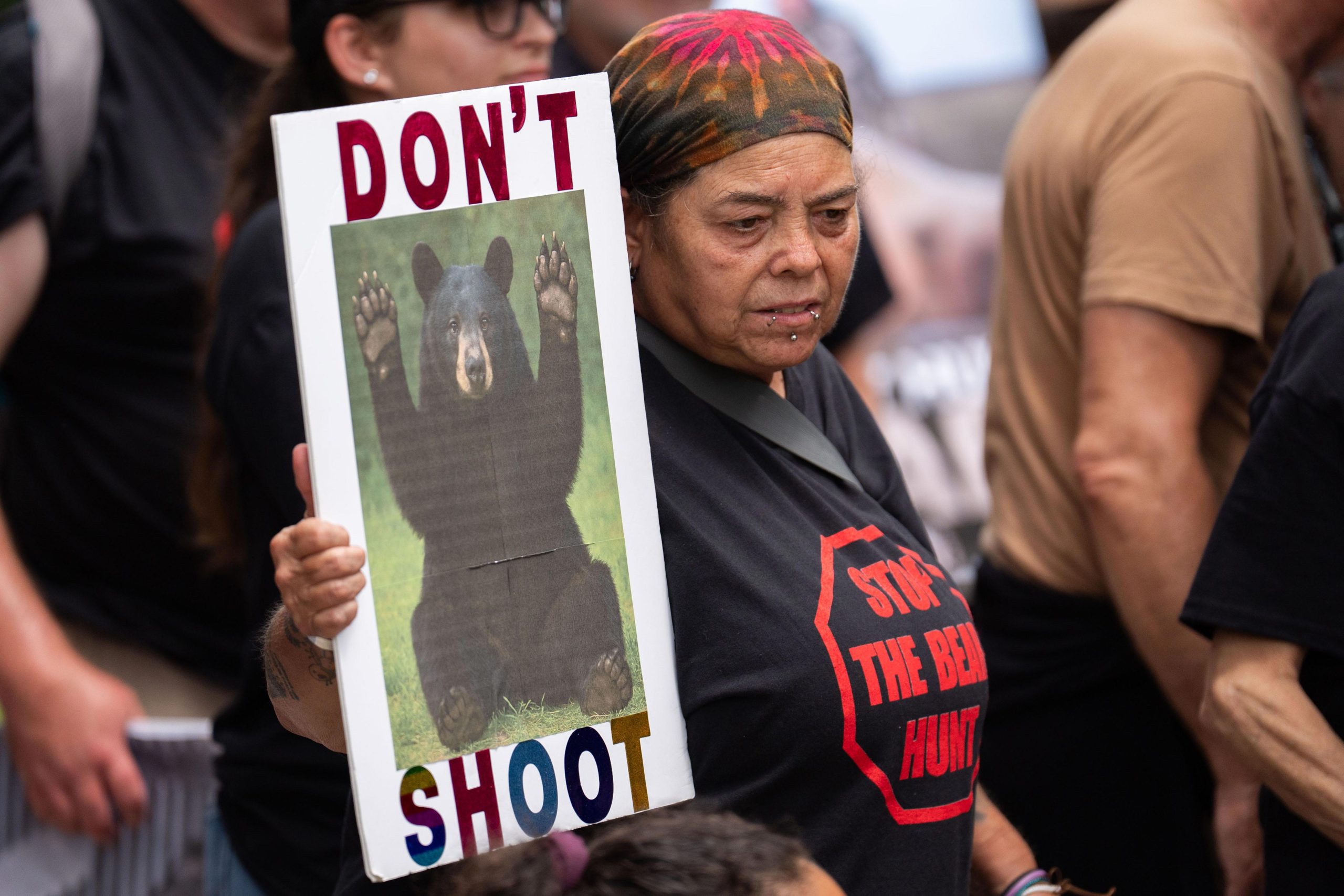
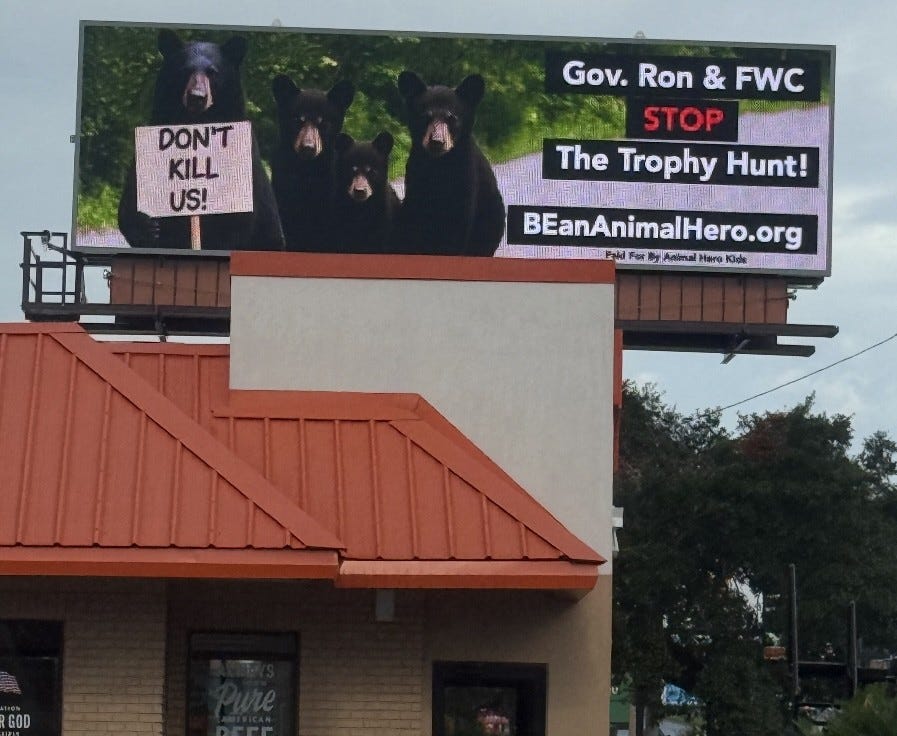
A coalition of a dozen conservation groups that organized weekend protests in at least 11 cities, put up billboards — including one near the Florida Capitol — and bused in members from Tampa, Daytona, and Jacksonville to speak against the hunt.
FWC officials and biologists said they constructed a highly regulated structure for a hunt to reduce the bear population to a sustainable level.
Last regular bear hunt ended in 1990s
What appears to be a resurgent bear population led to calls to restart an annual bear hunt that ended in 1994. Moreover, calls about nuisance bears have increased from 2,000 in 2016 to more than 6,000 in 2024.
While conservationists see the black bear’s survival a Florida success story, others said the increased numbers make bears a nuisance and a threat to public safety and the bears’ health as a species.
The FWC estimated there are 4,050 bears in seven distinct regions statewide. The population has increased from 1,200 in the 1990s when annual bear hunts ended, and from 500 in the 1970s when the bears were listed as a threatened species.
Today, Florida is reaching its capacity to support a healthy bear population, according to wildlife biologists. And when bears become too populous in one area, some begin to wander into unsuitable areas.
“We start seeing underweight bears and other health issues,” said FWC chief conservation officer George Warthen.
This year’s hunt is confined to 68 bears in the East Panhandle BMU; 46 in the North, 18 in Central, and 55 in the South. Hunters will be allowed to use dogs to assist them and to bait bears, meaning using food to lure the bear into the open and shoot them while they eat.
Those two provisions were a dividing line between the nearly 300 people who filled an auditorium and two overflow rooms at a Tallahassee State College branch campus.
Groups like the Florida State Dog Hunters Association traded rhetorical blows with members of Bears Warriors United for nearly three hours while the commissioners watched and listened.
For example, for every Charles Travis Porter who thanked the commissioners for doing the work to create regulations for a bear hunt, there was a Morgan Sorbo who chided them for adopting rules that Teddy Roosevelt would have found unsportsmanlike.
After 168 public speakers weighed in, FWC chair Rodney Barreto led staff in addressing concerns raised by opponents. Warthen was called back to the lectern to defend the validity of the agency’s population estimates. They are based on a combination of genetic tests of material collected with hair snares and a tagging program.
Barreto then reminded the audience that the North American model of wildlife conservation has proven hunting to be an effective management tool, producing surging populations of ducks and wild turkeys.
And he added Florida’s success stories in managing wildlife populations include the alligator and manatee. But that drew murmurs from the audience.
“I want the public to know that this is not like a ‘run and gun.’ We make decisions based upon facts. We look to our professional staff with over 100 years of professionalism,” Barreto said.
Nonetheless, attorney Raquel Levy left the meeting and headed to Tallahassee to file a state administrative challenge to block the hunt.
“We believe the FWC has violated their own rules. They are not acting based on science. They’re just acting on self interest,” said Levy, of Daytona Beach.
The challenge, filed at the state’s Department of Administrative Hearings, lists Bear Warriors United as the plaintiff and seeks to have bears relisted as a threatened species due to the FWC’s failure to protect the animal from delisting in 2012.
“They have not taken into account habitat loss, which they are supposed to do. And they have delegated their authority to the executive director, which they are not allowed to do,” Levy said.
What to know about the Florida bear hunt
- FWC will consider a hunt to run Dec. 6–28. A vote on the proposal will be taken at the August quarterly meeting in Havana.
- The hunt will have a 187 bear quota from 31 counties divided into four bear hunting zones.
- Sixty-eight bears will be permitted for harvest from 11 eastern panhandle counties including Franklin, Leon, and Wakulla; 18 bears from 12 Central Florida counties, 46 from five North Florida counties, and 55 from Lee, Collier and Hendry counties.
- There will be a $5 permit application fee.
- If selected in a random drawing for a permit, permits will cost $100 for a Florida resident, and $300 for a out-of-state hunters.
- One bear is allowed per permit, and FWC must be notified within 24 hours of a bear being taken and a tag must be attached to the bear for it to be transported.
- Hunters may use all archery equipment, muzzle loading guns, shotguns, center fire, rifles, revolvers and pistols and pre-charge pneumatic air guns to harvest bears.
James Call is a member of the USA TODAY NETWORK – Florida Capital Bureau. He can be reached at jcall@tallahassee.com and is on X as @CallTallahassee.
This article originally appeared on Tallahassee Democrat: FWC approves Florida black bear hunting season amid protests, possible lawsuit