A Crisis of Survival in Zimbabwe
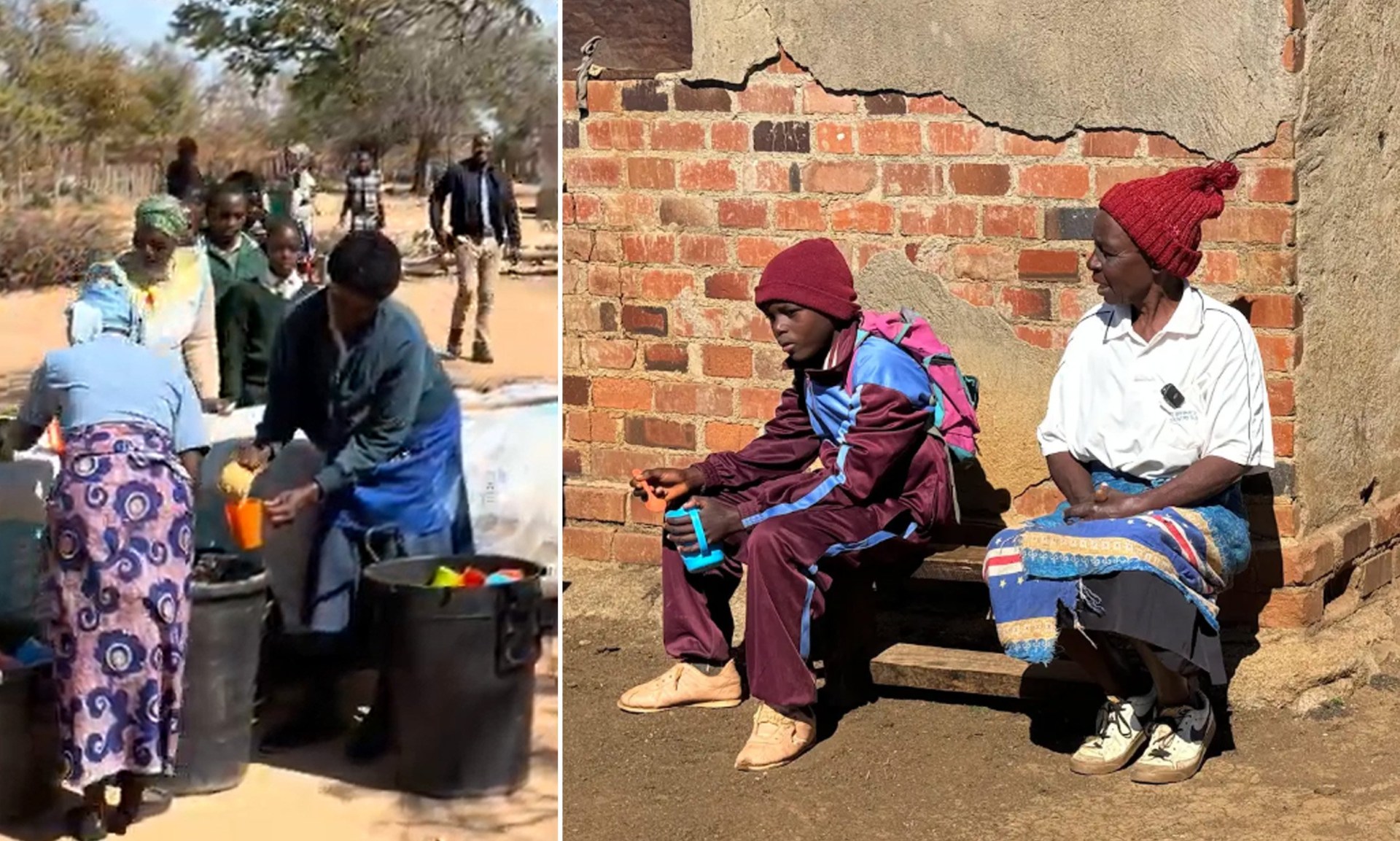
Madeline Mgwabi, a grandmother-of-three, stands at the gates of her crumbling home in western Zimbabwe. She clutches a single orange, a leftover from a hotel breakfast, which she must split among herself and her three grandsons. One of them is still a toddler, and all of them are being raised by Madeline alone in a region that has seen better days.
Beside her on a wooden bench is her eldest grandson, still wearing his school uniform, scooping porridge from a plastic container. To make ends meet, Madeline collects firewood and does odd jobs for neighbors in the village of Libeni, but it’s not enough to feed her family. The drought has turned once-fertile lands into barren fields, and the situation is worsening year by year.
The last time she had a harvest, it was from a garden that no longer exists. Now, the land is cracked and dry, with shrubs reduced to dust. “I have lived here for 25 years, and each year, the droughts hit us worse and worse,” she says. “Because of the climate, we often do not harvest anything.”
Her fears are shared by many in Zimbabwe, where the worst drought in a century has left millions struggling. The country’s economy, already burdened by decades of instability and political isolation, is now facing the added challenge of climate change. Driving through Matabeleland North, where agriculture used to be a key economic sector, the signs of devastation are clear. The Shangani River, once a lifeline, is now just a bed of mud and rocks.
In 2024, President Emmerson Mnangagwa declared a national disaster to address the crisis. Other African nations, including Lesotho, Malawi, Namibia, and Zambia, also faced severe droughts. Despite improved crops this year, seven million people in Zimbabwe still face food shortages.
Children Pay the Price
Children have been the hardest hit by the droughts. With families unable to afford food, some boys drop out of school to work in the mines, while girls are often forced into early marriages to provide financial relief. In Zimbabwe, one in three girls is married before turning 18, and more than one in five has given birth. Underage marriage is illegal, but poverty drives families to resort to it.
Lungisani Nyathi, a father of four, shares his fears about the future of his children. His wife recently gave birth to a baby girl, and he worries about what the future holds for her. “If I fail to provide for my daughter when she grows up, I worry that she will have to marry someone very young,” he says. “It is common for girls to be tied into early marriages due to the financial situation of their families.”
Lungisani works as a security guard near a borehole that supplies water in Bubi District, but the income is not enough. He wishes to move his family to another area to protect his sons from the lure of the gold mines nearby. Working in these unregulated pits is dangerous, with no protective gear and harsh conditions. “Even the dust was choking us,” he recalls.
A Ticking Time Bomb
Khumalo Fanta, a deputy headteacher at Amazwimabili Primary School, sees the impact of the mines on her students. “A lot of boys would leave school and go work at the mines,” she explains. “It exposes them to elicit behavior… There is always alcohol near the mines because it sells fast to adolescents.” The cycle of poverty continues as boys return with money, attracting girls who are then pulled into the same cycle.
For those who do attend school, hunger remains a major barrier. Many children walk miles on empty stomachs every day. Mary’s Meals, a Scottish-based charity, is working to break this cycle by providing daily school meals for children in early education. The program has become a lifeline for families like Madeline’s, where the promise of a warm bowl of porridge helps reduce the burden on parents.
At Dromoland Primary School in Bubi District, the feeding program has helped increase enrollment. Headmaster Simeleni Mguni notes that the number of pupils has grown from 255 to 279 since the program began. “We enroll new learners every week,” she says. Before the program, several students dropped out because they could not afford to eat. Some boys went to work in the mines, while girls left due to lack of period products.
Mary’s Meals has been operating in Zimbabwe since 2018, working with local NGOs like ORAP. Today, the charity feeds three million children every day across Africa, Asia, the Middle East, Latin America, and the Caribbean. Their efforts are making a difference, offering hope in a region where survival is an everyday battle.