
Mitchell Robinson Emerge as Starter, Rotation Taking Shape
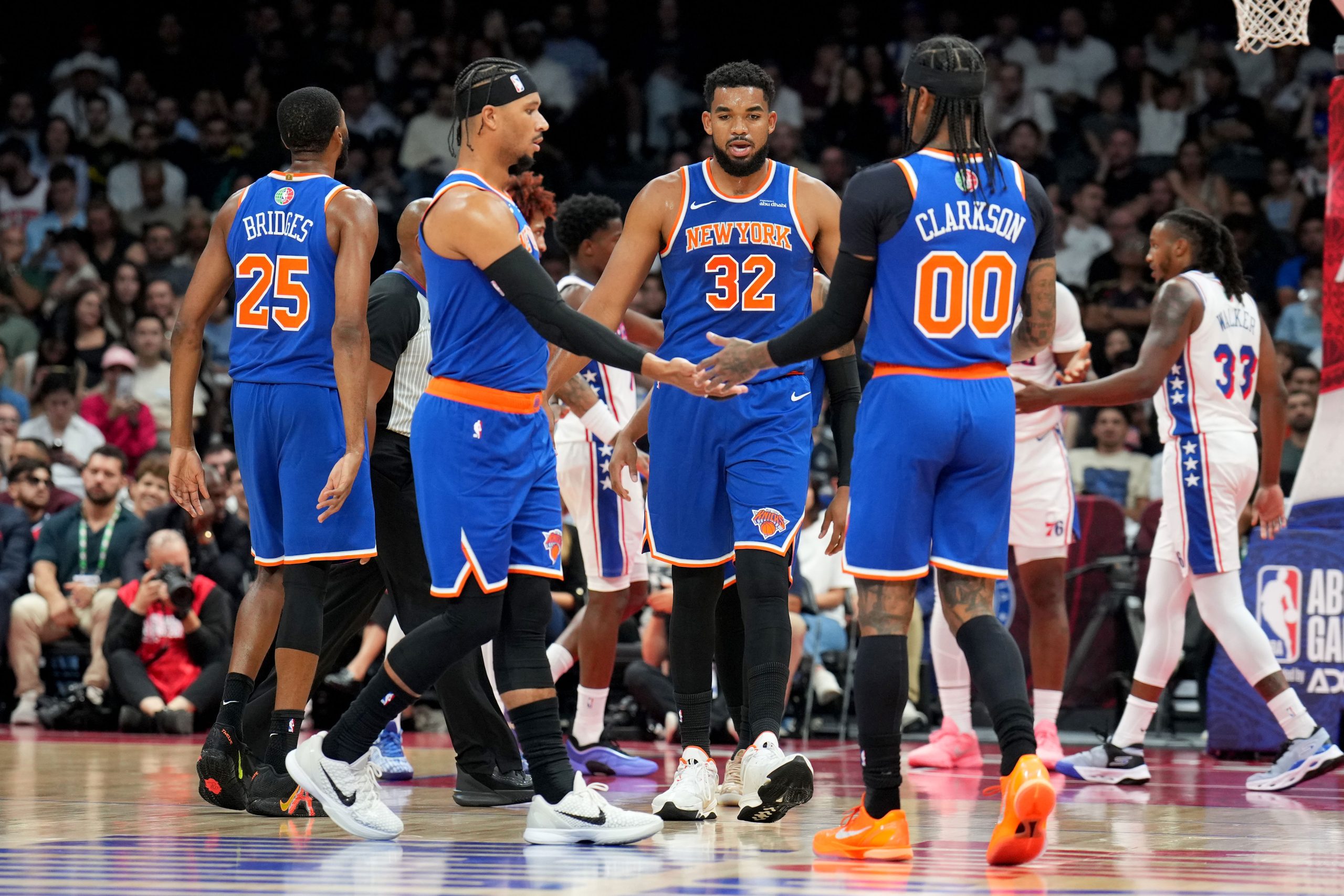
Two games into the Mike Brown era, the New York Knicks are already reshaping who they are and how they play. From Mitchell Robinson’s appearance in the starting lineup to Jalen Brunson’s growing command of a faster, freer offense, New York’s preseason has us irrationally giddy for the official campaign. Meanwhile, the front office remains patient on the Giannis front, the rotation is coming into focus, and the team’s new system is beginning to hum.
Mitchell Robinson appears to be penciled in as the opening-day starter, signaling a philosophical shift toward defense and control after last year’s perimeter-heavy approach. Brown’s emphasis on tempo (a 102.5 first-half pace so far) shows he’s chasing speed without abandoning structure. His projected 9–10 man rotation blends continuity with experimentation, and Brogdon’s steady hand could quietly define the second unit.
Last year’s Brunson–Bridges–Anunoby–Hart–Towns lineup logged more minutes than any five-man group in the league but was not the wrecking crew we expected. The unit slipped into the red after January and cratered in the playoffs. That prompted Tom Thibodeau to swap Hart for Mitchell Robinson in the Eastern Conference Finals, and Leon Rose to swap Thibs for Mike Brown in the offseason.
Starting Robinson at center, beside Karl-Anthony Towns at power forward, offers rim protection for days, whereas Hart brings versatility and connective tissue. Of course, the new skipper could surprise everyone and pick a third option. That dark horse might be Deuce McBride, with his point-of-attack defense and three-point range.
The final roster battle between Brogdon, Landry Shamet, and Garrison Mathews raises a larger question: does Brown want familiarity or firepower? The returning Shamet fits the system as a utility man who can hit from deep; Mathews brings spacing with a sniper’s range.
Evaluated through the preseason lens, these Knicks are tightening their defense while speeding their offense, creating a new identity grounded in flexibility, cohesion, and intent. Coach Mike is not finished yet, but his club is starting to look like a team built to last.
Giannis’s Unsettled Future
According to ESPN’s Shams Charania, Bucks GM Jon Horst flew to Athens in July to meet with Giannis Antetokounmpo after waiving Damian Lillard and signing Myles Turner. Both moves were seen as bold attempts to reset around their franchise cornerstone.
The overhaul did little to calm Giannis’s unease. “I want to be on a team that allows me and gives me a chance to win a championship,” he said later.
Behind closed doors, Antetokounmpo’s representatives assessed potential landing spots, and one city emerged as his clear preference: the Big Apple. In fact, the two teams talked in August about a potential deal. Sources described the talks as “an exclusive negotiating window” that was brief, but revealing. Milwaukee wouldn’t entertain a deal, and New York’s depleted draft cupboard, after the Mikal Bridges and Karl-Anthony Towns trades, left it short on leverage.
Still, if Giannis ever decides to leap, Madison Square Garden tops the list.
From a strategic lens, New York’s restraint this summer may prove wise. They could have emptied their bench and remaining picks in a desperate push, but they chose stability and long-term positioning instead.
Milwaukee is a franchise tethered to a superstar, burdened by Lillard’s stretched contract, and vulnerable to early-season failure. The Knicks’ front office could be playing the long game, waiting it out for a more favorable swap. They have constructed a runway rather than a trade package, with a flexible roster, retained key contracts, and maintained cap adaptability.
The Knicks are doing what smart teams do when dealing with a generational player under strain: staying close, staying quiet, and staying ready.
Jalen Brunson Settling Into Mike Brown’s High-Speed System
Kristian Winfield wrote in the NY Daily News about Jalen Brunson getting ‘comfortable’ in Mike Brown’s system.
The Knicks’ preseason sweep of the lowly Sixers offered the first real glimpse of Coach Mike’s offense — and how Jalen is adjusting to it. The new system replaces Tom Thibodeau’s grind-it-out pace with motion, spacing, and quick decisions. Brunson, after a shaky opener, looked more in sync in Game 2, using the extra space to attack and read defenses more efficiently.
Brown’s approach pushes Brunson to operate both on and off the ball, conserving energy for late-game stretches while keeping tempo high. For Captain Clutch, it’s less about playing faster and more about playing smarter: moving the ball, stretching defenses, and trusting teammates to make the right reads.
“We’re still adjusting, and that’s the process of this entire season. You’re not just gonna be who you are at the end of training camp. You’re gonna continue to get better throughout the season. So, I think the longer that we go through this and understand what’s needed and asked of us, the better we’re gonna be.”
Strategically, Brown’s offense challenges the Knicks to trade control for flow, precision for adaptability. If it clicks, New York could forge a modern hybrid: Thibodeau’s discipline fused with Golden State-style freedom.
Brunson’s growing comfort suggests that the balance between speed, spacing, and trust is beginning to take shape.
“Obviously we want to get the ball across halfcourt in a certain time frame, but it’s about playing fast, seeing what the defense does and reading that. We weren’t trying to leak out, but we were just trying to sprint corners, and we were getting behind the defense and able to get layups. So as long as we come away with a stop, that allows us to run.”