
Exploring Shared Paths Through Art
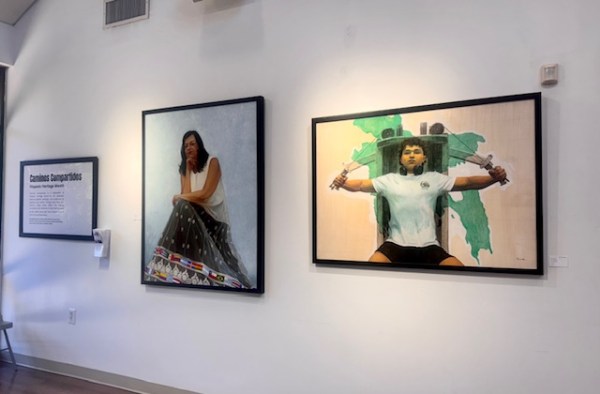
This fall, the Gallery at Abernathy Arts Center presents “Caminos Compartidos,” an exhibition celebrating Hispanic Heritage Month with nine artists of Latin American origin. Running through Oct. 30, the show delves into how heritage, ancestry, and migration shape artistic expression. Curated by Brazilian-born artist Carol Santos, who is based in Atlanta, the exhibition features painters, sculptors, and installation artists whose work reflects personal histories and the broader Latino experience often underrepresented in the area.
Santos emphasizes that the title “Caminos Compartidos” highlights the balance between individual and community. “Each artist approaches their practice uniquely, exploring subjects tied to their personal journeys,” she explains. “What unites them is a strong commitment to sharing their cultural heritage and personal experiences through art.”
Santos herself works across various forms and frequently collaborates with family and friends. She views art as a conversation that transcends time and place, keeping stories alive and relevant. In “Caminos Compartidos,” she brings together nine voices from Latin America to illustrate that resilience, creativity, and belonging are shared efforts.
Ancestry and Remembrance
For several artists in the exhibition, remembrance serves as a starting point. Their works echo family stories, ancestral ties, and the tension between holding on and letting go.
Monica Campana roots her practice in the women who raised her in Lima and the ancestors she considers her guides. “The art I make is based on memory and identity,” she says. “I keep finding myself making work that resembles art from my Peruvian ancestors, not because I plan to do that but because it simply turns out that way.”
Patricio Marín, who grew up in Nicaragua, recalls molding animals from fruit and colored soil after rain and watching farmers’ “rough hands” coax life from the earth. “It was a life shaped by colors, traditions, and a deep passion for life,” he remembers. His paintings carry that sense of wonder, using nature’s colors and textures to honor resilience and tradition.
Johanna Flores, who works in porcelain, ties ancestry to spirit as much as to the past. “Within my practice, I explore themes of creation and the relationship between spirit and matter,” she explains. Her smooth, seedlike sculptures suggest inner multiplicity and transformation.
Landscapes and Belonging
Place—both remembered and lived—is another strong thread in “Caminos Compartidos.” Several artists discussed viewing landscapes as sites of belonging, linking Atlanta to their roots across Latin America.
Carla Contreras, from Quito, Ecuador, grew up in the Andean highlands. After moving to Atlanta, she found comfort in hiking Stone Mountain during the pandemic. “Traces of my cultural heritage emerge naturally in my work, bridging my current home in Atlanta with my origins in the Andes,” she says. In paintings like Mujer, she layers textures inspired by mosses and lichens and references jewelry made by Ecuadorian women artisans resisting displacement.
Pedro Fuentes of Peru paints abstractions that avoid literal symbols. “My heritage appears transformed: I take the local and transform it into a universal language,” he explains. He aims for “emotional traces,” inviting viewers to see their own stories in the work. Sharing his culture in Atlanta, he says, means “sowing a presence, building bridges, and contributing to the artistic dialogue.”
Colombian-born Catalina Gómez-Beuth blends realism and symbolism to explore migration, identity, and daily life. Her canvases, she notes, “reflect on culture, identity, and the emotional inner world,” holding shared experience while making room for private reflection.
Resilience and Migration
A third theme in the exhibition is migration and how people adapt and persist. Several artists directly address displacement, representation, and survival.
Melvin Toledo, from Nicaragua, uses portraiture to challenge stereotypes of immigrants. His Stars of America series portrays friends, neighbors, and strangers in a dignified and luminous manner. “I wanted to change the narrative of immigrants being depicted as drug traffickers and criminals,” he says. “I wanted to show immigrants as human beings, neighbors, teachers, someone you might encounter on a run at the grocery store.”
Jessica Caldas, of Puerto Rican descent, combines drawing, collage, and performance to explore womanhood, migration, and care. Her move into fabric sculpture and installation came from “a growing desire to tell collective stories at scale,” blending personal narratives with broader social issues.
For Carlos Solis, who moved to Atlanta from Chicago, migration revealed a gap. “As soon as I moved here, I noticed the lack of presence of Latin art in galleries and museums,” he says. In response, he founded Contrapunto, a collective of Latin artists, and has organized shows to highlight Latin American expression. His surrealist paintings, steeped in religious symbols and indigenous mythology, bring Venezuelan cosmology into vibrant, contemporary images.
Together, these artists show that migration is not only about loss or adjustment. It can also create new cultural presences—reshaping Atlanta’s art landscape in the process.
“Caminos Compartidos” is on view through Oct. 30 at the Gallery at Abernathy Arts Center, located at 254 Johnson Ferry Rd NW in Sandy Springs. Admission is free.