A Glimpse into the Life of a War Photographer
The documentary “Love + War,” directed by Elizabeth Chai Vasarhely and Jimmy Chin, opens with footage that has become all too familiar in recent years—civilians caught in the chaos of war. In this case, it’s the city of Novoluhanske in Ukraine on February 19, 2022, just days before Russia’s invasion plunged the country into violence and turmoil. However, from the outset, the focus of the film is not solely on the destruction but on one particular figure documenting it: photojournalist Lynsey Addario.
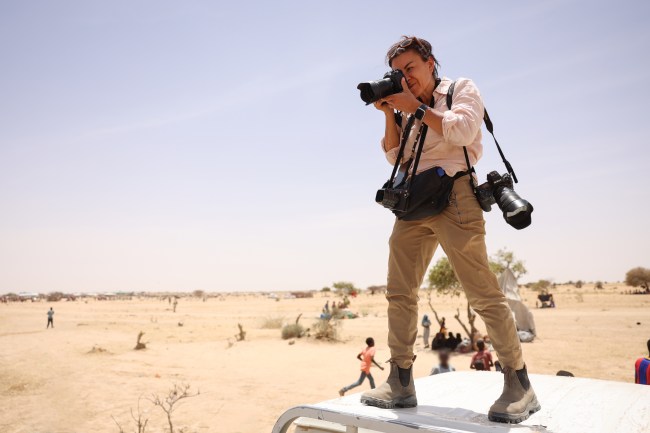
Wearing a protective helmet and press jacket, Addario stands out as a compelling documentary subject. She is serious about her work, displays a dry sense of humor when appropriate, and is unflinchingly honest about her experiences. Early in the film, she expresses frustration to the camera while waiting in line with other journalists to survey the aftermath of an attack, noting how men are often given priority over women. More importantly, Addario is exceptionally skilled at her job, and through the documentary’s footage, we witness the events leading up to her iconic photograph of Ukrainian soldiers rushing to the bodies of a family killed by Russian mortar fire during the invasion. This image became one of the defining moments of the conflict in its early days.
While the title suggests a balance between love and war, the film is not only about Addario’s career. It explores her life across various conflict zones, including Ukraine, Iraq, and Afghanistan, highlighting both her professional achievements and the emotional toll of her work. The filmmakers take great care to present Addario as a complex individual rather than a one-dimensional hero. By focusing on her personal life, the documentary avoids the pitfalls of hagiography, instead offering a nuanced portrayal of a woman navigating the challenges of her profession and her relationships.
Addario lives in London with her partner, former Reuters journalist Paul de Bendern, and their two young sons. Their relationship is portrayed with warmth, yet it is clear that Addario’s career has significantly shaped her domestic life. The couple discusses how she only considered having children after a near-death experience, and it’s evident how difficult it is for her to maintain a sense of normalcy when she is away for extended periods and exposed to such intense situations.
In intimate scenes set at home, the film reveals how Addario’s work affects her family. One of her sons becomes sullen and distant, while another regresses and begins wetting the bed. When asked to tell a bedtime story, Addario appears distracted, her mind clearly elsewhere. In interviews, she admits that the place where she feels most present is in her work: “I feel like I’m home.” The documentary does not judge her for this, allowing her to express her passion for helping civilians and showcasing the resilience that defines her career. At the same time, it acknowledges the frustrations of those close to her.
The film also includes perspectives from other journalists and experts who discuss the challenges of covering war, particularly the gendered dynamics within the field. Despite a long history of female war photographers, the profession is often perceived as male-dominated. Writers like Dexter Filkins reflect on the personal costs of covering conflicts, with dark humor about colleagues who have struggled with the emotional weight of their work.
While “Love + War” offers a thoughtful and engaging look at Addario’s life, it occasionally feels like it only scratches the surface of her complexity. A pivotal moment in her career, when she was captured in Libya, serves as the film’s emotional climax but comes across as somewhat detached, lacking the depth needed to fully convey the gravity of the experience. Nevertheless, the documentary remains a compelling and insightful exploration of a woman whose work has left a lasting impact.
Overall, “Love + War” is a smart and emotionally resonant film that highlights the human side of a war photographer. It succeeds in portraying its subject as both a dedicated professional and a deeply flawed, vulnerable individual. The film premiered at the Toronto International Film Festival and is set for a later release.