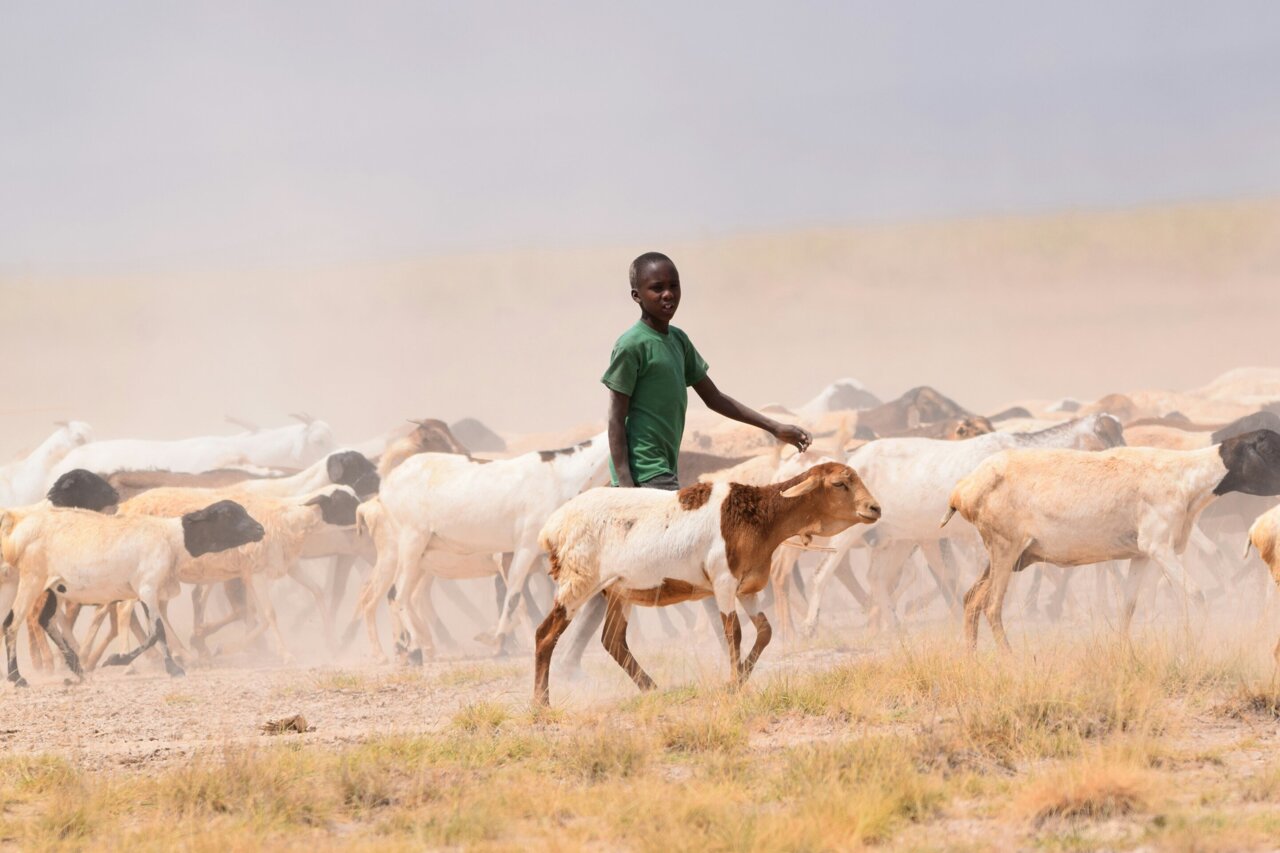
Since 1990, over 2.5 million individuals have lost their lives due to civil conflict in Africa, either directly or indirectly. A contributing factor to these conflicts, which often involve confrontations between Muslim pastoralists and Christian farmers, could be the struggle for farming resources, exacerbated by the warmer and drier climate experienced over the past three decades.
Subscribe to our newsletterfor the most recent science and technology news updates.
The link between climate and conflict is something Eoin McGuirk, the J.C. Keogh and Family Assistant Professor of Economics at Tufts, proposed several years ago while seeking to comprehend the rise of warfare and its effects on African economies. As a development economist, he examines how economies expand in less developed nations, with war being extremely harmful to developing economies.
Farmers across various parts of Africa have historically maintained beneficial, mutual relationships with pastoralists who move their livestock, according to McGuirk. During the rainy season, herders allow their animals to graze on less fertile land beyond farming areas—where the rainfall provides sufficient nourishment for their livestock. As the dry season approaches and farmers complete their harvest, pastoralists relocate their animals to the farmland, feeding on leftover crop remnants. The animals help loosen the soil and add natural fertilizer through their waste.
“It’s not only that they can live in peace on their own, but also that they both gain advantages—and support each other,” McGuirk states.
However, under drier conditions, herders are moving their animals into farmland areas earlier, before the crops are ready for harvest, leading to increasing conflicts over the past 20 years, particularly in the Sahel region and the Horn of Africa. In addition, because pastoralists are often Muslim and farmers are typically Christian, recent civil conflicts between these groups have acquired religious dimensions as well.
Now, following multiple years of study, McGuirk and his colleague Nathan Nunn from the University of British Columbia present findings indicating that prolonged periods of extremely low rainfall lead to increased conflict between pastoralist communities and nearby farmers, with some incidents involving religious extremists. The study, titled “Transhumant Pastoralism, Climate Change, and Conflict in Africa,” ispublishedearlier this year in theReview of Economic Studies.
Mapping rainfall and violence
For the study, scientists developed a map of Africa split into approximately 10,000 grid sections, and then added highly detailed information across the whole continent regarding precipitation trends; conflicts based on location; religious beliefs of residents; categories of economic work, like agriculture or animal husbandry; and kinds of animals, including large grazing creatures or domesticated animals such as chickens and pigs.
They discovered that reduced rainfall in a region heightened the chances of conflict between different ethnic groups, but this was only true when settled farmers lived near grazing pastoralists. If the neighboring group was another agricultural community or engaged in stationary animal farming, the risk of conflict was low. They also observed that Islamist jihadist activities coincided considerably with the clashes between pastoralists and farmers.
The research ‘demonstrates an economic factor that is fueling the expansion of jihadist conflict,’ according to McGuirk. ‘An encouraging perspective on the findings is that jihadist conflict can be tackled through policy measures. We should not view it solely as being tied to fundamental, strongly held beliefs or identity.’
An approach to managing such conflicts could involve increasing development assistance. “You might assume that aid initiatives could reduce the impact of these droughts on conflict,” explains McGuirk. However, this is not what the researchers discovered. “Our findings indicate that areas with a greater total number of aid projects do not appear to influence the situation in any way.”
In addition, assistance initiatives that place land under environmental conservation—where habitats are protected from human activity—can actually worsen conflicts. “When there is an increase in conservation areas, you’re limiting the amount of land accessible to herders,” explains McGuirk. “This leads to more competition for resources in the remaining areas, and we observe that the impact of a drought on conflict becomes more pronounced, which is logical.”
But there is still hope, according to McGuirk. Those involved in pastoralism, often located on the edges of society, typically have limited political power, which frequently motivates them to strive harder to attain their objectives.
The researchers developed a way to measure the national political influence of pastoral groups, “and we observed notable changes over time,” he explains. During periods when these groups had greater political power nationally, the effect of droughts on conflict decreased substantially.
It’s definitely in line with the concept that when pastoralists are involved in discussions, communities can prevent conflicts,” he states. “They are more capable of negotiating a fair allocation of resources that prevents violence.
Another strategy that McGuirk sees as promising is the World Bank’s implementation of programs aimed at supporting pastoralists in the Horn of Africa and West Africa, “individuals who have been neglected by much of the development sector for a significant period,” he notes.
These efforts involve drought relief programs, which vary from those that support established agricultural communities. “It will be intriguing to observe how much these types of policy actions can lower the chances of conflict in these regions,” he states.
More information:Eoin F. McGuirk et al., Transhumant Pastoralism, Climate Change, and Conflict in Africa,Review of Economic Studies (2024). DOI: 10.1093/restud/rdae027
Provided by Tufts University
This narrative was first released onMuara Digital Team.