When General Motors revealed a significant shift from the Renaissance Center along the Detroit riverfront to a location on Woodward Avenue, CEO Mary Barra stated that the new place would be “very personal to me.”
Raised in Waterford, Barra holds cherished memories of the sparkling Christmas lights on Woodward, as her family regularly visited the J.L. Hudson Department Store, which once held the title of the world’s tallest department store.
My mother would bring my brother and me here, and we’d shop at the kids-only store. It was a really neat space, smaller than this room, where you’d go in — for me, it was $7, and I’d be buying Christmas gifts without my parents.
Begin your day with more knowledge. Receive all the essential news in your inbox every morning.
Hudson’s closed its downtown store in 1983, and the structure was demolished in 1998, resulting in an empty lot.
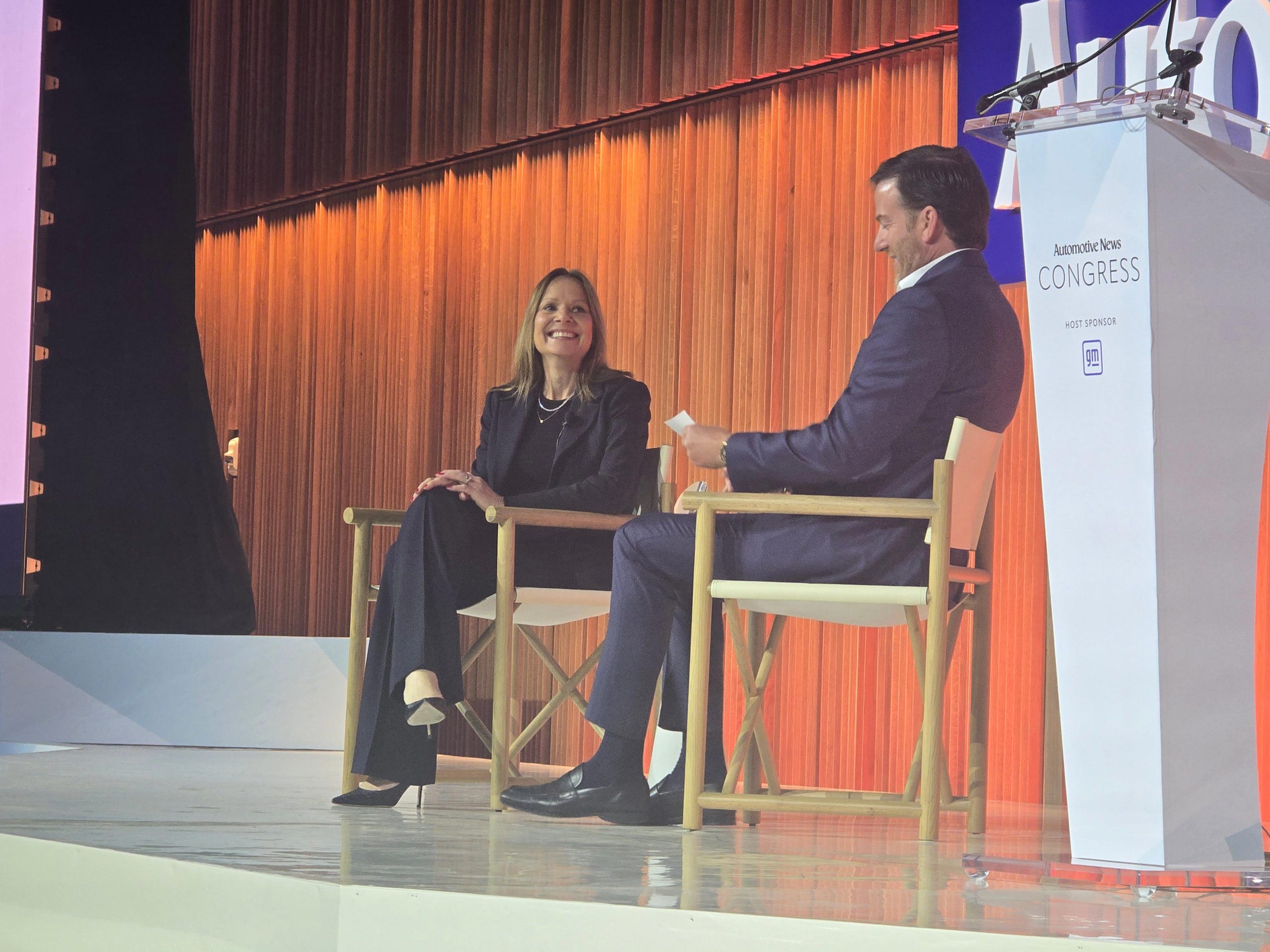
Speaking on September 11, Barra addressed the audience at the Automotive News Congress — the publication’s annual industry gathering held at The Department at Hudson’s, an event venue located beneath the new GM global headquarters being developed inside the newly constructed Hudson’s Detroit building — and mentioned that the occasion was a bit of a full circle moment.
GM has accepted a preliminary 15-year, multi-tier leasefor the upper office levels of the structure located on Woodward, which is part of billionaire Dan Gilbert’s Hudson’s project.
We knew we wanted to remain in Detroit, as it’s our home, but we also understood that our business was evolving, and how we conduct our operations,” Barra stated. “We’re thrilled to be collaborating with (Gilbert) and can’t wait to move in during January.
Barra answered inquiries regarding GM’s future business plans and shared her thoughts on her tenure as the head of the biggest Detroit-based car manufacturer during the Automotive News event on September 11. Below are some of the subjects she discussed:
Barra on GM’s strength in the face of electric vehicles
Over the past decade, since General Motors introduced its plan to create a comprehensive range of electric vehicles across different types, major challenges have continuously affected the industry and placed pressure on the company’s financial resources.
Following significant restructuring after the automaker’s bankruptcy, “unprecedented events” complicated the industry as GM tried to establish a new direction for its powertrain systems in the United States that more closely matched global trends, she stated..
Throughout our country, the world, and the industry, we’ve faced so many challenges — consider COVID, the semiconductor shortage, and how that affected suppliers — and we’re still dealing with those issues while managing tariffs and a significant change in regulations,” Barra stated. “Until a year ago, we were on a path toward a regulatory environment that required us to push for electric vehicles.
There has been an increase in customer interest in electric vehicles, she stated, butnot moving quickly enoughto validate the initial production designs. GM hascontinually modified the product to suit customer demands;matching the current vehicle inventory that consumers are buying with the electric options the company has developedsubstantial investment and planning for a debut.
One of the difficulties, Barra mentioned, was determining how long the company could delay deciding which vehicles to manufacture using gasoline power versus electric batteries.
There were several key moments in the past few years where, if we were to launch a new initiative, we asked ourselves, ‘When did we need to make a decisive choice about our approach? And what were the important steps along the way?’ As we gathered more information, we decided, ‘Yes, we will proceed with that program using internal combustion,’ ” she explained. “You have to make decisions based on various possible situations.
The GM Spring Hill Manufacturing facility, situated in Spring Hill, Tennessee, serves as the model for the automaker’s adaptable approach, she noted, as the plant had been reconfigured to manufactureboth internal combustion engine vehicles and electric battery-powered vehicles at the same site.
On GM’s Hyundai partnership
Barra had a meeting with Euisun Chung, the executive chair of Hyundai Motor Group, on September 11, she mentioned..Chung received recognition at the Automotive News gathering.
GM and Hyundai entered into a non-binding memorandum of understanding in September 2024 to collaborate on vehicle production and “explore possibilities for joint purchasing in fields like battery raw materials, steel, and other sectors,” according to Barra.
The firms announced on August 6 thatthey would collaboratively create five vehicles, four of them — a small SUV, a car, a truck, and a midsize truck — are aimed at Central and South American regions and will offer both gasoline and hybrid engine options, along with one electric van for North America.
Barra did not share specifics about their conversation, but mentioned that the relationship has gone past the memorandum of understanding stage and that the companies are “actually working together.”
We had a meeting that I would describe as highly effective. I believe the automotive industry could improve significantly in sharing (research and development) funds and capital, particularly in areas that aren’t directly related to customer interaction, which don’t set us apart,” Barra stated. “As we began discussing with Hyundai, we found a partner who agreed with this perspective. We approached the situation seeking mutual benefits.
About vehicle design
No matter the propulsion system, GM’s aim to excel through appealing products has resulted in strong sales despite ongoing challenges, Barra stated.
When questioned about the individual she considered the most impactful figure in the automotive industry over the past century, Barra mentioned Harley Earl, the first automotive designer in the field and founder of the GM Design department.soon approaching its 50th year.
Nothing takes place in our industry until a vehicle is sold, and that vehicle must be attractive. I owe that to our design team,” Barra stated. “We aren’t just involved in the movement sector; we’re part of the fashion industry.
Jackie Charniga reports on General Motors for the Free Press. Contact her at jcharniga@freepress.com.
This piece first was published on Detroit Free Press:GM Chief Executive Mary Barra states that the move to Hudson’s building is a ‘full circle’ moment for her.