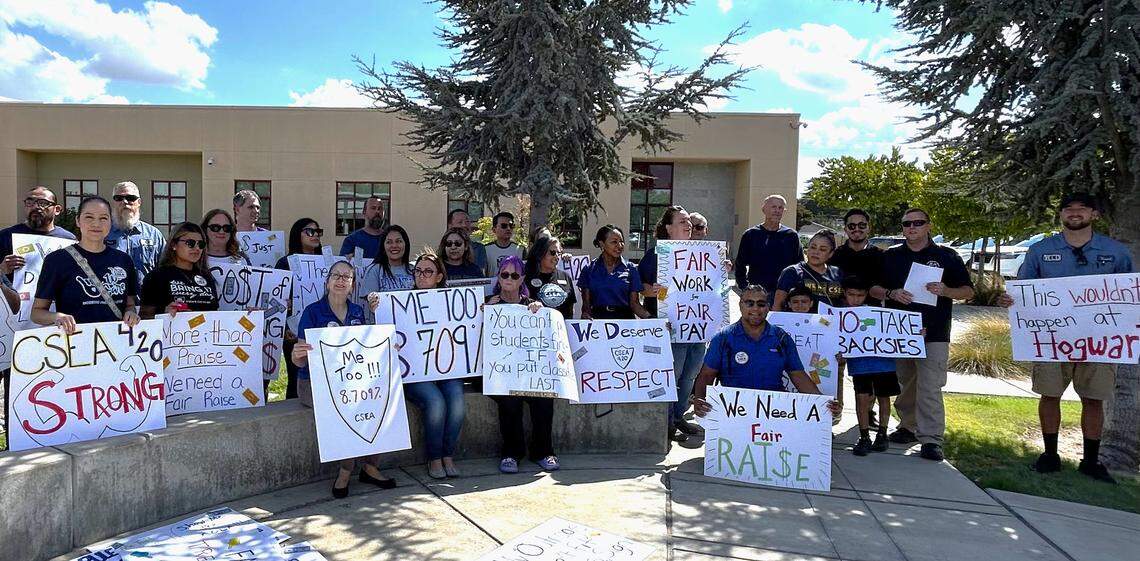
Employees of the Yosemite Community College District, which encompasses Modesto Junior College, are demonstrating against what they describe as an inequitable agreement—where instructors will be granted a larger cost-of-living adjustment (COLA) to their salaries for the 2025-26 academic year.
The California School Employees Association mentioned that YCCD employees received a 3% cost-of-living adjustment, whereas faculty were granted an 8.7% raise.
Staff classified as administrative, cleaning, maintenance, and facility personnel are those who do not hold managerial positions. Faculty members consist of professors, teaching assistants, instructors, and advisors. The lowest annual salary for YCCD employees is approximately $39,000. The minimum starting salary for faculty is roughly $76,000 per year.
CSEA claims the difference breaches a ‘Me Too’ provision in its contract with the district, which states that any increase in COLA for employees must match what faculty receives.
Employee staff members are puzzled as to why the district provided such a raise to faculty members but did not extend the same to them. Their research indicates that the district had the financial capability to do so. Several staff workers believe they are not valued as much as the faculty, even though they play equally vital roles.
They are inside the classroom while we are outside of it. As a team, we support this institution in order to assist students and deliver education to our community,” said Lisa Schut, a program specialist with 28 years of experience at YCCD. “You can’t accomplish this without faculty, but you also can’t do it without the classified staff.
Discussions between CSEA and the district did not succeed before the prior contract’s June deadline. The district’s agreement with the Yosemite Faculty Association—the union that represents faculty—included a COLA allocation in the proposed budget for the 2025-26 fiscal year.
This has prompted CSEA to organize demonstrations throughout the summer and bring approximately 80 of its members to a board of trustees meeting on September 10. Public comments from CSEA staff expressed feelings of being undervalued, overlooked, and insulted due to the difference in COLA.
Melissa Clark, a scholarship technician with 26 years of service at YCCD, urged board members to recall their student days and questioned whether campuses were clean, safe, and welcoming due to the efforts of non-exempt staff.
As soon as a student calls or arrives on our campus, we are ready to serve—whether helping with enrollment, guiding them through the financial aid application, providing meals for a student in need, or offering a clean restroom or a shaded area to study on the well-maintained grass.
Complaints against chancellor
YCCD Interim Chancellor Lena Tran was hired in May via an unconventional recruitment method, after a contentious period as president of Columbia College. In November, Tran faced a vote of no confidence from the Academic Senate and Classified Senate at Columbia College. The vote was backed by the Academic Senate of MJC. Tran was also encouraged to resign, but she refused.
As per multiple reports, Tran has made statements in the past that led staff to believe she held a superior attitude toward them.
During a December conversation with The Bee, Tran mentioned she hired a consultant to enhance communication. Nevertheless, some employees stated that remarks made at a staff breakfast in October did not reflect any progress in this area.
According to a statement by MJC employee Ian Miller and other reports, Tran suggested that her role as a classified employee was just a temporary position and made remarks indicating that, due to her master’s degree, she felt she didn’t fit in there.
Several of us also hold degrees. The distinction is that many of us decide to remain because we are driven by a desire to assist students at the basic level,” stated Miller. “That’s where our sense of pride lies. However, the message we consistently receive—through derogatory terms and inadequate counteroffers—is evident: Unless we possess the title of faculty, our contributions are not valued.
Tran could not be reached for comment by The Bee, as stated by her office. A request for comment from YCCD as a whole was sent to its legal representatives, who refused to respond. Tran, however, spoke to classified staff members present at the meeting on September 10 and expressed appreciation for their attendance.
“I’m being honest with you as I sit here; it’s challenging… and these moments are tough, but I want to express my appreciation for your ideas, your dedication, and your professionalism in maintaining this space so we can keep having this conversation,” said Tran.
However, some employees are not convinced. They hear the expressions of gratitude and appreciation but do not witness it being reflected in the district’s actions.
“It seems like empty words at this stage. … we aren’t seeking anything additional, we’re simply asking for the same. We’re requesting that the contract be handled with equal and fair treatment,” Schut said.
The method to act correctly.
A financial review conducted by CSEA indicates that the district has the funds available to increase the cost-of-living adjustment for classified staff to 8.7%, which is the same amount provided to its teaching staff. The YCCD’s budget analysis, submitted to the board on September 10, seems to support this finding.
Based on CSEA’s evaluation, the district has maintained an annual surplus for the last five years. The present reserve amount is $56.9 million, representing a 72% rise from 2020.
CSEA’s study also revealed that increasing the COLA for classified employees costs $3.1 million each year—approximately 25% of the district’s typical annual surplus.
Here is a chance to uphold that contractual obligation and show this district stands by its promises, with the ability to do what is correct,” said Patrick Krebbs, a campus safety officer and former CSEA president. “The district’s financial management has been outstanding, allowing for fair treatment of employees.
YCCD Vice Chancellor Trevor Stewart’s financial report presented at the meeting on September 10 revealed that the district had $14 million more in income than initially planned for the 2024-25 fiscal year. This surplus was due to higher levels of state and local funding.
The district’s fund balance was expected to decrease by $13.5 million during that year. However, it actually increased by approximately $10.8 million. According to Stewart, this amount would be directed into the district’s reserves.
We are financially prudent and understand that this district has faced some tough budget periods,” stated Stewart. “I believe it’s crucial to keep a strong reserve for what lies ahead.
Could a strike happen?
Carol Black, a labor relations representative with CSEA, mentioned that the union presented a counterproposal to the district on September 2nd but did not reveal its contents.
When questioned about whether CSEA would be willing to call for a strike, Black responded, “It’s not about a strike, but rather about ensuring the employer follows the terms of the agreement.”
We’re hoping the parties can unite and reach some sort of deal,” said Black. “There have been at least five meetings, so we think there’s potential to come to an agreement.
Daily updates on the most recent local, national, and global news, available every weekday morning.