Due to the challenges of contemporary life, it’s evident that a version of Michael Ende’s 1973 book “Momo” would feel extremely timely in 2025. Never before has it seemed like there are not enough hours in the day.
In writer-director Christian Ditter’s visually appealing interpretation of a whimsical tale about the value of time, an enigmatic girl with red hair named Momo (Alexa Goodall) resides within the amphitheater of an unnamed European city (possibly resembling Rome). The townspeople become intrigued by Momo due to her unique ability to listen to others. When someone shares their thoughts with her, they feel magically encouraged to be honest. They depart from the conversation feeling relieved and understood, a rare experience in today’s internet-driven world. Interestingly, Momo’s role is not central to the overall story but rather serves as a means for her to uncover the nefarious schemes of the Grey corporation.
Individuals employed by Grey are referred to as “time thieves,” supernatural beings that depend on taking hours from humans in order to survive. Their method involves persuading the public to wear bracelets that track whether they use their time productively or “waste” it on leisure. The belief is that all the time saved will eventually be available for them to use with family or to pursue personal interests later in life. This is a simple warning about how current economic systems prioritize productivity and consumption, while taking away the energy and opportunity from people to seek fulfillment during their limited lifetimes. However, the actual process of how time is taken or returned to the individual remains unclear. For a movie that also presents other clearly defined futuristic technologies as potential threats, the absence of specific details regarding this central element is somewhat disappointing.
Momo’s enigmatic background as a young girl who emerged without any family offers an engaging starting point. However, once she embraces her task to rescue others from time thieves, the protagonist is not given room for uncertainty or reflection on her future or past. Although this aligns with the idea of living in the present, it raises questions about whether the character might desire a parent, to attend school, or to experience life like other children her age. Does she ever wonder why she was selected or brought into existence? Momo seems more like an idea than a real person. Goodall’s lively performance is sure to boost her growing career, but within “Momo,” there are inherent limits to the emotional range she can display beyond constant resolve.
In addition to the kind-hearted janitor Beppo (Kim Bodnia), Momo’s most significant connection is her friendship with Gino (Araloyin Oshunremi), a young man juggling several jobs to assist his mother Liliana (Jennifer Amaka Pettersson) in supporting their siblings. When Grey provides him with an opportunity to pursue his dream of gaining a following, Gino becomes an online sensation through advanced contact lenses that allow people to view content. Similar to many concepts in “Momo,” this commentary on how social media distorts our perspective and consumes our time is quite clear, yet only superficial because the director doesn’t delve into the underlying reasons.
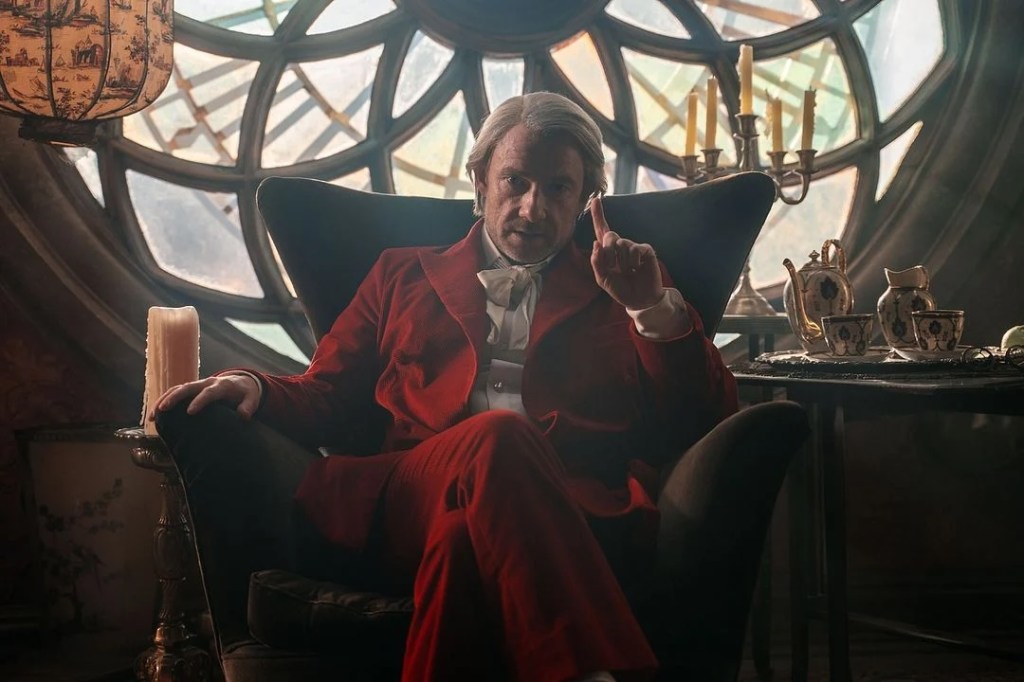
Halfway through, Momo is helped by a tortoise whose shell has glowing text for communication, as she journeys to another reality to meet Master Hora (a humorous Martin Freeman), a typical kind-hearted magical figure who provides additional background information through narration during the adventure. Thoughtfully used visual effects add to the playful atmosphere in this world where a large pendulum above water symbolizes the flow of time. The film’s alternate reality has a timeless feel, combining old-fashioned charm with hints of a technocratic dystopia, all set within a small area of a fictional town. The movie’s high production quality ensures an engaging visual experience.
“Momo” has difficulty integrating its various elements into a unified whole, but as soon as one explores the story’s background or the characters’ reasons and internal struggles, the film appears to be lacking in depth. The discussion about how duties consume our lives, pushing aside what is genuinely important, never truly addresses the underlying causes, such as economic disparity, limited opportunities, and corporate greed. When adapting the original story for today’s context, maintaining the theme’s depth with the phrase “time doesn’t exist in their watches but in their hearts” seems somewhat insincere, even if it’s intended for younger viewers.
When Momo ultimately steps in to rescue the situation, after freezing time and confronting the head of the Grey adversaries (portrayed by a calm Claes Bang), everything appears to return to normal. Everyone likely has come to appreciate the importance of time, but have their material circumstances improved enough for them to truly concentrate on the things they desire? This remains uncertain.
- “BabyStar” Review: Born for Views, the Children of Social Media Stars Rebel in a Stylish but Unfulfilled German Film
- Benedict Cumberbatch Claims Portraying ‘Male Emotion, Sorrow, and Family’ Is a ‘Positive Development for Society’ as He Receives Zurich’s Golden Eye Honor