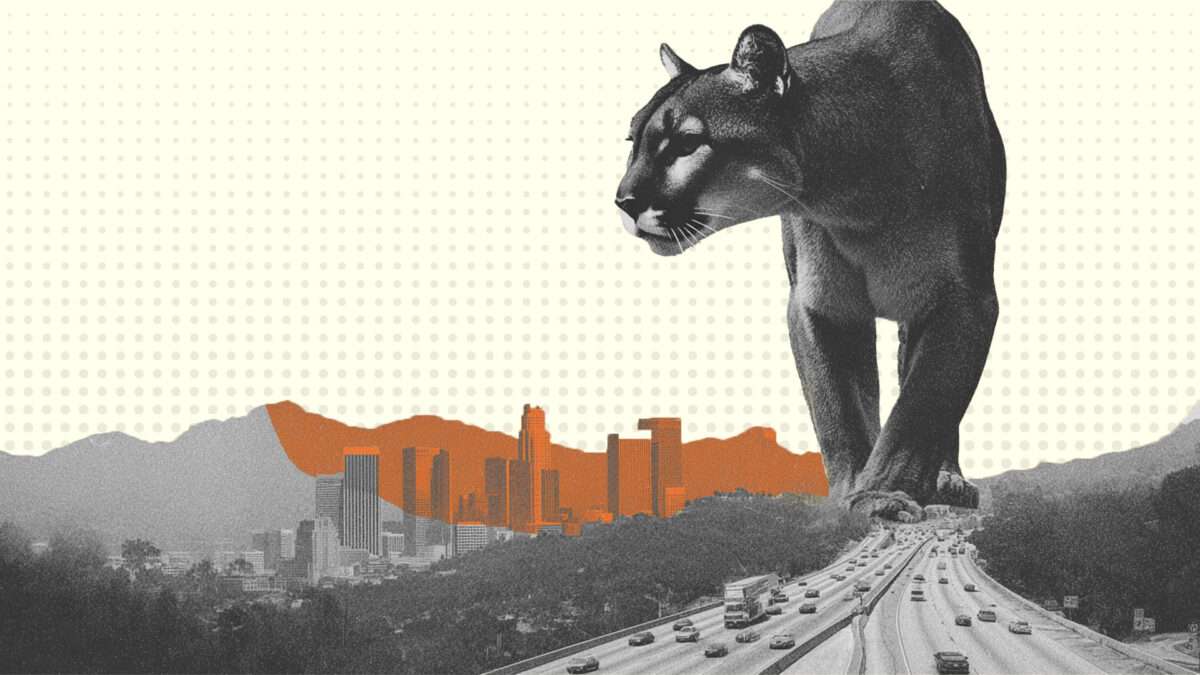
A four-legged folk hero once roamed Los Angeles: P-22, a solitary mountain lion who surprisingly made Griffith Park his home. A well-known image captures this appealing feline with the Hollywood sign perfectly positioned in the background. Upon P-22’s passing in 2022, there was a significant display of public affection, including a tribute event at the Greek Theatre. P-22 emerged as a powerful symbol that helped secure the financial support and public funding needed for the Wallis Annenberg Wildlife Crossing, which spans the U.S. 101 freeway near Los Angeles.
A bridge designed to assist animals in safely crossing one of the country’s most heavily traveled highways appears to be a worthy initiative. However, this specific project has an astonishing cost and excessive engineering—and it is completely unnecessary for safeguarding the mountain lion.
Consider the wildlife overpass in Parleys Canyon, Utah, which was finished in 2018. The structure covers approximately 16,000 square feet and had a construction cost of $5 million. This amounts toapproximately $312 per square foot. The Wallis Annenberg Wildlife Crossing in California, on the other hand, spans 35,700 square feet, featuring anApproximate cost of $92 million—$58 million taken from California taxpayers. That’s over $2,500 per square foot, eight times the price of the Utah bridge. While California has rigorous earthquake construction standards and higher labor expenses, this project aimed at saving lions is stillfour times the cost per square footof a standard California bridge.
The project team took extreme and costly measures to make the bridge appear “natural.” The California Transportation Department hired a design team to create a custom soil mixture “to replicate the biological composition of the local soils near the site,” as theLos Angeles Times reported in April,and has grown more than a million seeds in an on-site nursery since 2022.
Do the animals really care? Makeda Hanson, Utah’s wildlife migration coordinator, states that “animals don’t spend much time searching for food or hiding on these crossing structures. They treat them as a passageway.” If wildlife just crosses and continues on, why invest so much time and money into building a small ecosystem on top of a bridge?
Supporters of the bridge argue that it is essential to tackle the issue of low genetic diversity among mountain lions in the Santa Monica Mountains. The 101 freeway restricts animal movement between the Santa Ana Mountains and the Santa Monica Mountains. PBSreportedin 2019, it was stated that Southern California’s mountain lion populations are in danger of disappearing within just 50 years.
That assertion goes back to a2019 studyby John F. Benson and others, which calculated a 16–21 percent chance of local extinction within 50 years. The same study indicated that bringing in a single mountain lion from another area every two years could lower that risk to 2.4 percent.
That option is significantly more cost-effective than constructing a $92 million bridge. A peer-reviewed2014 paper in PLOS ONEdiscovered that relocating big cats of similar size—cheetahs and leopards—would cost an average of $2,760 and $2,108, respectively. Even if rounded up to $3,000 per relocation, $92 million could support over 30,000 years of biannual mountain lion relocations. Given an average bridge lifespan of approximately 100 years, moving the animals proves to be a much more economical method of conservation compared to constructing a bridge.
Supporters of the bridge view the mountain lions in the Santa Monica Mountains as a species nearing collapse. However, a consistent and self-replenishing number of lions already inhabit the area, and the bridge will not notably boost this population.
As per the Benson study, their primary group in the [Santa Monica Mountains] is quite limited, with a “maximum estimate of 15 individuals.” This figure isn’t due to recent losses or low reproduction rates; rather, it’s because the environment isn’t capable of sustaining a larger population. Mountain lions are solitary and territorial hunters. According to Benson’s research, it’s typical to encounter only one or two breeding adult male mountain lions in the Santa Monica Mountains at any specific time.
The authors explain, ‘Territorial behavior and conflicts within the same species seem to combine with limited space and human-made obstacles to raise the risk of death.’ In simpler terms, even if new lions come through a wildlife corridor, they must fight for scarce territory. This rivalry frequently results in one lion killing another.
The mountain lion population isn’t declining due to a highway. The number of lions in the Santa Monica Mountains is limited by the area’s natural ability to support them. Constructing a bridge costing over $90 million won’t alter this environmental fact.
Additionally, mountain lions are not considered endangered. The International Fund for Animal Welfare hasseven different classificationsof the level of endangerment of an animal, with “least concern” being the least severe category. Andaccording to the Mountain Lion Conservation Group, that’s their official conservation status. Mountain lions are among the most broadly distributed mammals globally, inhabiting areas that extend from Alaska to Argentina.
Even in the Santa Monica Mountains, exactly where this bridge is being constructed, the National Park ServicesaysThe population remains steady, with good levels of survival and reproduction. The lions were able to cross U.S 101 even without a bridge. The Liberty Canyon underpass features several culvert pipes that animals can readily use and has been effective for many years. One lion, P-64, crossed the 101 and 118 highways over 40 times using these passages.
Liberty Canyon underpasses are effective and cost significantly less. Matt Howard, a natural resources manager at the Utah Transportation Department, states, “there is some data indicating that mule deer tend to favor underpasses, while animals such as pronghorn, elk, and moose prefer overpasses. However, this doesn’t imply that one type of crossing won’t enable animals to pass. It simply means they may take a bit more time to adapt to it.”
Creatures adjust. A tunnel could take more time to be widely utilized, but it still serves the purpose, without needing $92 million and years of building.
Conservation initiatives must be directed by necessity, effectiveness, and tangible results, rather than by how appealing a project appears in media coverage. The Wallis Annenberg Wildlife Crossing is excessively costly, overly complicated, and unnecessary.
The post Mountain Lions in Los Angeles Don’t Require a $92 Million Government Initiative to Thrive appeared first on Muara Digital Team.