Scientists in Vienna have uncovered something extraordinary: crystals that do not develop in space, such as diamonds or salt, but rather within time itself. Rather than atoms organizing into regular structures, these new “time crystals” exhibit their own consistent beat, continuously oscillating without the need for an external timer.
Researchers report that they have discovered not only one, but two new types of continuous time crystals. Unlike previous models that required a constant external force—similar to a drumbeat—these ones form independently. This implies that time can be structured in an unexpected and fundamentally quantum manner.
From Space to Time
The idea of a crystal often makes people think of something rigid. In a liquid, molecules move about randomly until the liquid turns solid. At that point, they arrange themselves into a consistent lattice structure, disrupting the symmetry of the liquid. No direction is alike anymore—you observe structure.
Scientists have long questioned if a similar phenomenon could occur with time. Could a quantum system, initially identical from one moment to the next, unexpectedly settle into a natural pattern without any external intervention?
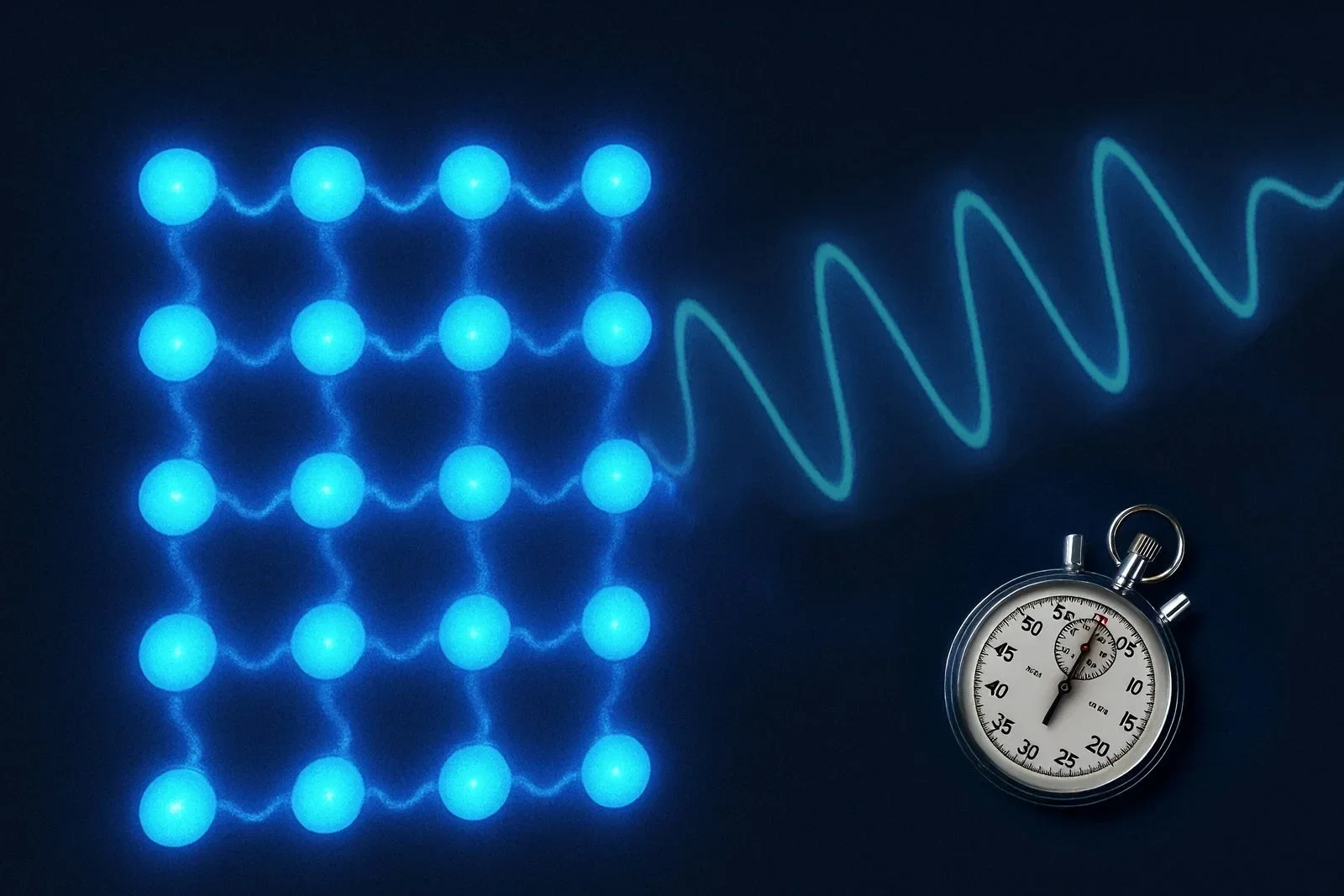
That issue has sparked discussion for over ten years. And recently, intricate models demonstrate that it is feasible—not merely in exceptional situations, but in methods unforeseen by anyone.
A Quantum Rhythm
“Time crystals are feasible—systems where a temporal pattern is created without external influence,” stated Felix Russo, a doctoral student in Thomas Pohl’s group atTU WienRusso stated that scientists previously thought these phases would disappear when quantum fluctuations were considered. “We have now demonstrated that it is exactly the quantum mechanical correlations among the particles, which were once believed to hinder the formation of time crystals, that can result in the creation of time-crystalline phases.”
In other words, the chaotic, unpredictable aspect of quantum mechanics—the element that appears random—actually contributes to maintaining these time patterns. Rather than disrupting order, it sustains it.
Building the Model
To investigate this concept, scientists examined a grid of particles, each capable of being in three conditions: a base state, a middle level, and a very energized “Rydberg” state. Lasers linked these states, and the particles also influenced each other based on their proximity.
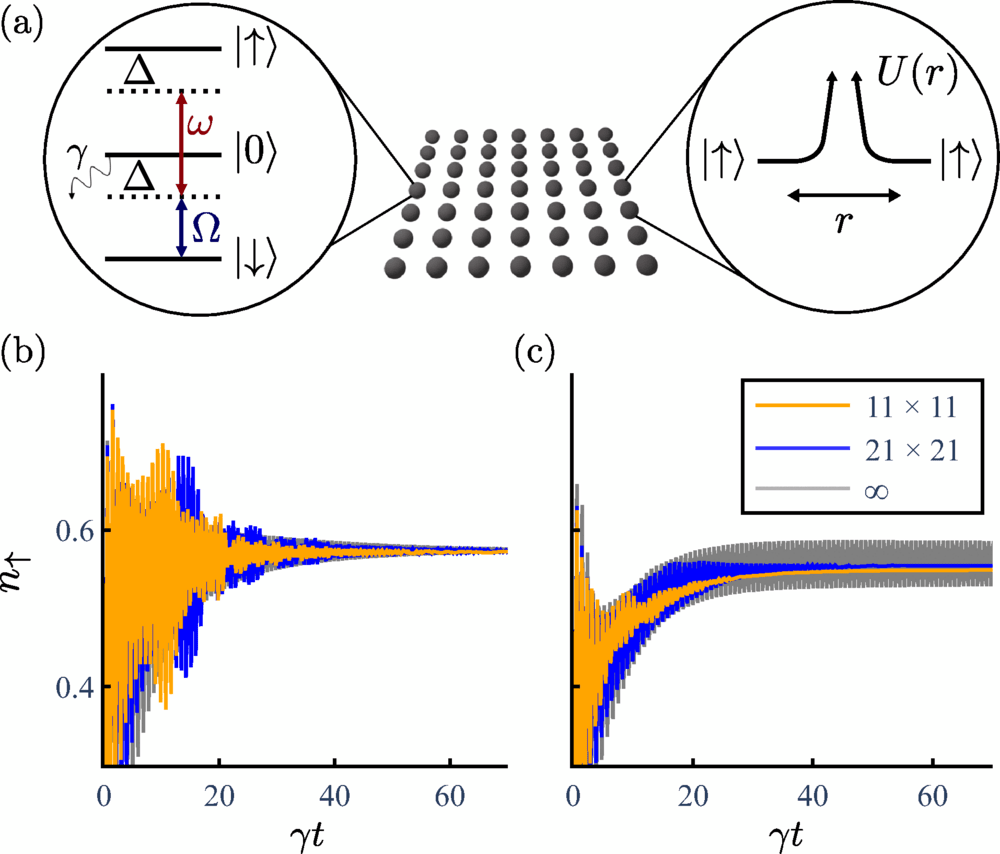
This configuration, referred to as a Rydberg atom array, is already a popular instrument in quantum laboratories. It has been utilized to investigate magnetism, entanglement, and even unusual phenomenaphases of matter. However, in this case, scientists searched for something more subtle: whether the system could enter a natural rhythm, fluctuating between states without external influence.
Energy escaping from the system was found to be significant. Rather than halting the pattern, this loss of energy contributed to maintaining equilibrium, resulting in recurring patterns of behavior.
Two Unexpected Phases
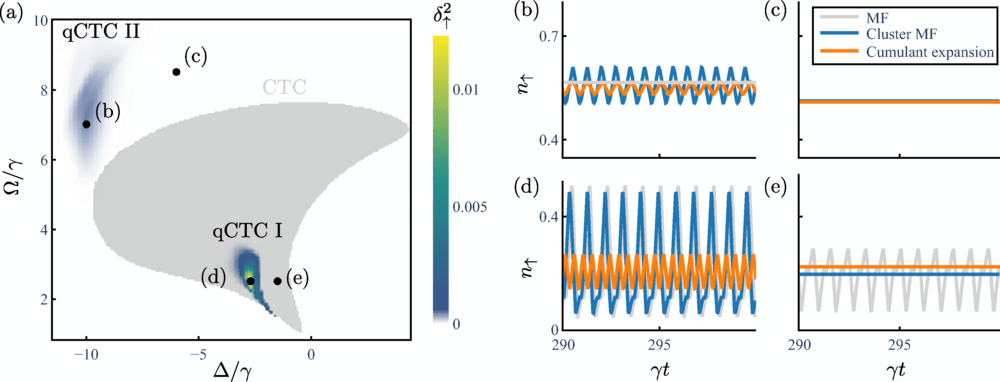
To determine if these cycles actually occurred, the researchers monitored how the population of excited particles evolved over time. The findings showed two distinct oscillating phases.
The first, named qCTC-I, resembled a traditional time crystal that had been adjusted forquantum effects. It aligned with previous theories but remained stable even after incorporating actual quantum fluctuations.
The second, qCTC-II, came as a complete surprise. It emerged solely due to quantum correlations—links between particles that cannot be accounted for by typical behavior. In this state, the pattern did not depend on long-range order. It represented something entirely new: a phase that exists only because of the strange principles of quantum mechanics.
Why Three States Matter
One unexpected discovery was that these time-crystal phases were only observed in systems having three particle states, referred to as spin-1 systems. In more straightforward spin-½ systems, which have just two levels, the phenomenon disappeared. This result implies that additional complexity might be necessary to create actual time crystals.
It also brings up new questions. Is having three levels the minimum required? Could other platforms, such as molecules orsolid-state materials, host similar time crystals? Scientists are now keen to examine these concepts.
Experiments on the Horizon
The most thrilling aspect is that this is not merely theoretical. The parameters applied in the models correspond to what can be achieved in present-day laboratories. As Rydberg atom experiments progress rapidly, researchers anticipate practical evaluations of qCTC-I and qCTC-II in the near future.
Since the qCTC-II phase inherently reduces energy loss, it may be particularly stable in real-world applications. This implies that researchers could observetime symmetrybreaking the play out in the lab, verifying that time can solidify through quantum effects by itself.
A Different Order of Materiality
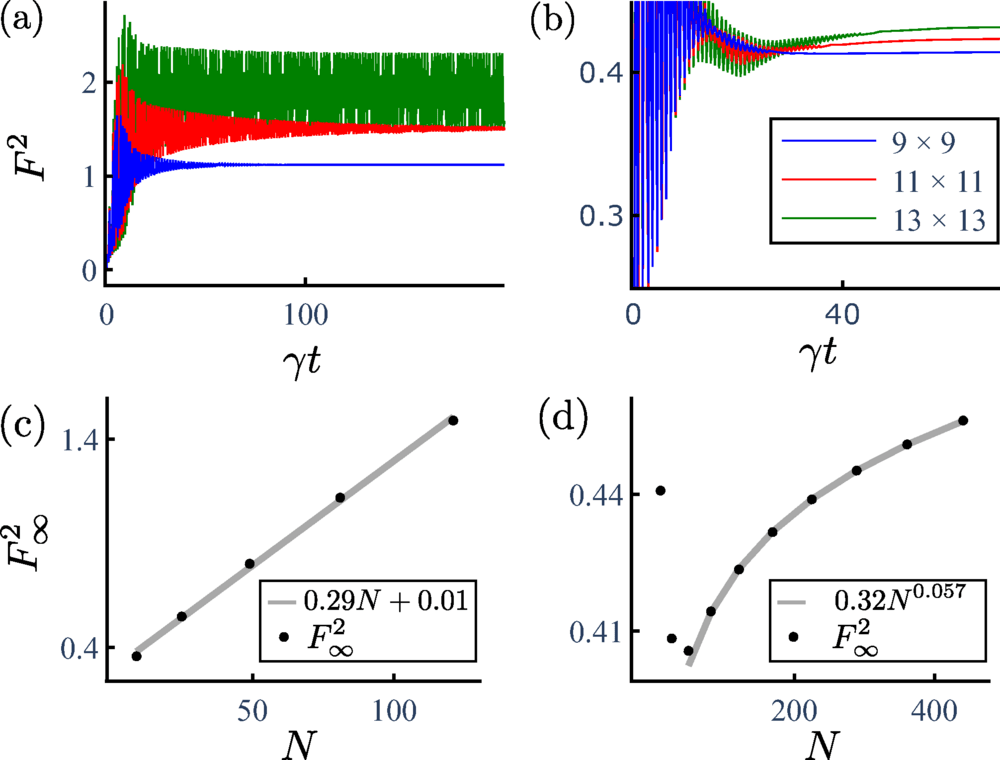
The identification of qCTC-II broadens the understanding of nonequilibrium matter, demonstrating that breaking time symmetry can be genuinely quantum in nature. It suggests potential new methods for quantum technology, including more accurate timekeeping devices and memory systems based on stable oscillations.
This offers a novel and unexpected perspective on the quantum mechanics of systems with multiple particles,” Russo stated. “The intricate quantum interactions among the particles lead to collective phenomena that cannot be understood by examining each particle individually.
Like smoke forming structured rings from a candle, time crystals demonstrate that pattern can arise spontaneously from disorder. Here, however, the pattern develops not through space but throughout time.flow of time.
Real-World Applications of the Study
The identification of two new continuous time crystals might change your perspective on time within quantum physics. These states could result in advancements in quantum computing, more accurate atomic clocks, and innovative methods for storing or transmitting data.
Since the effect is maintained through quantum correlations, it also serves as a novel method for investigating entanglement and dissipation, which are crucial for developing upcoming quantum technologies.
If verified through experimentation, these results may provide researchers with enhanced ability to manage systems that depend on long-lasting, self-sustaining oscillations.
Research results can be found online in the journalPhysical Review Letters.
Related Stories
・Time Crystals: A Novel Area in Quantum Physics
・New discovery in quantum physics allows researchers to reverse the direction of time
・Quantum networks may reveal the mysteries of time and gravity.
Like these types of uplifting stories? GetThe Positive Aspect of News’ newsletter.