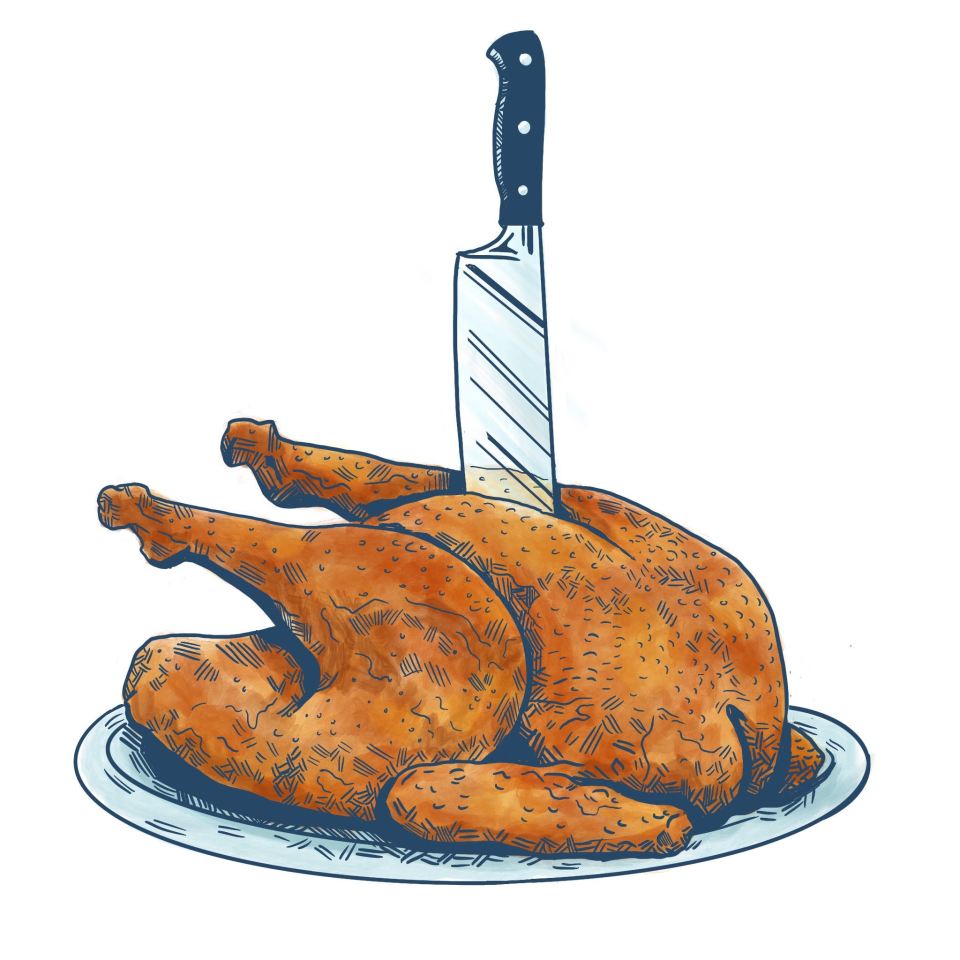
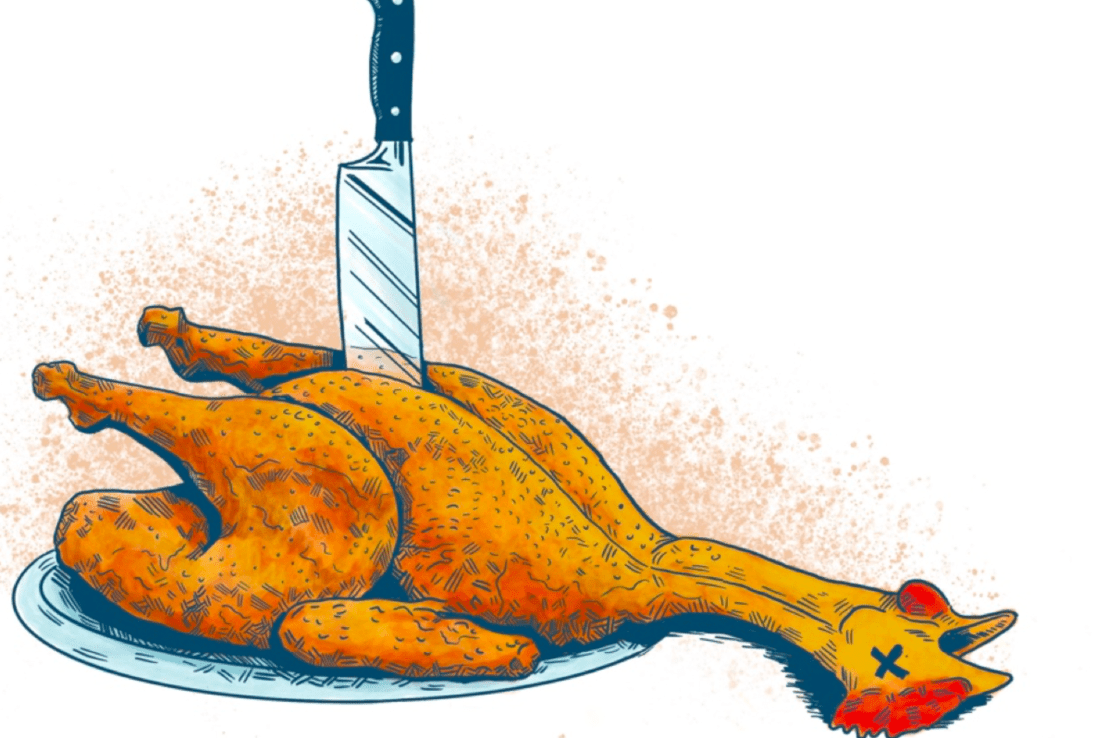
The ‘customer’ at the fried chicken restaurant didn’t eat his food. Rather, he took pictures of the kitchen door’s keypad and then left. “Corporate spy,” the cashier said, as he showed me three similar occurrences captured on his security cameras.
This is the first line of a proposal I received from a writer named Joseph Wales, titled “London’s Fried Chicken Wars: Espionage, Betrayal and Social Media Sabotage.”
Wales vowed that following “six weeks of secret investigation,” he would reveal the shadowy, often violent realm where temporary workers are actually spies from competing companies, social media accounts are frequently targeted by organized troll groups, and fake mystery shoppers place dead flies in rival stores.
These allegations, he stated, could be supported by Freedom of Information requests directed at local councils, screenshots from private WhatsApp groups, and police reports connecting chicken shops in Brixton to Tottenham with organized crime. He also asserted that, during his research, a restaurant manager gave him a napkin with a hastily written warning: “Be careful who you eat with.”
It’s the type of presentation that grabs you by the lapels. It offers everything: vibrant colors, memorable characters, and a strong sense of location. It explores a specific topic but relates to a broader audience. The only issue? It was entirely fictional.
It wasn’t long before red flags began to appear. Why would a restaurant manager write his threatening message on a napkin, where it could serve as proof, instead of just speaking it in a threatening manner? Wales stated he was in a branch of Chicken Cottage in Stratford – butthere is no Chicken Cottage located in StratfordThe more I examined the tale, the more ridiculous everything appeared.
I reviewed the pitch again and quickly noticed the clear indicators: numbered headings separated into bullet points. Key terms were highlighted in bold. Em dashes were used frequently. This was clearly created by AI. When I confronted him about it, Wales admitted to using AI in his pitch but promised me he would never use it to write or research his stories. I asked him to join a call, but there was no response.
Usually, at this stage, I would discard the pitch and proceed. However, there was something about Joseph Wales that kept bothering me, a sense that there was more to this tale. So I began investigating. And soon, this fake pitch about conflicting London chicken shops led me on a journey around the world, from East Africa to Chicago, uncovering a larger, more tragic narrative about the lives we live online. It’s a story about how AI is threatening people’s jobs—and how those individuals are using AI to resist. But above all, it’s about how AI is not onlychangingthe world: it’s also causing it to be identical, butmore.
Initially, I believed Joseph Wales was the antagonist in this tale, but as I discovered more, he started to appear as the story’s anti-hero, a man struggling and navigating through the challenges of a changing era. And, similar to all compelling thrillers, the true villain remained hidden until the last act.
Who is Joseph Wales?
So what was the situation with the pitch? My initial thought is what I’ve come to call the ‘Oobah Butler theory’: that the AI chicken shop story was intentionally inserted in order to make me appear foolish, for the sake of journalism! I can picture moon-faced gonzo journalist Butler, best known for promoting a fictional restaurant named The Shed (which was actually his parents’ shed) to the top of Tripadvisor’s list of top London restaurants, barely able to hide his smile as he explains to the camera how he deceived an unsuspecting editor into publishing his fabricated story.
But if it wasa joke, the person pulling the prank was executing a long-term plan: Wales has had a small online presence for years, including a portfolio and a website. His clippings consist of copywriting work covering financial advice (“Best Way to Invest 20k in 2025”) and pest control (“What does a bat bite look like?”). Some of his posts are, according to basic detection tools, partially written by AI. His WordPress site features a few unexceptional blog posts about SEO writing: “Imagine you could get your search traffic to hang on your every word…”
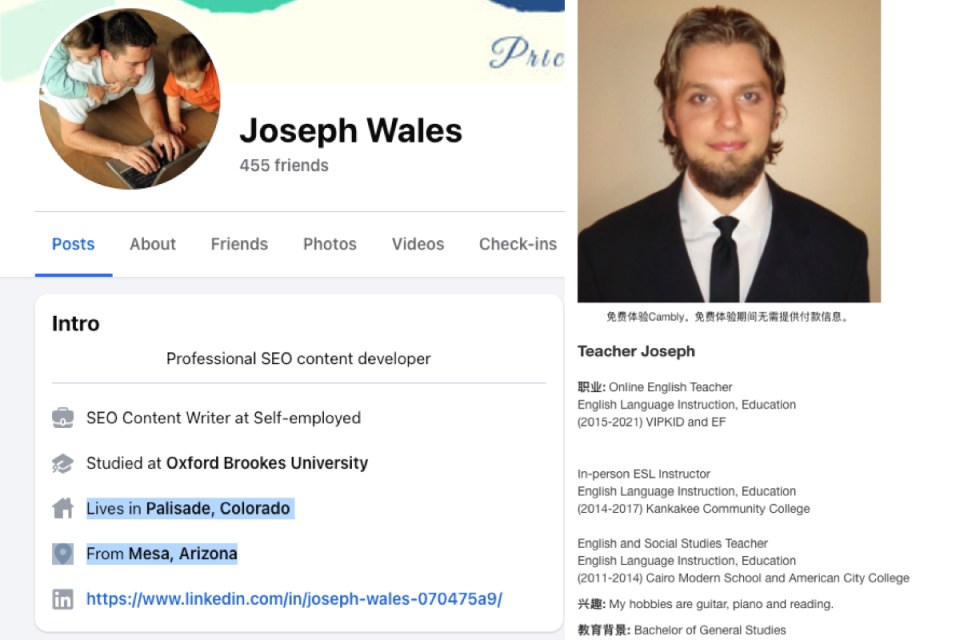
His resume indicates that he is currently located in Los Angeles and pursued business administration at Oxford Brookes University. A reverse image search of the headshot from his portfolio yields only one result: a profile on Cambly, a platform that connects language learners with tutors. He is listed as “Teacher Joseph,” and there’s a video showing a friendly, bearded white man with an American accent who claims to be “from Chicago in America.” Teacher Joseph apparently attended Cairo Modern School between 2011 and 2014, which conflicts with the dates.myJoseph claims he attended Oxford.
Joseph Wales’ email signature and curriculum vitae include two distinct American phone numbers: one is no longer in service, while the other simply rings without answer. The first number is associated with eastern Michigan, and the second is located 1,000 miles away in Bartlesville, Oklahoma. Links to his Discord and LinkedIn profiles are non-functional.
I continue to search and discover adifferentJoseph Wales on Facebook who is involved in SEO anddidGo to Oxford Brookes, but this one mentions he resides in Palisade, Colorado. A reverse image search for this Joseph leads to a stock photo that is frequently used across the internet. Fortunately, this Joseph is following several freelance writing networks that sometimes share my calls for writers.
After that, I check the references listed in his CV. Most of them are major international copywriting agencies, which I email with little expectation of a reply. One, however, stands out: the WayneGlance Writing Agency, which seems to have no online presence.
I’m about to end my day when I spot Joseph’s email address: “miminiwriter”. I search for “mimini” but find very little. I experiment with different combinations of those letters and “mimi ni” (with a space) offers a hint: it translates to “I am” in Swahili. “I am writer” aligns with another intriguing detail from his resume: a “professional affiliation” with the NCCK – the National Council of Churches of Kenya.
A search for “WayneGlance Kenya” leads me to a Kenyan job site that has a CV with the same wording as the resume ofmyJoseph Wales. It is owned by someone residing in Nairobi: I have located my person.
The Margaux Blanchard incident
I sent my findings to Wales, not to criticize him, but because I wasn’t certain who else would care. I’ve spent so much time trying to figure out who he is that I’m beginning to actually like him a bit. He’s definitely a con artist, but he knows how to present an idea well, and he could advise you on what to do if you find a snake’s nest on your land, which seems like a practical skill. He doesn’t respond.
As a trial, I inputChatGPTThe last few issues of this magazine and ask it to generate some features: it instantly produces two ideas that are disturbingly similar to stories I’ve been considering writing. I wonder how many proposals I’ve accepted that began in the digital mind of an AI.
I contacted several fellow editors and found that I wasn’t the only one getting pitches created by AI. A desk editor at a prominent British tabloid mentioned that “a blizzard” of AI-generated pitches “arrives with depressing inevitability.” She sent me a press release so bland it could not have been written by a human. None of the people I spoke to have received anything as bold as Joseph’s chicken shop pitch.
Then the journalist and broadcaster Sonya Barlow, with whom I had discussed this story, emailed me with the message “Might be of interest…” along with a link to an article in the Press Gazette: the now well-known Margaux Blanchard scandal, where AI-generated pitches evolved into AI-written articles that were published in reputable outlets such as Wired and Business Insider.
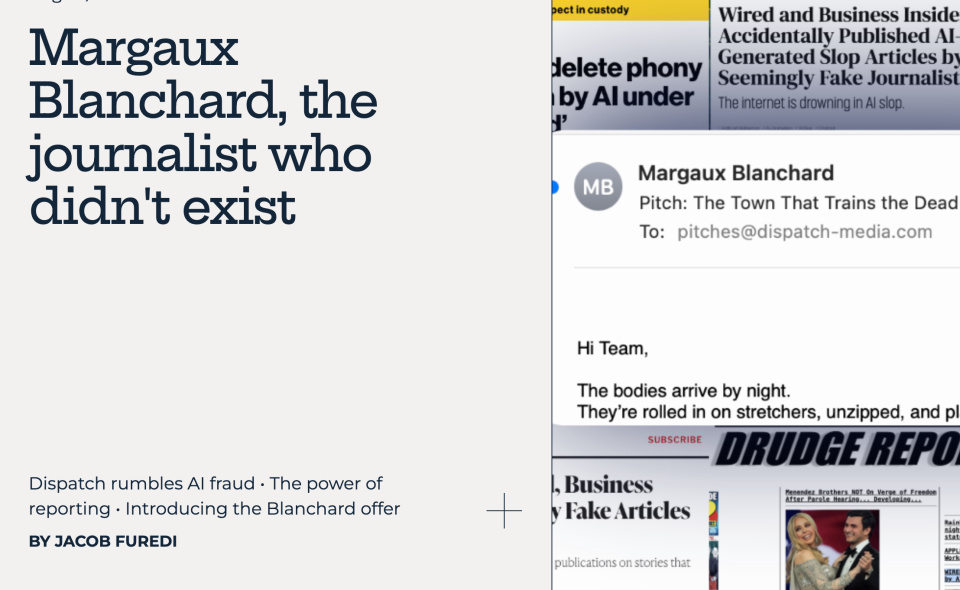
This was a shocking development for British journalism. Dispatch Media journalistJacob Furedi, the one who uncovered the story, had personally received a grim proposal from Blanchard regarding a closed-down mining town in Colorado named Gravemont, which she claimed was being utilized as an underground training site for forensic teams and emergency personnel.
The bodies come during the night,” was the pitch. “They are brought in on stretchers, opened up, and positioned in the fake apartments, classrooms, and bus stations.
Similar to my chicken shop story, it was a compelling offer. And just like my chicken shop story, it was completely made up by AI. Gravemont, Colorado isn’t real. However, unlike Joseph Wales, Blanchard seemed to be a credible journalist. She had written an engaging article for Wired about couples tying the knot within the Minecraft world (Wired had already taken down the article after becoming doubtful about the unusual method Blanchard used to request payment).
Meanwhile, Business Insider published two essays by Blanchard titled “Remote work has been the best thing for me as a parent but the worst as a person” and “I had my first child at 45. I’m financially secure and have years of life experience to rely on.” Her articles have also appeared in SF Gate and Index on Censorship magazine.
I look through my emails for “Margaux Blanchard” and experience a small surge of dopamine each time I find a match. There’s a pitch from June 21 titled London’s Silent Raves Are the New Status Gyms. “This article would explore the growing trend of silent dance parties that also serve as fitness sessions—taking place in parks, rooftops, and even beneath train arches—where attendees use wireless headphones and enjoy DJ-curated workouts together. It’s intense, spiritual, and very photogenic on Instagram. But here’s the twist: I would present it as the latest status symbol for those focused on wellness and dealing with burnout.”
This is the first time I’ve encountered a story that’s clearly an AI-generated delusion.
She volunteered to write 1,200 words “with that somewhat playful City AM style.” It’s a weak proposal – I’m a little envious she reserved her top concepts for other outlets – and if I had ever checked her email, I would have quickly dismissed it. I respond by saying I love it. She never replies.
I conduct further investigation. The headshot linked to Blanchard’s Gmail account – margauxblanchard414 – shows a woman in her fifties with a tidy bob. I’m nearly certain it’s a photo of the French-American writer Mireille Guiliano, who authored the 2004 book French Women Don’t Get Fat (as far as I know, she has absolutely no connection to this story).
“This is the first time I’ve come across a story that’s clearly what you’d term an AI hallucination,” Furedi told me later. The one thing neither of us can figure out is thewhyof it all. “I would really like to find out what the motivation is,” he says. “Business Insider doesn’t pay much for that kind of lifestyle opinion piece. There must be a simpler way to earn money.”
Furedi believes the main victims could be newer, younger freelance writers. “It’s clearly frustrating for editors and disrespectful to readers, but it’s a genuine pity for freelancers. There may be a tendency for editors to rely on people they are already familiar with and trust.”
I’m thinking about what all this signifies formyAI story when – record scratch – I receive a message from Joseph. “I was just going through your emails and I couldn’t stop smiling,” he says. I tell him I want to speak with him, and he asks why. I say I want to discover who he really is. “Okay, get ready for the truth!” he replies. “It’s about time I revealed this… You’re definitely going to be shocked… Of course, there’s a story behind everyone.” He ends with a winking emoji.
A lovely afternoon in Nairobi
It’s a magnificent afternoon in Nairobi. The sun shines brilliantly against the greenery of the garden where the man I’ve known as Joseph Wales is seated with three of his dogs – “I have so many dogs, bro” – all strong mixed-breed dogs that occasionally leap up to him for affection. In the background, I can spot low brick houses and lush tropical plants. This is the neighborhood where he resides with his wife and the two young girls he recently took to school. “They are quite beautiful,” he says proudly. “And they have my intelligence.”
After a few unsuccessful attempts and some tense discussions (I ultimately transferred him £20 from my own bank account as a “gesture”), we finally connected via Google Meet. It becomes immediately apparent that Wales is not the cheerful white man “from Chicago in America,” but rather a slender Black individual “born and raised” in Nairobi, the son of a Kenyan mother and a British father, who he claims works for the Kenyan air force. He speaks fluent English with a strong, warm accent. He is dressed in a tracksuit top and a black face mask, which he explains is to conceal a swollen lip from a recent car crash.
The first revelation is that his name isn’t Joseph Wales, but Wilson Kaharua. “I told you, I have a long story to tell!” he laughs. I ask him to begin from the beginning. He shares that he has always been fascinated by technology. As a child, he would read about phishing scams that came from Nigeria, which was years ahead of Kenya in terms of online culture, although he mentions he has never engaged in anything like that himself.

He pursued studies in economics and finance at Kenyatta University, which he refers to as “one of the top institutions in my country.” After graduating in 2011 – placing him in his early thirties – he took on a tutoring role assisting language students with essay writing, as well as working at several banks. However, he mentioned that “the pay was not sufficient,” prompting him to seek out international copywriting opportunities. One of his initial assignments was with a British firm that specialized in industrial lighting. The company’s owner, named Joseph, “helped me learn the basics. He was the one who showed me who I am… before I started learning on my own. I have a great deal of appreciation for him.”
When Joseph passed away from a brain tumor, Wilson adopted his name, believing that English language publications would feel more at ease with an English-sounding name. Why “Wales”? He simply enjoyed the way it sounded. The image he uses on his website was something he found online: “It was someone who looks somewhat like me,” he says (in fact, it would be difficult to imagine two people who look).less alike).
By 2015, Wilson was employed by several major copywriting agencies. The salary wasn’t impressive according to British standards but it stretched well in Nairobi. “I was earning a decent amount,” he mentions. Most of his work was published without a credit, but some—such as the pest control articles—were attributed to “Joseph Wales.”
I asked how he was able to get paid when his byline didn’t match his bank account. “That’s very simple,” he laughs. He explains that some companies paid him in cryptocurrency, but for the others, he simply purchased a fake driver’s license from the dark web and set up a PayPal account under the name Joseph Wales. I asked about the American phone number on his resume: he said he pays $3.99 per month for it and it forwards to his phone in Kenya.
Wilson Kaharua was experiencing success. Funds were coming in and his alternate identity, Joseph Wales, had everyone deceived. However, in 2023, everything fell apart in this meticulously built life: “AI replaced us.”
Suddenly, there was no longer a need to pay individuals like Wilson to write about bat bites and snake nests — AI can accomplish this for free in a few seconds. So what is one supposed to do now? “I don’t like AI, but I’ve started studying it every day,” he says. “You have to work with it because it’s here to stay and we can’t do anything about it.”
Wilson paid for a subscription to a service that would notify him about pitch opportunities: callouts similar to the one I posted on X seeking “big, bold, fun, weird” concepts. With the help of DeepSeek, Wilson created a proposal that would be ideal for this publication. “If you weren’t smart enough, it would have worked,” he says practically. “I have to try. I’m not a fraud, I’m just doing what I need to do to get by.”
I wonder if he ever considers the legal consequences of this arrangement, but he shifts the topic. After all, it’s the magazine that would face a lawsuit, not him. He is vague about how many publications he has sent AI-generated pitches to, but he strongly insists that his actions aren’t harmful. He argues that if I had commissioned the chicken shop article, he would have done online research and written it to the best of his ability. He mentions having relatives in London who could have visited the chicken shops. However, I point out that the places he mentioned didn’t exist. The story wasn’t real.real. Wilson appears unfazed. “I’m not a bad person,” he says with a shrug.
This feeling is somewhat weakened by a link he sent me to a story that was published the morning we talked, which he himself admits is “pure fiction.” It’s an essay titledThe Skip That Created a Family: How a Damaged Led Zeppelin Album Taught Me to Appreciate Flaws, published on a website named I Have That On Vinyl. Byline: Joseph Wales. It’s a nostalgic tale about listening to a Led Zeppelin record with his father, where the record skipped at a particular moment in the song, and how that skip became an essential part of the music for his family, resulting in a lifelong fascination with flawed vinyl records.
The narrative exhibits several indicators of AI-generated content – such as em dashes, bullet points, and emphasized words – yet it also features some truly elegant expressions. It portrays a water-damaged version of Pet Sounds, where the warping slows down “Wouldn’t It Be Nice” just enough to give the teenage romance the feel of a middle-aged recollection.
It details how his “friend’s” Nashville basement studio “had the smell of old electronics and cheap bourbon” and remembers the author spending $200 on a clean Mobile Fidelity Sound Lab reissue. In no way could this be the work of someone with a good but not perfect understanding of English who resides on the outskirts of Nairobi.
Domo arigato Mr. Roboto
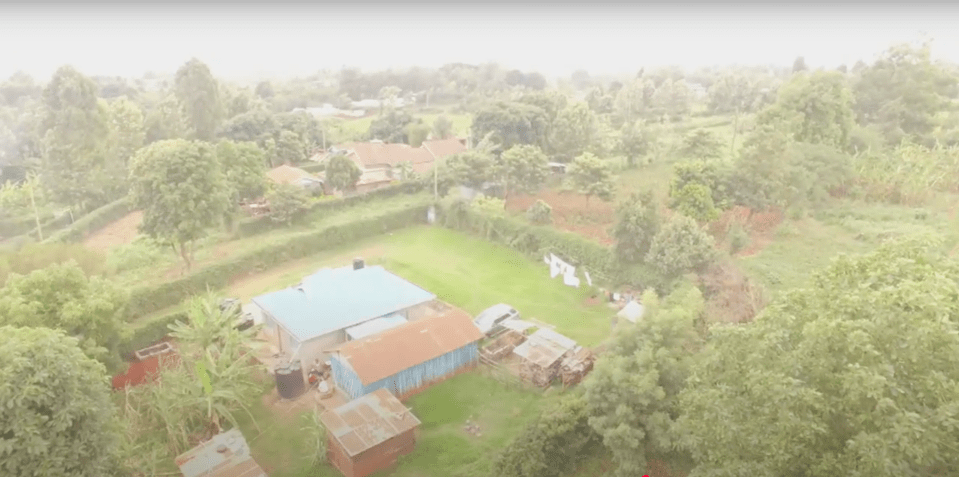
Wilson and I conclude our call on positive terms. He shows me some YouTube videos he created eight years ago, featuring drone footage of his village set to a hip-hop soundtrack, and invites me to stay with him if I ever visit Nairobi. Nevertheless, I’m still uncertain whether anything he said is genuine or if all of this has been a huge waste of time.
But there is another character in this story. While I was reviewing Joseph Wales’ references, IdidReceive a response from Loud Interactive, an SEO agency located in Chicago. “Hello, possibly an unusual email, but I’m a journalist in the UK and a person named Joseph Wales has listed you on his resume as an employer,” I wrote. “I don’t believe he is based in the US, and I’m fairly certain the story he submitted to me was created by AI – I wanted to confirm if he was actually employed by you as an SEO copywriter… I hope you can assist!” Within an hour, I got a reply – from the founder himself.
Let me present to you Brent D Payne, a confident individual who isn’t shy about promoting himself. His confusing website is organized under subheadings that include statements like “Brent D Payne is an SEO pioneer.” There’s a part that outlines his “journey” from Oregon to California to Chicago. Even during the early days of web 1.0, Brent claims he “had a vision for the internet’s future, which is similar to his current vision for AI’s future.”

I found it enjoyable to research Brent. He often @ people such as Elon Musk on X. His followers consist of Barack Obama along with a few mutuals of mine. He was once referenced in a New York Times article about a conflict he had with Google. He’s the type of person who is likely quite influential but believes he’s significantly more so.biggeragreement. The first line of his email to me – no “hello” – says: “We had more than 600 stay-at-home mothers and fathers working for us then. I let them all go and substituted them with [a] AI solution I developed over the last two years. Handling AIs is much simpler and more reliable than dealing with people.”
He then posted a link to a blog article from December 2024 discussing the termination of all those parents, which he claims was also created by AI. He concludes with: “I am not surprised that someone we hired might be attempting to present something as original when it was actually generated by AI. There are many unscrupulous writers out there. I’m not saying he is or isn’t one of them, but…”
I’m somewhat surprised. Most founders are careful when speaking with reporters and very few respond when someone from another country reaches out using the generic email address listed on their website.
I read his blog post and it is… quite an experience. “Yesterday morning, while making ‘roll-ups’ for my family,”Mr. Roboto by Styxcame on through our HomePods,” it starts. “Do you know that feeling when a song perfectly matches your emotions and thoughts at the perfect moment in life? There I was, holding a crepe in one hand and a spatula in the other, singing ‘Domo arigato [‘thank you’ in Japanese], Mr. Roboto…’ when an idea came to me: how appropriate this song was for what we at Loud Interactive had just achieved.
Play Video
Mr. Roboto, for those unfamiliar with 1980s synth rock, is a track from Styx’s eleventh studio album, Kilroy Was Here. The song follows a cyborg—neither human nor machine—as he tries to find his place in a world of people, touching on themes of isolation and the desire for connection. I don’t believe it’s as pro-robot as Brent suggests. It goes:
You’re questioning my identity /
Machine or mannequin? /
With components manufactured in Japan /
I am a contemporary individual /
…
The issue is clearly visible /
Too much technology /
Machines that can preserve our lives /
Machines dehumanize
The choice wasn’t easy,” Brent continues, “after all, we let go of 600 part-time, stay-at-home parents who had been with us for more than ten years. But when I reflect on it in the context of that Styx song, it seems like a natural evolution. It’s a point where technology takes over from human effort… Domo arigato, Mr. Roboto kept playing in my mind as I made breakfast, serving crepes, and singing along.
Here’s a rephrased version of your text: It’s quite a scene: the tech entrepreneur in his stylish kitchen humming to existential 80s dance-rock while a group of parents begin to update their resumes with a somber attitude. This, if I might say so, is a poorly written blog post. Maybe he should have retained one or two of them.
Thanks for your response,” I reply, “and it’s fair – this isn’t an anti-AI story, but rather one about how AI is transforming the way people and traditional media operate. As an editor, these are issues I’m currently dealing with, although I don’t enjoy the thought of being completely replaced by a group of LLMs! Have you ever felt sorry for letting go of the 600 people? Also, is there any way to find out if Joseph Wales was one of them?
Brent, clearly enjoying a calm afternoon, responds right away. “No regrets. Our tool produces much better results.” He then lists all the capabilities of his custom AI before reassuring me that “Journalism is secure. Stay-at-home moms and dads who do speculative writing… they’re outdated. Joseph Wales falls into that group. Joseph worked for us. He wasn’t in our top 10% for output volume or quality. So, I never had direct contact with him. But he did a lot of speculative writing for us and for many years. I have no idea if it was any good.”
So Joseph – or, more precisely, Wilson –didWork for Brent. His resumeisn’tcompletely made up. I tend to think he is being truthful about most of the other things he shared with me, although there’s no way to confirm it.
A massive mass of imagined debris A large clump of delusional waste A thick pile of hallucinatory sludge A substantial chunk of surreal filth A heavy accumulation of fictitious grime A considerable heap of illusory muck A dense collection of phantom refuse A substantial buildup of imagined trash A heavy mass of hallucinated garbage A large accumulation of delusional slop
As an editor, I certainly can’t support using AI to create fictional proposals, particularly if you intend to submit them tome. The last thing we require is additional individuals contributing to the expanding mass of fabricated nonsense that increasingly constitutes a greater share of the internet (some sources indicate that as much as 90 percent of new online material might be AI-generated by 2026, though this figure could also have been created by AI for all I can tell).
But I find it amusing that individuals who have lost their jobs due to AI are now using those same tools to get back into the workforce through an unconventional route, potentially creating a bizarre cycle of distorted content, pieces of real life mixed together and rearranged, an endless stream of poorly made cars coming out of countless questionable workshops.
The undeniable reality is that AI is here. It will transform nearly every sector, disrupt and destabilize us all, and shake the system thoroughly without much concern for what might spill out from its pockets. And, as is often the case, it will begin at the lowest level and move upward. I don’t believe what Brent did is inherently wrong, although I could do without the triumphant attitude and all the ‘Domo arigato, Mr. Roboto’ garbage.
Given everything, I can understand why someone like Wilson might choose to finally follow the example of those Nigerians he had read about for so many years. He is intelligent, capable, and charming, but at risk of being completely left behind, his way of life destroyed by a wave that he could never hope to survive. It could have been me, or you, or any of us.