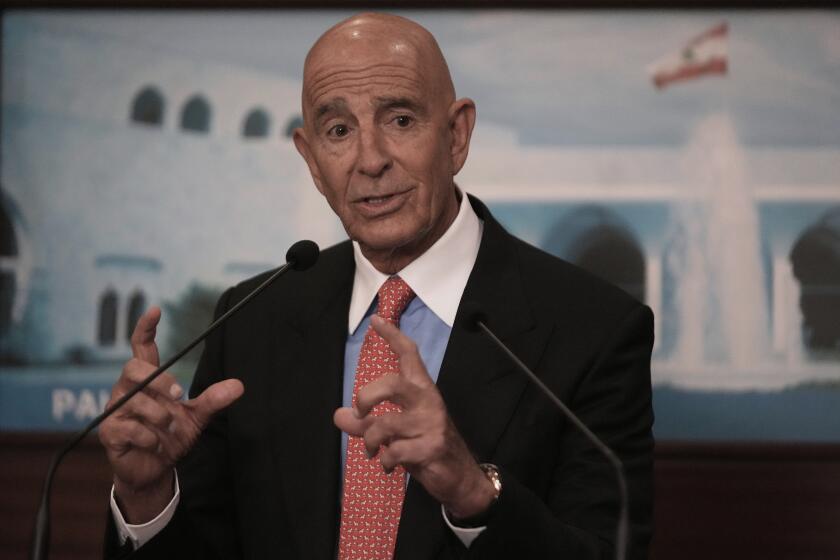
Saudi Arabia and Qatar are prepared to fund an economic zone in southern Lebanon, close to the border with Israel, which would generate employment opportunities for Hezbollah members and their allies if they cease hostilities, according to a representative of President Trump in the Middle East on Tuesday.
Tom Barrack expressed his remarks in Beirut following visits to Israel and Syria, where he engaged in discussions with officials regarding the current circumstances in Lebanon after the government’s decision this month to disband Hezbollah by year’s end. The leader of Hezbollah opposed the government’s proposal, promising to retain their arms.
On Monday, Israeli Prime Minister Benjamin Netanyahu stated that Israeli troops might start pulling out from areas under their control in southern Lebanon following the Lebanese government’s “significant” move to disband Hezbollah.
A plan by the U.S.-supported Lebanese military aimed at disarming Hezbollah is being developed and is expected to be finalized by the end of August. The government is set to review and endorse the military’s proposal during a meeting scheduled for September 2.
We need funds to flow into the system. The money will come from the Gulf,” Barrack said to reporters following a meeting with President Joseph Aoun. “Qatar and Saudi Arabia are allies and are ready to do so for the south (of Lebanon) if we ask a part of the Lebanese population to sacrifice their way of life.
“We have 40,000 individuals who are being funded by Iran to engage in combat. What’s your plan for them? Take their weapons and then tell them ‘by the way, good luck growing olive trees’? That’s not feasible. We need to support them,” Barrack stated. He was talking about tens of thousands of Hezbollah members who have received financial backing from Tehran since the early 1980s.
“All of us, the Gulf, the U.S., and the Lebanese will collaborate to establish an economic forum that will generate a means of living,” Barrack stated.
When questioned about why the U.S. doesn’t directly address the Hezbollah matter with Iran instead of going to Israel and Syria, Barrack responded, “You think that’s not already happening? Goodbye.” After that, Barrack concluded his press conference and left the room.
Discussing the U.N. peacekeeping mission that has been stationed in southern Lebanon since Israel’s initial invasion of the country in 1978, Barack mentioned that the U.S. prefers to support the Lebanese army over the force known as UNIFIL. Commenting on this week’s vote at the United Nations in New York, Barack stated that the U.S. supports renewing UNIFIL’s mandate for just one year.
War broke out in September 2024, prior to the November ceasefire.
A minor clash between Israel and Hezbollah began one day following the Hamas-led assault on Israel from Gaza on October 7, 2023, as Hezbollah initiated rocket attacks across the border to back its Palestinian ally. The tension escalated into a full-scale war in September 2024, resulting in over 4,000 fatalities and causing damage valued at $11 billion in Lebanon, as reported by the World Bank.
The conflict concluded in November through a U.S.-mediated truce, and since then, Hezbollah claims it has withdrawn from the border region. Israel has maintained nearly daily air strikes that have resulted in the deaths of numerous Hezbollah fighters.
Amnesty International, in a report published on Tuesday, stated that it has found over 10,000 structures that were “severely damaged or destroyed” in southern Lebanon from October 2024 to January of this year.
Israeli troops stayed in a significant portion of the border region for several weeks following the ceasefire and continue to control five key locations.
Amnesty’s report claimed that Israeli forces might have breached international law by demolishing civilian structures in regions they were managing using “manually placed explosives and bulldozers” following the cessation of active combat, when there was no longer a “pressing military need.”
Barrack criticizes reporters prior to a press briefing, sparking anger
At the beginning of the joint press briefing with U.S. representative Morgan Ortagus, Barrack instructed journalists at the presidential palace to remain silent, urging them to “be polite, be kind, be tolerant.” He warned that the briefing would conclude prematurely if they did not comply.
The instant this turns into chaos, like something wild, we’re out,” said Barrack. He then questioned: “Do you believe this is economically advantageous for Morgan and me to stay here enduring this madness?
None of the journalists in attendance replied to his remarks, but the Lebanese Press Syndicate released a statement regarding the “inappropriate treatment” that local journalists endured and urged Barrack and the State Department to issue an apology. It noted that failure to do so could lead to further action, including organizing a boycott of Barrack’s visits and meetings.
The official residence also released a statement expressing disappointment over the remarks made by “one of our visitors” and acknowledged the journalists who report news at the palace, appreciating their “dedicated efforts.”
Mroue and Chehayeb are contributors to the Associated Press. The report included input from AP journalist Abby Sewell.
This narrative first was published inLos Angeles Times.