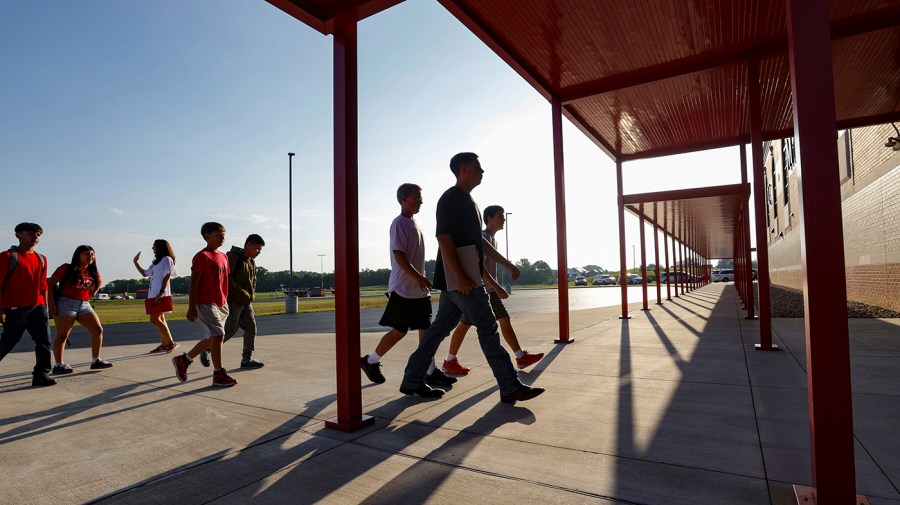
K-12 enrollment is decreasing due to a mix of factors includingdropping birth rates and more school choice optionsplacing schools in a difficult situation.
The public school system is projected to experience a decline of millions of students within the next five years, which will have financial implications and could result in the closure of additional school districts. Strategies to address this issue are limited, as experts suggest that schools will need to consider alternative approaches.reducing activities or facing competition with other educational institutions.
Between fall 2019 and fall 2023, there was a 2.5 percent decrease in student enrollment, affecting more than a million children in the K-12 system. The National Center for Education Statistics (NCES) forecasts that enrollment will decline from 51 million in 2019 to 47 million by 2031.
The primary factors causing this decrease are mostly beyond the influence of a school district, such as falling birth rates and movements away from specific states.
“We think the main reason is probably because the U.S. birth rate is currently at historic lows, meaning fewer children are being born to enter the public school system. We definitely see this with significant declines in kindergarten and first grade enrollment over the past few years,” said Tara Moon, a policy analyst at Future Ed.
The Centers for Disease Control and Prevention discoveredthe fertility ratehas decreased by 2 percent each year from 2014 to 2020. In 2022, ahistoric low occurredwhen the number of births decreased by 3 percent.
Another issue for certain areas is households relocating from California and New York toplaces like Florida.
Furthermore, we observe many families in states such as New York and California moving from high-cost urban areas to more affordable regions outside the city,” Moon stated. “In the past, immigration has helped counter these decreasing birth rates, but projections indicate it may not be sufficient to prevent the drop in enrollment.
But other elements may fall under a school’s influence, such as studentsdeparting from the public education systemfor alternative educational choices.
Since COVID-19, the interest in homeschooling and private schooloptions have expanded significantly, particularly as states enact laws that simplify the process for students to attend different schools and divert some funds from public school systems to facilitate this.
Information from the John Hopkins Institute for Education Policy’s Homeschool Research LabfoundNinety percent of states that monitor homeschooling numbers reported a rise in enrollment during the 2022-2023 academic year, contrary to expectations that it would decrease following the peak of the pandemic.
It’s crucial to examine the role that private school choice initiatives are having in this scenario,” said Carrie Hahnel, a senior associate partner at Bellwether. “There has been a notable rise in education savings accounts throughout the country,
“According to Bellwether, approximately 40 percent of K-12 students currently have access to an ESA or voucher. These types of programs could not only shift students from traditional public schools to private alternatives, but also have the potential to impact overall public education funding,” she added.
Decreasing enrollment typically does not signal positive outcomes for school districts, which depend on strong enrollment figures for financial support. One result of this decline has been the closing of schools, as the Reason Foundation reported data from 15 states indicating 98 school closures during the 2023-2024 academic year.
Other methods schools have used to reduce expenses include eliminating courses and roles.
“So, in essence, when considering declining enrollment per student, it really means fewer resources, less support, and fewer opportunities for children,” said Lin Johnson, the chief strategy, growth, and finance officer at TNTP, an organization dedicated to enhancing the public education system.
So, as these numbers decrease, funding decreases, leading to fewer teachers and larger class sizes,” Johnson continued. “It means a reduction in the support systems we value, such as arts and additional extracurricular sports, which our young people genuinely benefit from.
While some schools may have to downsizeExperts suggest that this is not always negative. The issue may arise from state requirements when attempting to establish a school that caters to a limited number of students.
Often, the state dictates to districts and schools precisely how to allocate their funds, requiring one person to handle this task and half a person for that,” said Matthew Joseph, senior policy advisor for education funding at ExcelinEd. “When you have 10 percent fewer students and only need 75 percent of the chemistry classes, but are still instructed to hire the same number of people, that’s the challenge.
Another example is that they would need one fewer teacher,” Joseph continued. “If the state tells them, well, now you have to, instead of looking for the teacher you don’t need, or the one who isn’t providing the best service, you have to let go of the people you hired first, most recently, who are the least experienced teachers,
He stated, “Therefore, rather than possibly eliminating one individual who earns a higher salary, you might end up having to let go of three people, which means the school will have three fewer staff members instead of just one.”
Copyright 2025 Nexstar Media, Inc. All rights reserved. This content cannot be published, aired, altered, or shared again.
For the most recent updates on news, weather, sports, and live video streaming, visit DC News Now | DC, Virginia, Maryland News, Weather, Traffic, Sports Live.