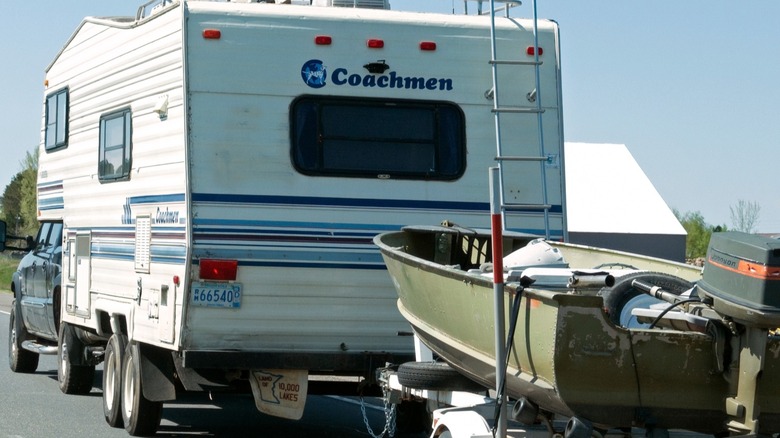
So, you’re planning a camping trip, which means you’ll have to bring your camper trailer. However, you’ll be fishing during your stay, which means you’ll also need to tow your boat. Now, you’re faced with a problem. Or is there a solution? The idea comes to mind: Why not simply tow your boat behind your camper?
This method is referred to as “double towing” or “triple towing,” which involves pulling two trailers simultaneously, and it’s commonly done. However, before you begin attaching your boat trailer to your camper, it’s wise to verify the regulations first. The legality of double towing may vary depending on your location.
If you’re looking to tow more than one trailer, the East Coast might not be the best place for it. Double towing for recreational purposes is against the law in all eastern coastal states, ranging from Maine to Florida, with the exception of Maryland (you’re a bit of a rule-breaker, Maryland). It’s also prohibited in Washington, Oregon, and Hawaii. Certain states, such as Florida, provide exceptions for commercial vehicles, provided they remain on specific highways. North Carolina has comparable regulations, permitting double towing exclusively on the National Network highways. Virginia allows double towing only through a special permit and lets individual cities establish their own restrictions. In fact, federal law mandates that every state must permit twin-trailer commercial vehicles on the federal highway network, as long as the total length doesn’t exceed 65 feet.GVWR, or gross vehicle weight rating, of 80,000 pounds.
A total of 20 states have laws that ban recreational double towing. These states, listed in alphabetical order, are: Alabama, Connecticut, Delaware, Florida, Georgia, Hawaii, Maine, Massachusetts, New Hampshire, New Jersey, New York, North Carolina, Oregon, Pennsylvania, Rhode Island, South Carolina, Vermont, Virginia, Washington, and West Virginia.
Read more: Protect Your Engine: 5 Strategies to Avoid and Remove Carbon Deposits
There Are Guidelines for Double Towing Even if It Is Permitted
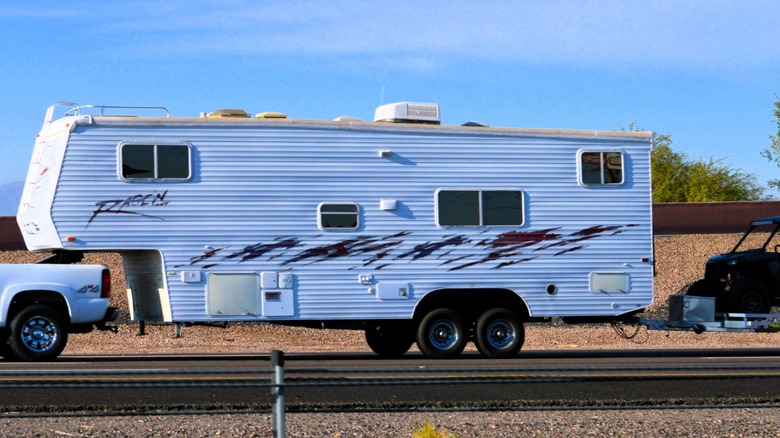
Some states that allow double towing typically have specific regulations. For instance, there are usually limitations on the weight of the vehicles being towed, the total length of your vehicle combination, the weight of the towing vehicle, the highways where double towing is permitted, and even the type of vehicle that can be towed on the second trailer. In Illinois, for example, the total bumper-to-bumper length of a double tow configuration is restricted to 60 feet, and it is not allowed to tow two full-size campers simultaneously. The second trailer must be a boat, jet skis, ATVs, or a similar type of vehicle. Michigan law also states that the rear trailer cannot be heavier than the tow truck or the other trailer, similar to Illinois. California requires that any vehicle towing two trailers must weigh at least 4,000 pounds when empty. You can certainly findstopped if your trailer setup is not safe or correctly.
It’s not only state laws that you should check. Municipalities and other local areas can also establish their own rules regarding double towing. Additionally, the federal government has imposed a weight limit of 80,000 pounds on interstate highways.
Ensure You Possess the Correct Gear and Abilities for Double Towing
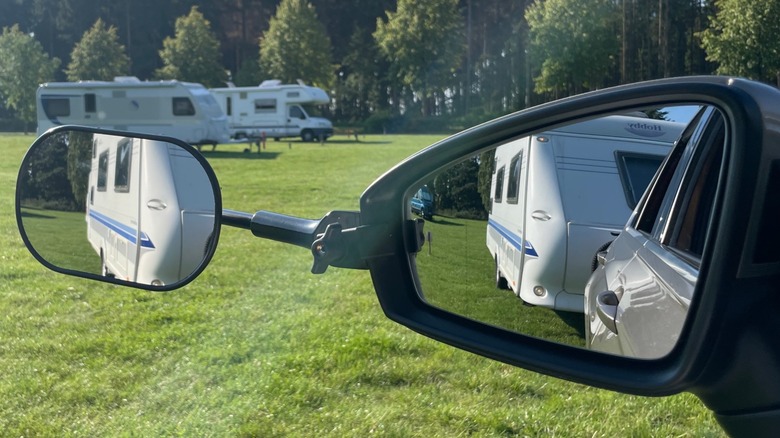
If you intend to pull your boat or ATVs behind your camper, this is not the moment for makeshift solutions. Proper gear is necessary even for single towing.here’s what you should be aware of), which is even more crucial when towing two trailers. Indeed, specific equipment is often required by state regulations. For instance, Illinois mandates that all vehicles involved in double towing have brakes, no matter their weight. Michigan requires the towing vehicle to have a fifth wheel. Kansas stipulates that the first trailer must have an anti-sway device and the second trailer must be equipped with an active braking system. You should also ensure you have the necessary lighting for the state you will be traveling through. Mirrors that allow visibility of both trailers are also essential.
Towing two vehicles isn’t recommended for those new to towing. There are more potential issues compared to pulling just one, so it’s advisable to have significant experience with single towing before trying to tow a second vehicle. Double towing setups are less stable and can roll over more readily, particularly when oversteering occurs. This phenomenon is known as the “crack-the-whip” effect. These combinations also require a longer distance to come to a stop, especially at higher speeds. For instance, stopping at 40 mph takes four times longer than at 20 mph. What about reversing? Avoid it! It’s best to detach the second trailer before maneuvering in reverse.
Security is key when pulling two trailers. You should also review the regulations in the state or states you’ll be driving through. With the proper knowledge and abilities, you should be able to reach your campsite safely (or in three parts, if you’re being technical).
Want more like this? Join the Jalopnik newsletterto receive the newest automotive updates directly in your email…
Read the original article on Jalopnik.