For decades, nuclear fusion has been hailed as the holy grail of energy—a clean, powerful, and virtually inexhaustible source. The conventional approach to fusion involves colossal machines designed to replicate the conditions at the heart of the sun, subjecting plasma to immense heat and pressure. However, a team of researchers at the University of British Columbia (UBC) has pioneered a radically different method, one that can be executed on a standard laboratory bench.
Their innovative experiment, detailed in a recent publication, utilizes a compact, room-temperature fusion reactor. While not yet geared for large-scale energy production, the primary focus is on refining the fusion process itself by significantly increasing the density of deuterium, a heavy isotope of hydrogen employed as fuel.
The UBC team has developed a unique technique that combines plasma field loading with electrochemical loading. This dual approach enables them to concentrate deuterium within a solid metal target composed of palladium. The higher the concentration of deuterium within the metal, the greater the probability of deuterium atoms colliding and fusing, thereby releasing energy.
Professor Curtis P. Berlinguette, a Distinguished University Scholar at UBC and the project’s principal investigator, explains, “The objective is to maximize fuel density and the likelihood of deuterium-deuterium collisions, leading to an increased number of fusion events.”
A Simplified Approach to Fusion
The simplicity of this approach is what sets it apart. Instead of requiring massive and expensive infrastructure, the researchers used a mere single volt of electricity to force deuterium into the metal. This achieved a compression level that would typically require pressures 800 times greater than Earth’s atmospheric pressure.
Inside the Thunderbird Reactor
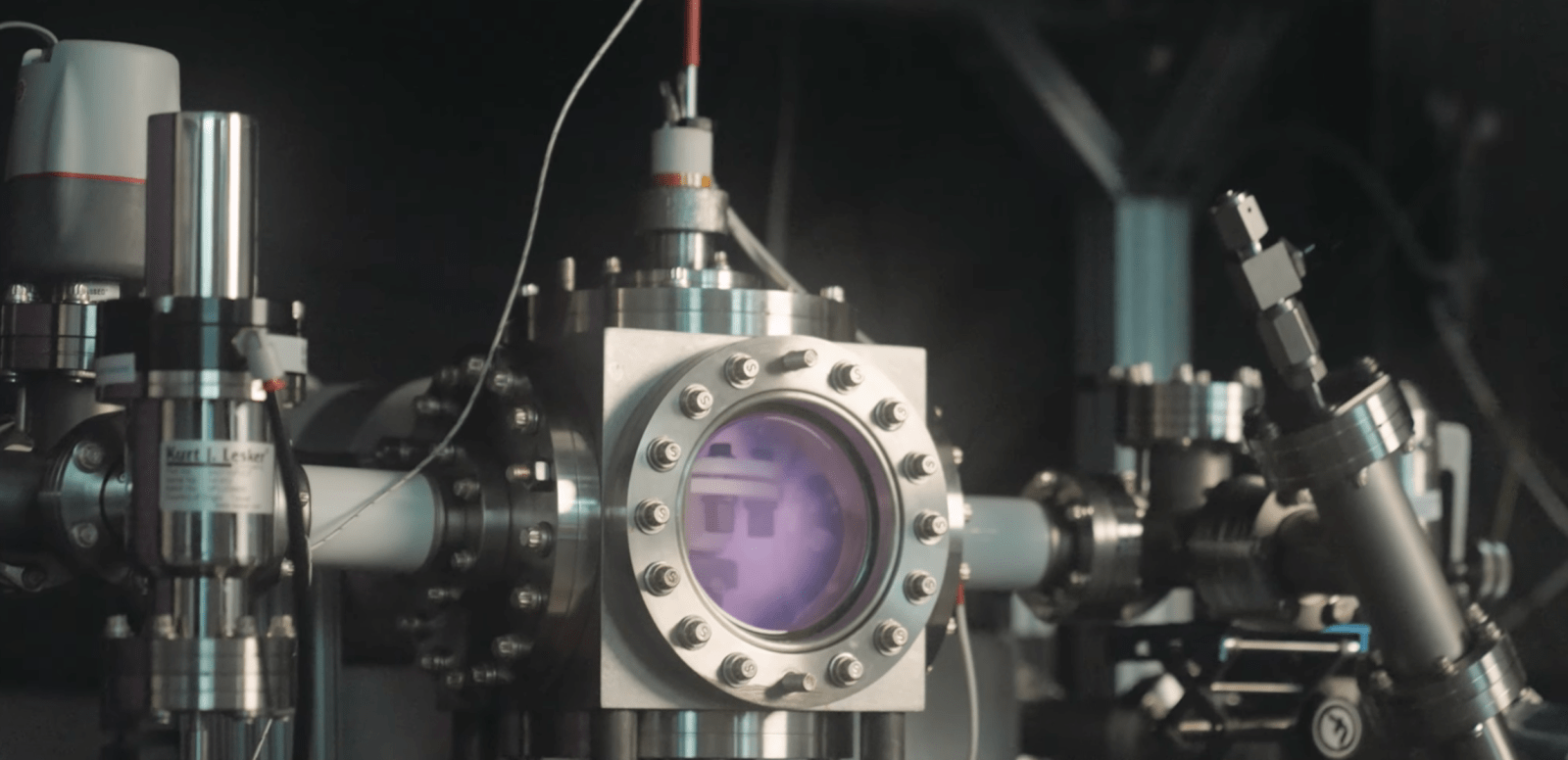
Their custom-built device, aptly named the Thunderbird Reactor, may appear unassuming, but it incorporates several key innovations. The reactor comprises three essential components:
- A plasma thruster: This component injects high-energy ions into the metal target.
- A vacuum chamber: This maintains the necessary environment for the fusion process.
- An electrochemical cell: This applies a controlled voltage to further drive deuterium atoms into the target.
Each element plays a crucial role in maximizing the loading of deuterium into the palladium target. The dual loading method results in a higher local fuel concentration than previously achievable.
Testing of this approach revealed a 15% increase in fusion rates compared to using the plasma method alone. While this figure may seem modest, it represents a significant advancement in experimental fusion. It validates the concept and demonstrates how fusion can be improved through previously unexplored methods.
“Using electrochemistry, we were able to load significantly more deuterium into the metal—akin to saturating a sponge with fuel,” Berlinguette notes. “Although we didn’t achieve net energy gain, the approach enhanced fusion rates in a manner that other researchers can replicate and build upon.”
Notably, the team did not measure heat or energy output. Instead, they concentrated on detecting definitive nuclear evidence of fusion—neutrons. These subatomic particles serve as a direct indicator of fusion events, unlike heat, which can be ambiguous and potentially caused by chemical reactions.
Building on a Legacy of Discovery
The science of fusion is not new. The first successful deuterium-deuterium (D-D) fusion experiment dates back to 1934. In those early experiments, scientists bombarded metal targets coated with deuterium with high-energy ions, establishing the foundation for modern fusion research.
The field experienced a significant controversy in 1989, when two researchers claimed to have achieved “cold fusion” by passing deuterium oxide through a palladium electrode and detecting unusual heat output. However, the claim was quickly discredited when other scientists failed to reproduce the results. Cold fusion became a controversial subject in mainstream science.
Despite the setbacks, interest in fusion never completely waned. In 2015, a research group supported by Google formed a peer group to reinvestigate cold fusion under rigorous, contemporary conditions. While they found no evidence to support the original cold fusion claims, they identified promising areas for further investigation.
Berlinguette was a member of that peer group. His team at UBC has leveraged those findings to develop a novel experiment that avoids the pitfalls of past claims by focusing on clear, measurable fusion signals.
With funding from the Thistledown Foundation, UBC continued the research. The outcome is a peer-reviewed and meticulously documented demonstration of how electrochemistry can enhance fusion rates—a result grounded in scientific evidence rather than speculation.
Democratizing Fusion Research
While this experiment did not achieve net energy gain, it suggests that the path to practical fusion energy may not necessarily require multi-billion-dollar machines. The Thunderbird Reactor is compact enough to fit on a lab bench, making it possible for universities and smaller laboratories to participate in the pursuit of fusion power.
“We hope this work will help move fusion science out of the large national laboratories and into the hands of researchers everywhere,” Berlinguette states. “Our approach integrates nuclear fusion, materials science, and electrochemistry to create a platform where both fuel-loading methods and target materials can be systematically optimized.”
This vision could democratize fusion research, fostering greater collaboration and innovation. By breaking down the challenge into manageable components—such as optimizing fuel loading—scientists across the globe can contribute, iterate, and refine the process.
Fusion remains one of the most potent reactions known. Unlike nuclear fission, which splits atoms and generates long-lived radioactive waste, fusion combines atoms, producing only a small quantity of short-lived radiation. It is also inherently safer, as it does not involve chain reactions and cannot experience meltdowns like conventional nuclear power plants.
If scientists can successfully achieve fusion that generates more energy than it consumes, it could usher in an energy revolution. Power would be clean, virtually limitless, and far more sustainable than fossil fuels.
The UBC’s approach will not solve all the challenges overnight, but it represents a significant step forward in a field marked by numerous setbacks and false dawns. By demonstrating that electrochemical loading enhances fusion, even modestly, the researchers have opened a new avenue for exploration.
Whether other researchers follow this path will determine the future of fusion science—and potentially the future of global energy.