
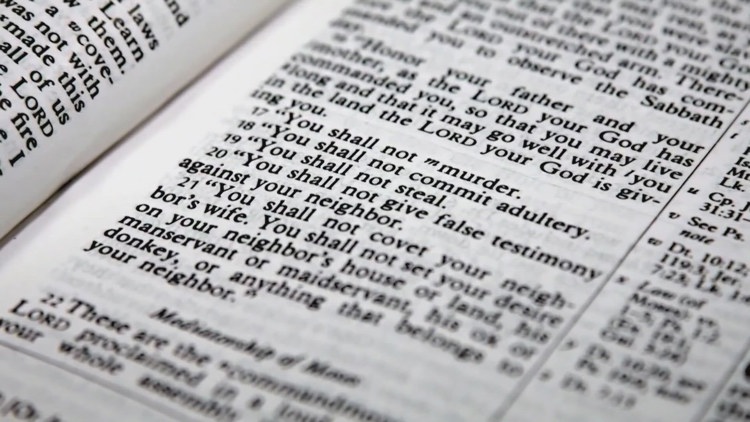
As students across Central Texas return to school this year, they’re encountering something new on their classroom walls: the Ten Commandments, now required by state law to be displayed in every public school classroom.
Governor Greg Abbott signed Senate Bill 10 into law in May, making the 2025-2026 school year the first time Texas students will see the biblical commandments posted in their learning spaces. The controversial requirement has sparked lawsuits and divided opinions on the role of religion in public education.
Law Requires Specific Display Standards
Senate Bill 10 is detailed in its requirements. The commandments must be displayed on a durable poster or framed copy, placed in a visible area of each classroom. The law specifies exactly which version of the Ten Commandments schools must use and mandates that districts accept donations if offered to cover costs.
Schools can also use district funds to purchase the displays, which must measure 16 by 20 inches and be placed “in a conspicuous place.”
Local District Implements Law District-Wide
Temple ISD Superintendent Bobby Ott figured early on that the law would pass.
“When I first heard, to be honest, I checked around with some legislators because I wanted to know if it was gonna pass or not,” Ott said. “My next question was: How do you implement something like this?”
The district received help from donors Jeff and Brenda Howard, who provided over 700 posters to cover the district’s 15 campuses and approximately 670 classrooms– at no cost to taxpayers.
“It’s 100% donated, yeah, we didn’t pay anything,” Ott explained. “The donors were kind enough, generous enough to give us over 700.”
Ott emphasized the district’s effort to maintain consistency across all campuses to avoid confusion among families with children at different schools, and protect teachers.
“I have a parent that has a child in an elementary school and middle school, and their elementary kids are saying ‘well we have it in the classroom’ and middle school kids saying ‘we don’t’ — well what does that look like? What does that mean to people?” Ott said.
Ott compared the requirement to other mandatory classroom displays like fire extinguishers or evacuation plans, noting that “to me, if it’s a district wide implementation, it’s our responsibility as a district.”
Legal Challenges Mount
Professor of Political Science at Baylor University, Pat Flavin, pointed to a similar law in Louisiana that was recently overturned by an appeals court as potentially problematic precedent for Texas.
“[They ruled] it violated the First Amendment Establishment Clause, separation of church and state,” said Flavin.
However, Flavin noted that the legal landscape may be shifting, with proponents likely aiming for a Supreme Court ruling that could overturn previous precedent.
“Those who are in favor would say that the Supreme Court has been trending more favorably towards allowing a little more intermingling of religion in public schools,” Flavin explained. “This really comes down to ultimately how the Supreme Court views it and whether it’s ready to revisit and potentially rule in a different way.”
The American Civil Liberties Union is suing in federal court against the law, representing 16 parents of various religious and non-religious backgrounds. This marks the second lawsuit challenging the Texas requirement.
The ACLU of Texas told Six News:
“We, along with other free speech advocacy groups have already filed our lawsuit on behalf of 16 diverse religious and non-religious families challenging the constitutionality of S.B. 10…There will be a hearing in this case this Friday.”
Community Reactions Vary
Flavin distinguished the Ten Commandments requirement from Texas’s previous mandate to display “In God We Trust” signs, calling the commandments “more specific, more specifically Christian, Judeo-Christian.”
“Seeing the 10 Commandments posted on your classroom wall on a day-to-day basis is much more apparent,” Flavin told 6 News. “It’s something that you see every day, that’s different than it being discussed in a lesson.”
Some community members have expressed concerns about the law’s impact on students of different faiths.
Al Siddiq, president of the Islamic Center of Waco and a U.S. Army veteran, criticized the requirement as unconstitutional.
“Of course, obviously it’s against our Constitution,” Siddiq said. “It puts a fire in the classroom, you know, they want to make you feel that you are different than others.”
Siddiq argued that the law’s supporters should focus on more pressing needs.
“They need to practice what they preach,” Siddiq said. “They can put 20 commandments in the class. It will not change the condition of hungry people in the class, hungry students in the class.”
Districts Moving Forward Despite Uncertainty
Despite the controversy, Superintendent Ott said Temple ISD will comply with the law while maintaining an inclusive environment for all students.
“We’re very inclusive in Temple ISD,” Ott said. “We do a moment of silence every morning at every campus, so you’re able to choose your own faith in that moment.”
Ott acknowledged that some students may have questions about the displays but said the district hasn’t received complaints from parents. Teachers have asked questions, he noted, “but they understand it’s the law.”
Ott emphasized the district’s commitment to following legal requirements, whatever they may be.
“I know it’s sensitive,” he said. “I know there are varying opinions about it, but it is the law that was signed and we’re gonna follow it. If the law gets overturned and it’s prohibited, well then obviously we’re gonna follow the law.”
6 News will continue following this developing story as legal proceedings advance.