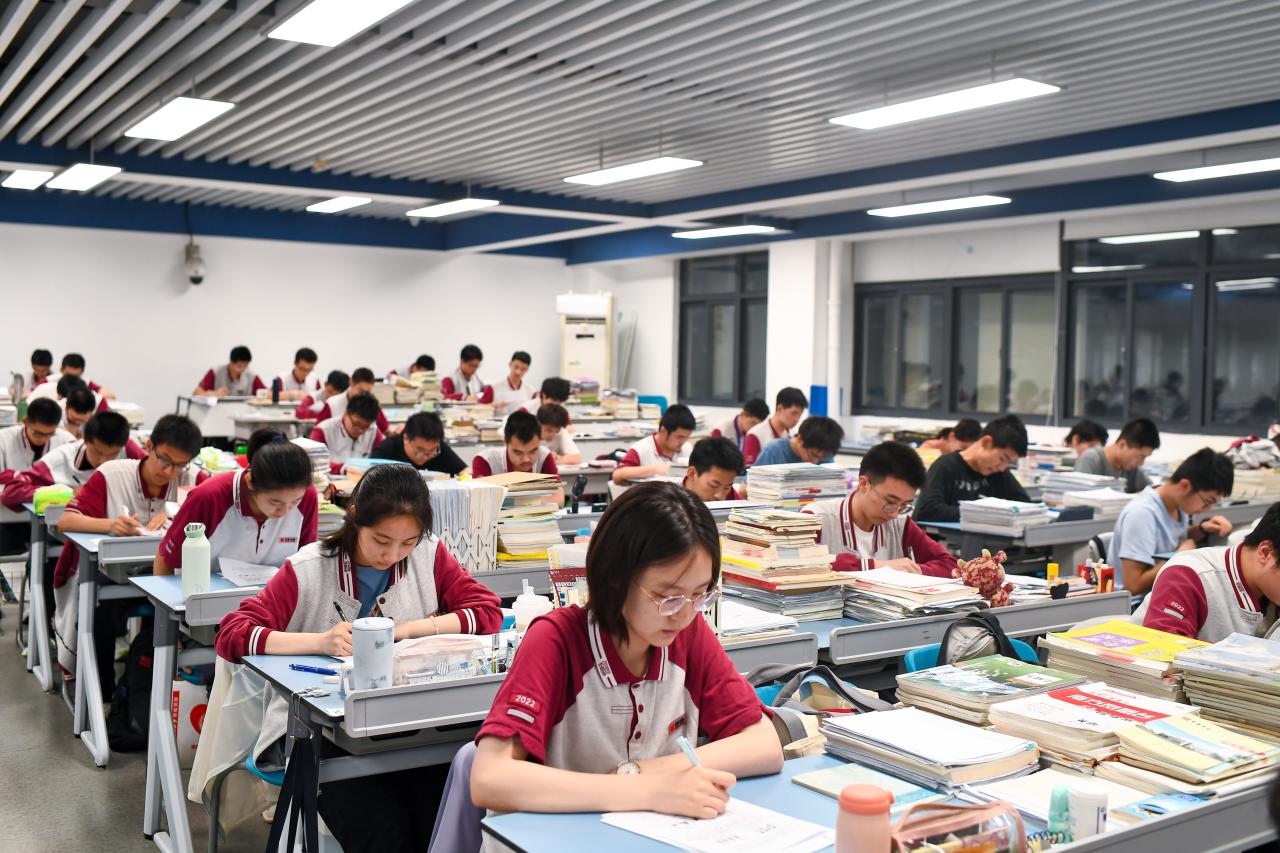
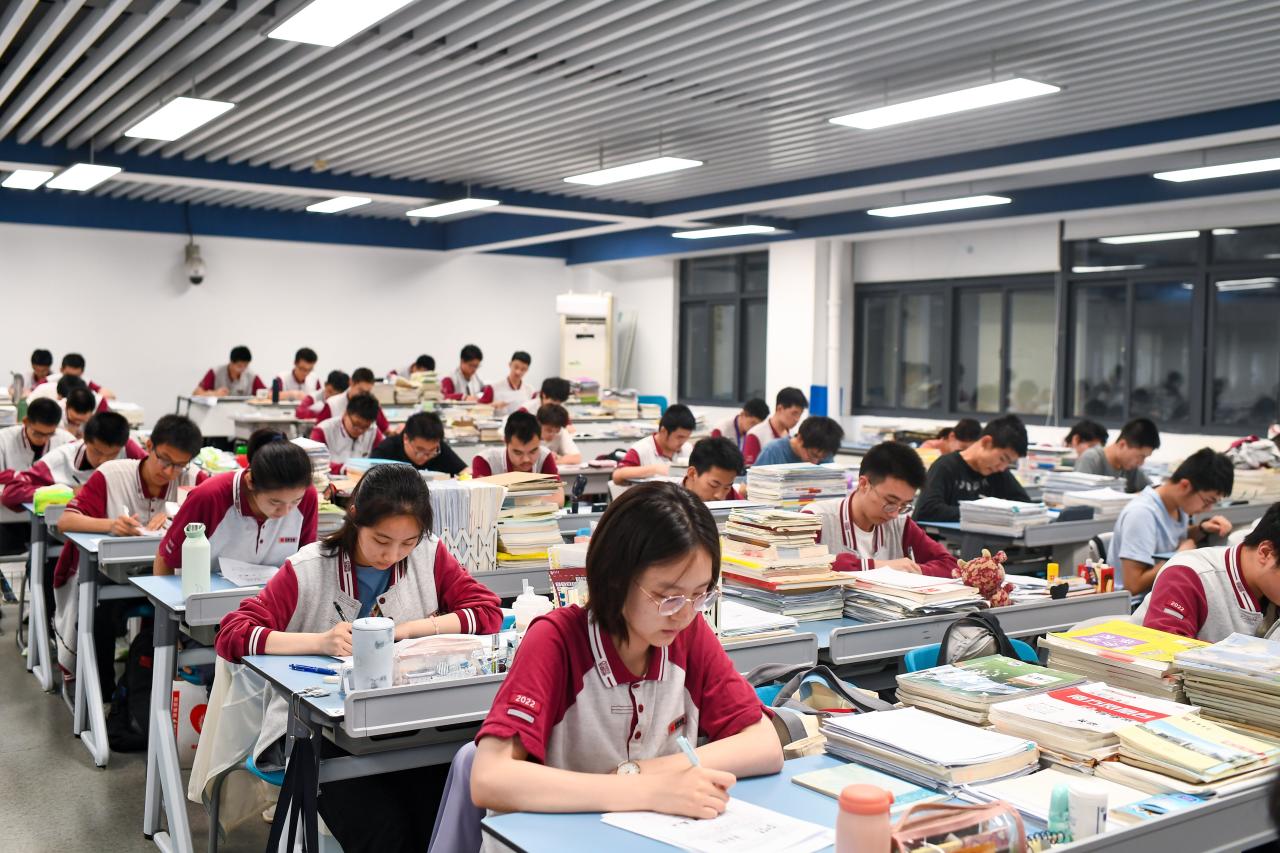
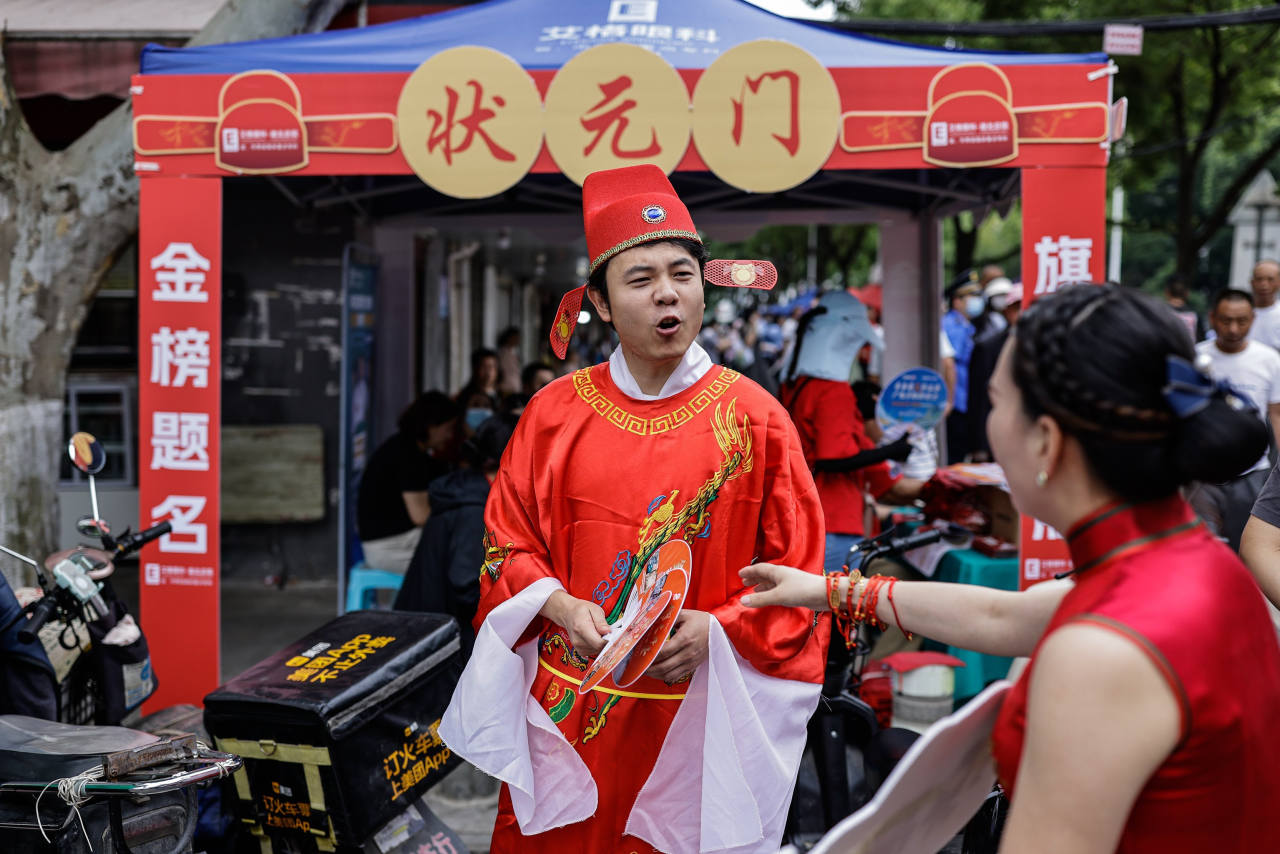
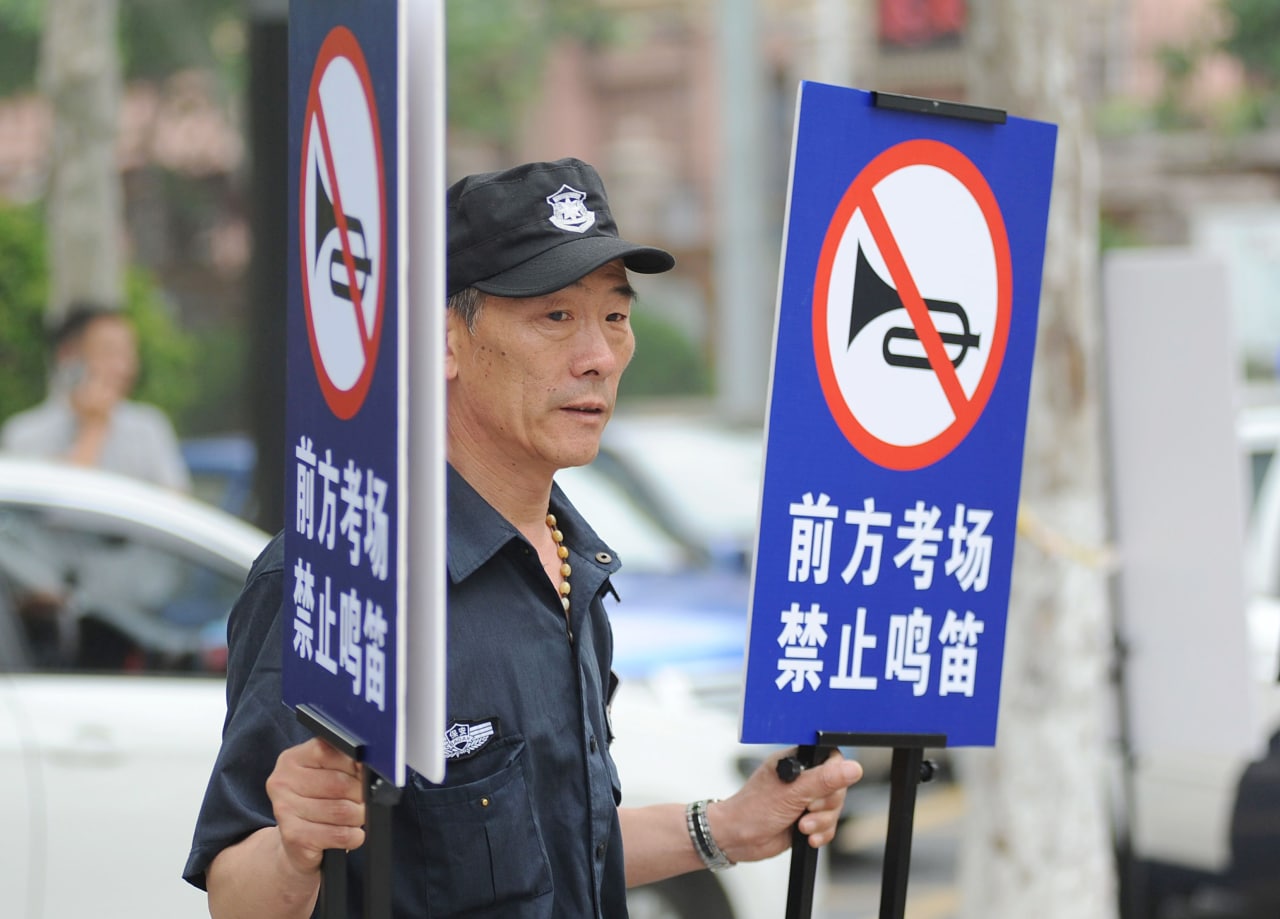
For two days every year in June, China comes to a standstill. Unusual sights abound: Men put on qipaos, traditional dresses typically worn by women, as a symbol of luck; police stand on street corners, silencing drivers to ensure minimal disturbance; temples overflow with relatives sending out final prayers; crowds, unusually quiet, gather in hushed vigils outside thousands of schools. State media zero in on an event affecting 10 million students and their many family members: the gaokao, China’s national college entrance exam.
The highest scorers on the gaokao in each province are practically guaranteed a spot at an elite university and the life-changing power that comes with it. In some places, top scorers are treated like celebrities and interviewed on local television. In others, legal measures now shield the identity of the highest scorers to protect them from overexposure.
The gaokao is the culmination of hundreds of tests that Chinese students take during the 12 years of elementary to high school. Exams are a fact of life in many places around the world. But no country is as thoroughly governed by test scores as China, where they both reflect and reinforce the structure of society as a tournament—a zero-sum competition where, if your neighbor wins, in all likelihood you lose.
The higher education system in China is a pyramid with five tiers. At the top are approximately 100 elite universities, which receive priority in government funding and resources. Below them are several thousand four-year universities designated Tier 2, Tier 3 and Tier 4, which differ substantially in terms of their reputation and resources. At the bottom of the pyramid sit two-year or three-year vocational colleges, which are similar to community colleges in the U.S.
Every student’s score on the gaokao is compared to the score of every other student within their province; it is only by knowing how well others are performing that one can gauge one’s own performance. Of the 10 million students who take the gaokao every year, about 500,000, the top 5%, will gain admission to a Tier 1 college. Admission is entirely determined by test score, in contrast with the U.S., where standardized tests like the ACT and SAT are just one of many factors considered by an admissions office, and each college typically accepts students with a range of scores.
For Chinese families, obsessing over the gaokao is perfectly rational: Unless they do so, they have little chance of succeeding within the system. That is why, even though Chinese primary and middle schools are free and high school tuition is relatively low, families with students devote about 7.9% of their total household expenditure to education, compared to a global average of roughly 2% to 3%. After all, if every student is supposedly receiving the same free public education, the only way to surpass your peers is to do something different, something extra. That’s where tutoring comes in.
For ambitious urban students, tutoring is nonnegotiable. The chance of getting into China’s two top universities, Peking and Tsinghua, is close to zero if a student does not attend one of the top 10% of high schools in their province. To attend a top high school, a student must be a top tester in one of the best middle schools. And to get into one of the best middle schools, a student must be a top tester in one of the best elementary schools. That means children often begin the tutoring grind at age 4 or 5.
The need to pay for tutoring puts wealthy families at a notable advantage. The same is true in many countries, but inequality of educational opportunity is especially problematic in a country that emphasizes socialist ideals. In recent years, China’s government has taken pains to tackle inequalities in the exam system, even outlawing all forms of tutoring in 2021. Within a month, the stock price of China’s most prominent tutoring company plummeted by 90%.
But while the policy was meant to help students and families struggling with expenses, it did nothing to change the underlying reality of the system. The demand for higher scores exists because the gaokao exists. Wealthy individuals now simply hire private tutors under the table instead of contracting with bigger companies. Other tutoring companies have gone underground, which only drives up the cost and limits access for students already struggling with limited resources.
Even housing can be considered an educational expense, since living in a top school district offers a shortcut to the best elementary schools. In Beijing, a 550-square-foot apartment in a prestigious district can cost roughly $1.2 million, a higher price per square foot than in Palo Alto, Calif., one of the most expensive cities in America.
China’s efforts to reduce private spending on education extend beyond the tutoring crackdown. Since 2012, the government has boosted its education budget to over 4% of GDP, matching the global average of 4.3%. It has also introduced a lottery system for school districts in major urban centers, to increase access for poorer students. But with the system as competitive as ever, these efforts have done little to reduce individual expenses, and Chinese parents still hear the popular phrase ringing in their heads: “Don’t let your children lose at the starting line.”
As graduates of elite Chinese universities, both of us know how life-changing China’s educational system can be for winners in the tournament. But after spending years in the system and even more time studying it, we are also aware of its limitations. “Teaching to the test” discourages students from exploring subjects beyond what appears on the gaokao. It can also hinder the development of social skills, which are extremely valuable in the workplace and likely to become even more so as many tasks become automated by AI.
Fostering social skills is undeniably a strength of the education system in the U.S., and few would doubt that the quality of an American college education exceeds that of a Chinese one. For younger students, on the other hand, Chinese education has significant strengths. Starting in elementary school, the system emphasizes “hard skills” like math and logic, as well as “soft skills” such as hard work and discipline, which are useful in higher education and the workplace.
As for whether the Chinese system stifles creativity and innovation, the answer reaches far beyond the classroom. The real problem is that Chinese society as a whole is structured as a hierarchical tournament, like the gaokao: It rewards the types of behavior necessary to climb the ladder while discouraging those that foster creative destruction. The failures of China’s education system won’t be remedied unless the broader society changes as well.
Ruixue Jia is a professor of economics at the University of California, San Diego, and Hongbin Li is co-director of the Stanford Center on China’s Economy and Institutions. This essay is adapted from their new book, “The Highest Exam: How the Gaokao Shapes China,” written with Claire Cousineau, which will be published Sept. 9 by Harvard University Press.
Sample Questions from China’s Gaokao
ANSWERS: Question 1: C.