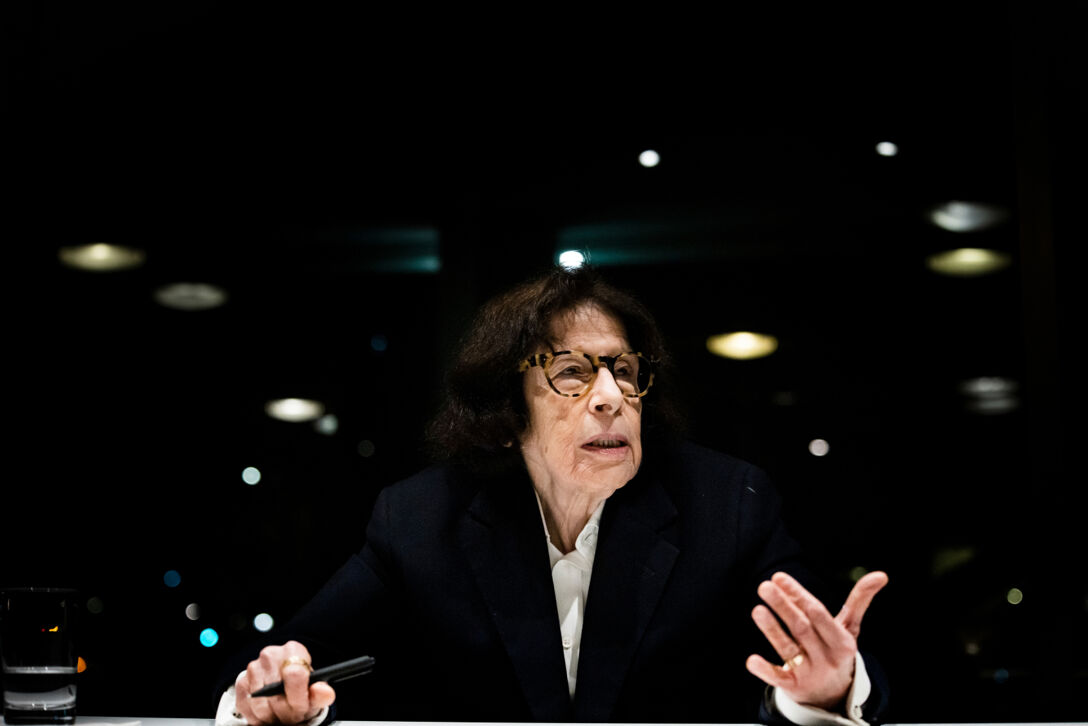
When one wants to capture the cultural zeitgeist, turning to Fran Lebowitz is a wise move. The public intellectual is known for her sardonic commentary and distinct uniform: suit jacket, white shirt, Levi’s jeans and tortoiseshell glasses.
Dressed in her signature attire, Lebowitz is seated at a restaurant booth and pontificating about the state of Manhattan and the culture writ large. The clip, which has gone viral in recent days, is lifted from Martin Scorsese’s first project with his long-time friend, Public Speaking.
In it, Lebowitz is talking about a subject on which she’s opined many times before: the corrosive impact of HIV/AIDS on the artistic community. Lebowitz, who lost many of her friends to the virus, including artists Peter Hujar, Paul Thek and David Wojnarowicz, says the virus didn’t only ravage the creative class.
It wiped out their audience, too. She says that’s just as important.
How about we take this to the next level?
Subscribe to our newsletter for a refreshing cocktail (or mocktail) of LGBTQ+ entertainment and pop culture, served up with a side of eye-candy.
Subscribe to our Newsletter today
“When people talked about it, they talked about what artists were lost. But they never talked about the audience that was lost,” she says. “Why was New York City ballet so great? … That audience was so, I can’t even think of the word. … There was such a high level of connoisseurship of everything that people like this were interested in that made the culture better. A very discerning audience, an audience with a high level of connoisseurship is as important to the culture as the artists.”
Lebowitz’s critics of contemporary art are rooted in her ennui over gentrification and the subsequent sterilization of urban spaces. In Public Speaking, which was released in 2010, she blames tourism on hastening New York’s descent into sameness.
As city officials were advertising New York to the masses, the AIDS crisis was destroying the city’s art community.
The most subversive, and thus the most interesting, were the first to go.
“When that audience died, it allowed the second, third and fourth tier to rise to the front,” she explains. “Because of course, the first people who died of AIDS—I don’t know how to put this—got laid a lot. Imagine who didn’t get AIDS? That’s who was then lauded as the great artists. Last man standing.”
As of Friday morning, the clip has been viewed nearly 2 million times on X.
Related
From Ancient Egyptian romances to Michelangelo’s queer secret, meet the man spilling the tea on gay history
With a new YouTube series, Kris Fitzgerald wants to find the queer stories that inspire.
With the advent of PrEP, it’s easy for the horrors of the HIV/AIDS crisis to fade into the background. But the current administration’s refusal to fully fund PEPFAR, an HIV/AIDS treatment and prevention program that’s credited with saving 26 million lives, shows that’s foolhardy.
As we’ve seen, culture can backslide.
When Lebowitz talks about HIV, it’s apparent its horrors are personal. A queer person herself, the now-74-year-old felt embraced by New York’s LGBTQ+ community when she arrived as a teenager in the late ’60s.
One of Lebowitz’s earliest writing jobs was working for Andy Warhol’s magazine, Interview.
“I fell in with a group of incredible talkers,” she says during Public Speaking. “I fell in right away with this bunch of incredible, they were all guys. They were all gay. They were much older than me–10 years. It wasn’t really competitive. But it was nasty, let me tell you. After that, I suppose nothing could phase me.”
At the time, homosexuality was criminalized in the U.S., and police often raided gay establishments. Lebowitz doesn’t think it’s a coincidence that many great queer artists lived on the fringes of society.
“It is not true that being homosexual makes you artistic,” she says. “What is true is, being put in [jail]. Or being kept down. Or being depressed. Being forced to observe.”
Given the marginalization, Lebowitz remarks she found it odd the leaders of the gay rights movement were transfixed on two conservative institutions: marriage and the military. They pushed for the “hetero-sizing” of queerness, which probably explains why the gay rights movement was so successful.
At least, when it comes to mainstreaming a certain gay prototype. You know, the kind of person who drives their SUV to the gay bar and then would snivel if the person next to them started smoking.
Our cultural decadence, Lebowitz indicates, can be told through the relationship between gay bars and smoking cigarettes inside.
“Gay bars were illegal. They were backrooms, they were raided by the police. But you could smoke in them,” she adds. “Now, gay bars have stained glass windows. They have valet parking. But you have to go outside to smoke.”
Related
Is this Berlin bathhouse really worth the 300+ person wait to get inside?
Is Lab.oratory worth it?
Sign up for the Muara Digital Team newsletter to stay on top of the hottest stories in LGBTQ+ entertainment, politics, and culture.