Good morning, Early Birds. We are coming to you live from a city we love, Washington, D.C. Send tips to earlytips@washpost.com. Thanks for waking up with us.
In today’s edition … Trump declares “liberation day” in the nation’s capital, looks toward other cities … Another Democrat gets in Iowa’s Senate race … And we answer your questions on Putin and the International Criminal Court … but first …
Get ready with The Post
- Trump’s risky role as the would-be CEO of America, report Naftali Bendavid and Abha Bhattarai.
- Nvidia, AMD agree to pay U.S. government 15% of AI chip sales to China, report Eva Dou and Grace Moon.
- Pressure mounts on Texas Democrats as walkout stretches into a second week, reports Patrick Marley, Molly Hennessy-Fiske and Yvonne Wingett Sanchez.
- China tariffs delayed again, hours before sharp increase was to take hold, report Rachel Lerman, Jacob Bogage and Christian Shepherd.
Trump says he’s tackled the border. Now he’s onto cities.
President Donald Trump declared victory along the U.S.-Mexico border from the White House briefing room yesterday, and homed in on his next target: Washington, D.C.
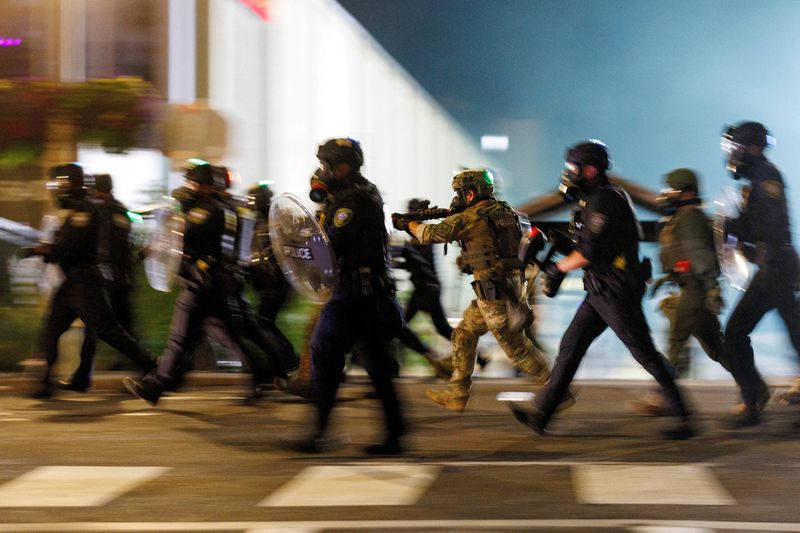
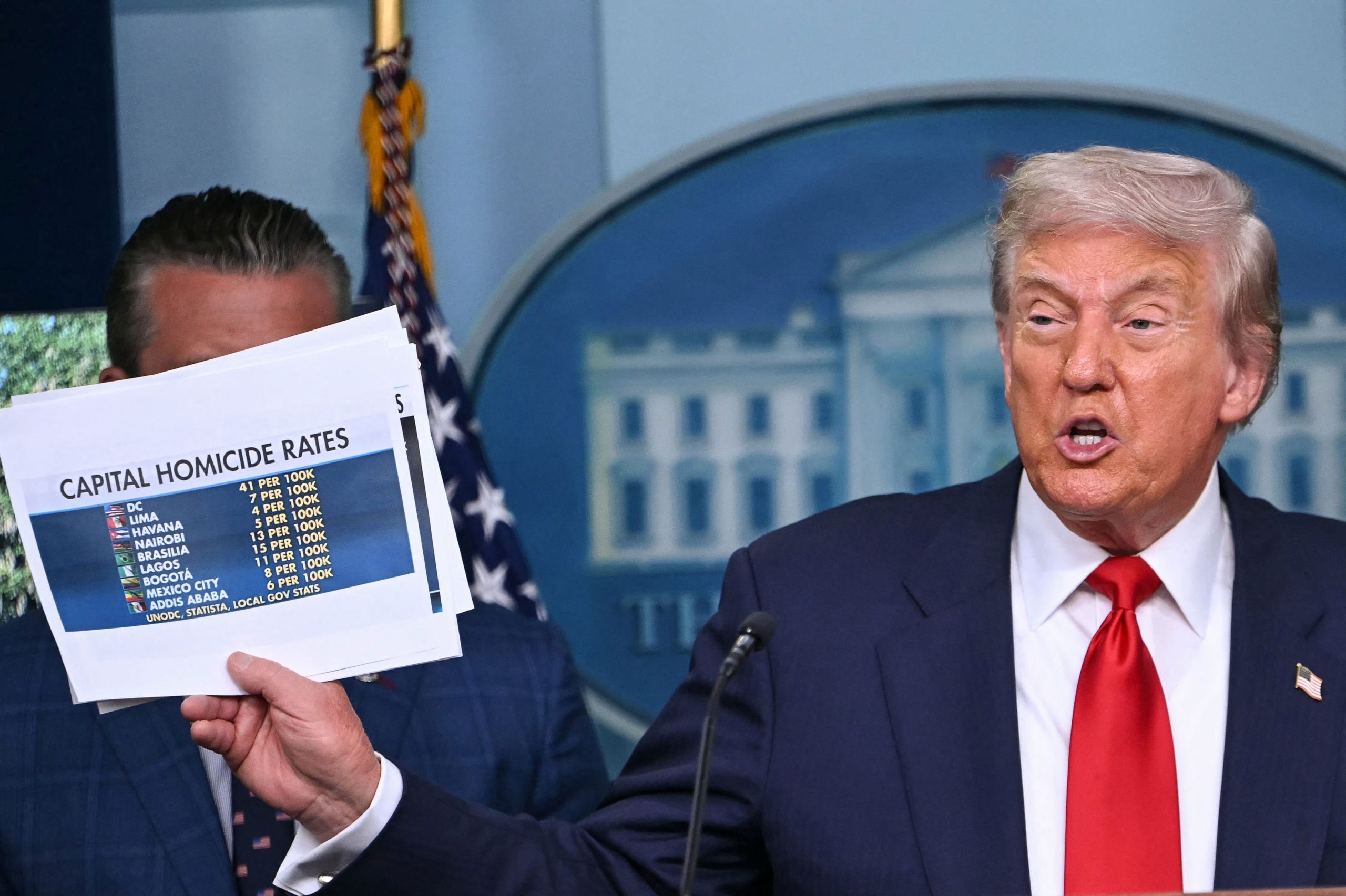
“This is liberation day in D.C., and we are going to take our capital back,” Trump said in a news conference where he announced the federal government was placing the D.C. police under direct control of Attorney General Pam Bondi, deploying the National Guard inside the district and calling a public safety emergency there — all in the name of combating crime.
In doing so, Trump drew a direct line between the nation’s capital and the Southern border, saying his takeover will bring order to D.C. “just like we did on our Southern border.” He also pledged that “this will go further,” saying he could target other large cities such as Chicago soon.
“We will bring in the military if needed,” he added, arguing that crime in Washington “directly affects the functioning of the federal government.”
This dark view of D.C. is nothing new for Trump, who has long used the district as a political cudgel, from branding it “the swamp” since the inception of his political career to complaining about its government and crime for years. And this move continues Trump’s war on major metropolitan areas, a fight that highlights the growing political divide between Democrats’ urban power centers and the rural areas that make up Trump’s base.
“Politically, it is smart on his part,” said Cheri Bustos, a former Democratic congresswoman who once represented a more rural district in Illinois and was known for her advocacy for rural Democrats. The urban-rural divide is “real,” said Bustos, and Trump “is trying to make that divide even wider than it is.”
The rural-urban divide has been one of the most consistent themes in politics over the last decade, widening ever since Trump burst on the political scene in 2016. Democrats have increasingly struggled to compete in rural areas as Republicans have successfully cast themselves as champions of rural issues.
This has led Republican lawmakers in rural areas across the country to define themselves as being opposed to the politics of their nearest big city, whether that be major metropolitan areas like Chicago or New York, or even smaller liberal bastions such as Madison, Wisconsin, or Austin. This issue has grown even more pervasive as the ranks of rural Democrats in national politics have dwindled.
“He is playing to his strengths and he is amplifying any issue that is negative in a big city because he thinks it makes the Democrats look bad,” said Bustos. “President Trump likes to make the villain as big as possible, and that is what he is doing here.”
Whether this moment is good politically for Trump is an open — and early — question. Republicans certainly believe it allows him to simultaneously bolster his tough-on-crime image, attack big-city Democrats and rally his base.
But the timing of Trump’s announcement is inconsistent with the reality in D.C. right now: Violent crime has declined for the last two years after a sharp spike in 2023, and the Department of Justice said earlier this year that violent crime in Washington hit a 30-year low.
That was clear during Trump’s news conference — when the president rattled off crime statistics to back up his federalization of Washington, D.C., he appeared to be referring to dated data, when crime spiked in the city after the peak of the coronavirus pandemic, not the more updated numbers.
For those of you who don’t live in or around the nation’s capital, here’s a recap on the city’s status. It’s a federally administered district constitutionally under Congress’s control. It has a devolved city government and D.C. residents can vote for a mayor and city council, who oversee typical municipal issues such as housing, crime, water, parks and rec, you get the idea.
But that city government was created by an act of Congress, not the Constitution, and Congress could take it away. The city has one nonvoting delegate in the House and no one in the Senate (there are symbolic shadow senators, but they do not sit on committee hearings like Del. Eleanor Holmes Norton does), despite the fact that its citizens pay federal taxes. “Taxation without representation” is written on our license plates.
Trump invoked legal powers under the law that created D.C.’s government to take control of the city’s police force. Federal law enforcement already has jurisdiction in other parts of the city, including national parks, the White House, Capitol Hill and the Supreme Court.
Even if his moves are technically legal, D.C. Mayor Muriel Bowser said at a news conference, they are an infringement of the city’s already fragile self-determination.
“We know that access to our democracy is tenuous,” she said. “That is why you have heard me and many Washingtonians before me advocate for full statehood for the District of Columbia. We are American citizens. Our families go to war. We pay taxes and we uphold the responsibilities of citizenship. And while this action today is unsettling and unprecedented, I can’t say that given some of the rhetoric of the past that we’re totally surprised.”
Trump’s announcement attracted protesters to the White House yesterday who criticized the move as a form of tyranny and a distraction from the Jeffrey Epstein case, which Trump has tried in vain to brush away.
“There is not a crime problem here in DC. He’s just doing this so he can throw his weight around and pretend like he’s not part of the Epstein files,” Donna Powell, a demonstrator who has lived on and off in D.C. for four years but moved to the city to protest Trump, said. “He’s targeting the homeless. He’s targeting Brown and Black and minority people, which … is not right, and we all need to nonviolently protest what he’s doing.”
The Post is all over this story:
- Trump says crime in D.C. is out of control. Here’s what the data shows, from Olivia George, John D. Harden and Jenny Gathright.
- Inside Trump’s decision to deploy the National Guard in D.C., from Matt Viser, Emily Davies and Perry Stein.
- Who is Terry Cole, the DEA boss now tasked with overseeing D.C. police? from David Ovalle.
- D.C. Mayor Bowser sticks with cautious approach amid Trump’s takeover, from Meagan Flynn, Jenny Gathright and Olivia George.
The campaign
The Democratic field for Senate in Iowa is growing, with state Rep. Joshua Turek announcing his bid this morning.
Turek first won a state house district in the deep red Pottawattamie County in 2022. He was born with spina bifida and holds wheelchair basketball gold medals from the 2016 and 2020 Paralympics.
“I was born an underdog,” Turek says in the opening of an announcement video that shows him wheeling around his district, pulling himself up a constituent’s stairs and knocking on doors.
“When I was a kid, it was a senator from Iowa that made sure the doors were open for kids like me,” he says in the video, invoking Sen. Tom Harkin’s successful work in passing the Americans With Disabilities Act of 1990. “Now the senator from Iowa is just closing doors,” Turek says as an image of incumbent Republican Sen. Joni Ernst flashes on screen.
Ernst has yet to declare her candidacy for reelection, and there is a sense among Democrats that she may not run.
It’s a tough race for Democrats whether Ernst is in or not. After backing President Barack Obama twice, Iowa has moved away from the party over the last decade, backing Trump three times, ousting all Democrats in the state’s congressional delegation in recent years and giving Republicans total control of the state’s government each cycle since 2017.
Turek told us in an interview that he welcomes a challenge.
“When people talk about winning in Iowa as a Democrat, they will talk about it being too difficult,” he said. “Well, my life has been filled with a lot of adversity.”
But, he argued, Iowa is not as red as people think. “At our core, Iowa, we are a commonsense state. I think we have masqueraded as much more red than we actually are,” he said, adding that voters are looking for that common sense reflected in their elected leaders.
Turek is jumping into a crowded field that includes state Rep. J. D. Scholten, who has run for Congress twice; Jackie Norris, chair of the Des Moines School Board; Nathan Sage, the executive director of the chamber of commerce in Knoxville, Iowa; state Sen. Zach Wahls.
From you
Many of you asked if Russian President Vladimir Putin could be arrested once he lands on U.S. soil for his meeting with Trump in Alaska this week. The International Criminal Court has a warrant out for his arrest over the forced displacement of Ukrainian children as part of Russia’s illegal invasion and annexation of Ukrainian territory. Signatories to the treaty creating the ICC are compelled to hand over anyone with an arrest warrant to the court.
But it’s very unlikely Putin will face any trouble waltzing into the United States. We are one of a handful of countries that do not recognize the court. The U.S. was party to the negotiations that led to the court’s creation, but the Senate never ratified the Rome Statute that established the ICC.
This is not without controversy. The U.S. has historically been respectful toward the court when its interests are aligned, but they has also clashed. The Trump administration placed sanctions on ICC judges for their investigations into the Gaza war and the U.S. involvement in Afghanistan. Republicans and Democrats criticized the court for going after Israeli officials over the war in Gaza. Sen. Dan Sullivan (R-Alaska) introduced legislation this year to ban any cooperation with the court.
The ICC issued arrest warrants against Israeli officials including Prime Minister Benjamin Netanyahu last year. Netanyahu visited Trump at the White House in July. No arrest was made.
In your local paper
Colorado Sun (Denver): Some states, like Colorado, are realizing that their state budgets will be dramatically impacted by the passage of Trump’s mega-bill earlier this year.
Now Habersham (Clarksville, Georgia): Georgia’s Democratic gubernatorial primary continues to grow, with former CEO of DeKalb County Michael Thurmond getting into the race.
Santa Fe New Mexican: Solar power and the increased use of battery storage facilities will become the norm in many American cities in the years to come. But in Santa Fe County, New Mexico, a debate over a planned facility south of the city highlights how such projects can quickly become contentious.
Send a reply
Trump’s announcement yesterday about Washington builds on years of conservative politicians casting the nation’s capital as a crime-ridden, dirty city, something that clashes with both statistics and the living reality in most parts of the city. So we wanted to ask our readers both in D.C. and around the world: What is your view of D.C.? How do you see the nation’s capital? Have you visited the city and had a good or bad experience? We’d like to know. Send us your thoughts at earlytips@washpost.com or at dan.merica@washpost.com and matthew.choi@washpost.com.
Thanks for reading. You can follow Dan and Matthew on X: @merica and @matthewichoi.