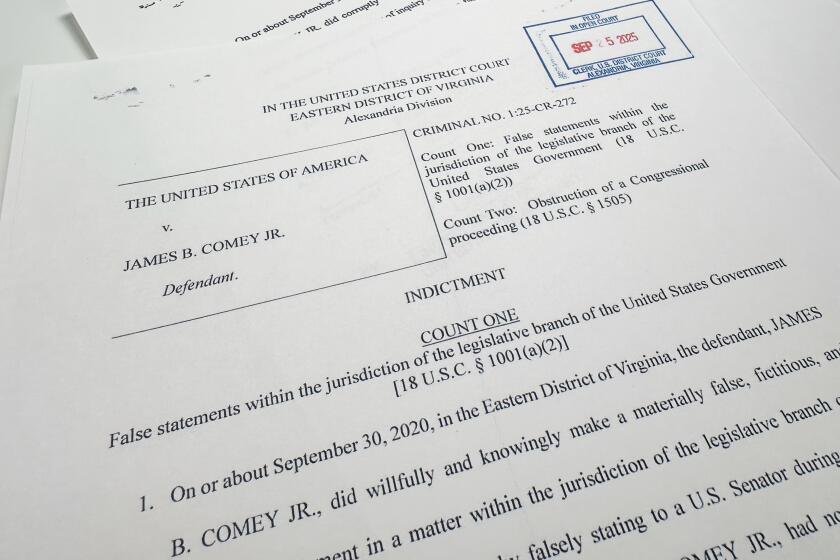
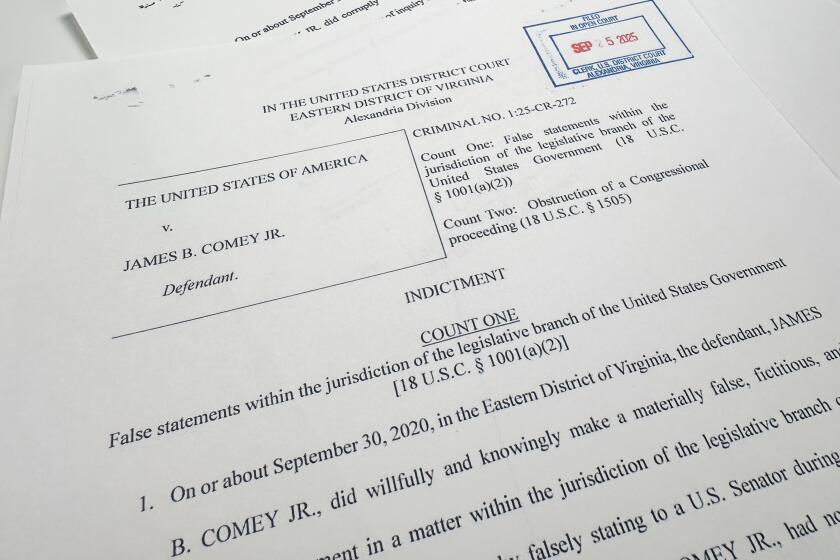
The charges against former FBI Director James Comey consist of just two pages and claim he provided false testimony to Congress in 2020 regarding approving an individual as an anonymous source in news reports.
This concise summary hides a complex and controversial history. The incidents central to the contested testimony are some of the most thoroughly examined in the bureau’s past, leading to internal and congressional inquiries that have resulted in thousands of pages of documentation and transcripts.
The examinations centered on how Comey and his team carried out critical investigations into whether Russia had illegally collaborated with Republican Donald Trump’s 2016 presidential campaign, which was against Democrat Hillary Clinton, and also looked at her handling of a private email server while serving as Secretary of State.
Here are some key points about that era and how they relate to Comey’s indictment:
What are the allegations?
The indictment allegesThat Comey provided a misleading statement during his testimony before the Senate Judiciary Committee. The single quote from the indictment seems to originate from a conversation with Sen. Ted Cruz (R-Texas).
Prosecutors argue that Comey was not truthful when he stated he did not permit any FBI personnel to act as an anonymous source for the media, claiming he had done so by instructing an individual referred to as “Person 3” in the indictment to speak with journalists.
“It’s a very minimal critique,” saidSolomon Wisenberg, a former federal prosecutor who is now a defense attorney in private practice. “We are not aware of what the evidence will be” at trial, he stated.
What did Comey tell Congress?
Wisenberg stated that the testimony in question seems to have occurred when Cruz was questioning Comey about the involvement of his deputy director at the time, Andrew McCabe, in approving a leak to the Wall Street Journal regarding a story that looked into how the FBI managed an investigation into Clinton’s use of a private email server.
Cruz’s question was complex, yet it ultimately aimed to place Comey against McCabe. The senator pointed out that Comey had informed Congress in 2017 that he had not given anyone permission to speak with reporters. However, Cruz claimed that McCabe had “publicly and consistently stated that he leaked information to the Wall Street Journal and that you were fully aware of it and had directly approved it.”
“Who is being truthful?” Cruz inquired.
Comey responded: “I stick by the statement you outlined that I provided in May 2017.”
At that moment, Comey found himself under pressure from Sen. Charles Grassley (R-Iowa). He was questioned about whether he had ever permitted another individual within the FBI to serve as an anonymous source in news stories concerning the Trump or Clinton investigations.
Comey answered, “No.”
The indictment claims that Comey incorrectly asserted that he did not “authorize someone else at the FBI to be an anonymous source in news reports,” but Comey seems not to have used those exact words during the 2020 hearing, which might make it harder to prove that he lied.
What could have triggered the inquiries?
“Person 3” is not mentioned in the indictment, but seems to have been involved in discussions about an investigation concerning Clinton, as indicated by a more explicit reference in a felony charge that grand jurors did not approve. Comey was involved in multiple inquiries regarding alleged leaks during the Clinton investigation, all of which created significant documentation.
One related to McCabe and the Journal story. McCabe informed the Inspector General of the Department of Justice that he had permitted a junior employee to speak with a Journal reporter and had subsequently notified Comey about this conversation.
It’s improbable that the indictment centers on that specific incident, as McCabe did not inform investigators that Comey had given him permission to speak with the media, but rather that the FBI director was aware McCabe had done so.
Two additional leak inquiries focused on a friend of Comey’s who temporarily worked as a paid government consultant to the director. This consultant, Daniel Richman, has informed investigators that he contacted the media in an effort to influence views on the struggling FBI director.
A law professor at Columbia University named Richman was questioned by FBI agents in 2019 regarding disclosures to the media that pertained to the bureau’s inquiry into Clinton. Richman stated that Comey had never given him permission to discuss the Clinton investigation with the media, although he admitted that Comey was aware he occasionally spoke with reporters.
Comey has admitted to using Richman as a channel to the media in a different situation. Following Comey’s dismissal by Trump in 2017, he provided Richman with a document outlining his communications with the president. Comey subsequently testified before Congress, stating that he had permitted Richman to share the memo’s details with reporters, aiming to encourage the appointment of a special counsel who could examine Trump’s actions.
Where did we end up?
Trump and Comey have been involved in a prolonged conflict. Trump holds Comey responsible for initiating an inquiry into Russia’s interference in his 2016 campaign, which resulted in the appointment of special counsel Robert S. Mueller. Mueller spent most of two years examining whether Trump’s campaign illegally collaborated with the Russian government.
Ultimately, Mueller found no proof that Trump or his associates committed a criminal conspiracy with Russia, but determined that they accepted help from Moscow and that Trump had interfered with the investigation. These conclusions were mostly supported by bipartisan congressional reports regarding the issue.
Trump, who was found guilty of felony fraud in the previous year, has consistently criticized the “Russia hoax,” which influenced and shaped the initial period of his first presidency. Over the following years, he has repeatedly attacked Comey and claimed that he should be charged with treason.
Shortly before the charges were filed, Trump openly encouraged his attorney general, Pam Bondi, to take action against Comey and two other individuals he viewed as adversaries: “We can’t wait any longer, it’s harming our reputation and trustworthiness,”Trump shared a message on social media last week.Justice needs to be delivered immediately.
Shortly after the indictment was announced, Trump once again took to social media to boast: “JUSTICE IN AMERICA! One of the most terrible individuals this nation has ever encountered is James Comey.”
Comey has continued to stand firm in his defense, while expressing criticism towards Trump on various issues. In a 2018 book titled “A Higher Loyalty,” Comey likened Trump to a mob boss and claimed he was immoral and “unconnected to the truth.”
Similar to Trump, Comey used social media following his indictment.
For many years, my family and I have been aware of the costs involved in opposing Donald Trump,” he stated. “My heart aches for the Department of Justice, but I have strong faith in the federal judicial system, and I am innocent. Therefore, let’s proceed with a trial.
Tau contributes to the Associated Press. AP reporter Eric Tucker provided input for this report.
This narrative first was published inLos Angeles Times.