
As England struggles beneath itsfourth significant heatwave of the yearAs droughts strain the country’s water supplies, the UK government has issued a confusing environmental recommendation: delete your old emails and digital images to save water.
In a press release on August 12The Environment Agency informed the public about a list of actions they can take to assist, such as “turning off a tap or deleting old emails” to support the “collective effort” in addressing water shortages. This advice, repeated by the National Drought Group (a group of agencies and industries), is part of an actual, climate-related issue. Water supplies are decreasing, farmers are struggling, and wildlife is in danger. However, officials advising people to clear their email inbox is not only somewhat ironic but also remarkably hypocritical.
A Genuine Crisis Confronts a Useless Answer
Clearly, the UK is facing a real environmental crisis. Government statistics show that reservoir levels have dropped to 67.7%, significantly lower than the August average of 80.5%. Five areas are officially under drought conditions. Another six regions are described as dealing with “extended dry weather.” Grasslands throughout the country are becoming dry, and crops are beginning to suffer.
Certainly, data centers, which have emerged as the physical foundation of our digital existence, do require water. In many cases, they consume significant amounts. Certain facilities utilize evaporative cooling methods, which can use millions of liters of water each year to prevent server racks from overheating.A 2023 estimateset the consumption for a small center at 25 million liters annually.
Therefore, the concept that our digital environment significantly affects water usage is accurate.
But suggesting “delete old emails” as the first step in dealing with a drought? That’s where the reasoning falls apart — and quickly.
Most cloud data, particularly your old photos and emails, is stored on high-density, low-power hard drives or archival tapes. These consume very little energy, and in certain situations, almost no energy at all when not in use. Secondly, deletion does not happen right away. Files remain for weeks or even months after being deleted, typically functioning like a “recycle bin.” Energy (or water) is only saved when data is overwritten, and this occurs only if it results in the hardware being retired.
Perhaps the most critical factor is the “flows” of data, which consume the majority of resources, rather than the “stocks.” In other words, the true environmental impact of digital life stems not from what you retain, but from what you engage with. Streaming a single episode of a Netflix series requires as much energy as keeping 50 GB of photos stored for an entire year. Activities like using AI applications, participating in video calls, or scrolling through TikTok — these real-time actions are significantly more demanding in terms of resources.
How Much Water Is Actually Saved by Removing a Photo?
Let’s perform some approximate calculations. These are all just rough estimates to help you grasp the magnitude of the topic at hand.
Holding 50 gigabytes of images and videos, which is about the size of a typical personal photo collection,consumes approximately 8.5 kilowatt-hours (kWh)amount of electricity annually. A typical refrigerator consumes between 100 and 800 kilowatt-hours each year.
In terms of water usage? If traditional power plants are utilized (which need cooling water to generate electricity), this could equate to a few liters of indirect water consumption annually. Possibly. And only if that information is kept on a rotating disk within a data center that employs evaporative cooling and hasn’t yet transferred it to an energy-efficient archival level.
If you’d delete your entireA digital archive would be as significant as forgetting to brush your teeth once or missing an episode of your favorite series.
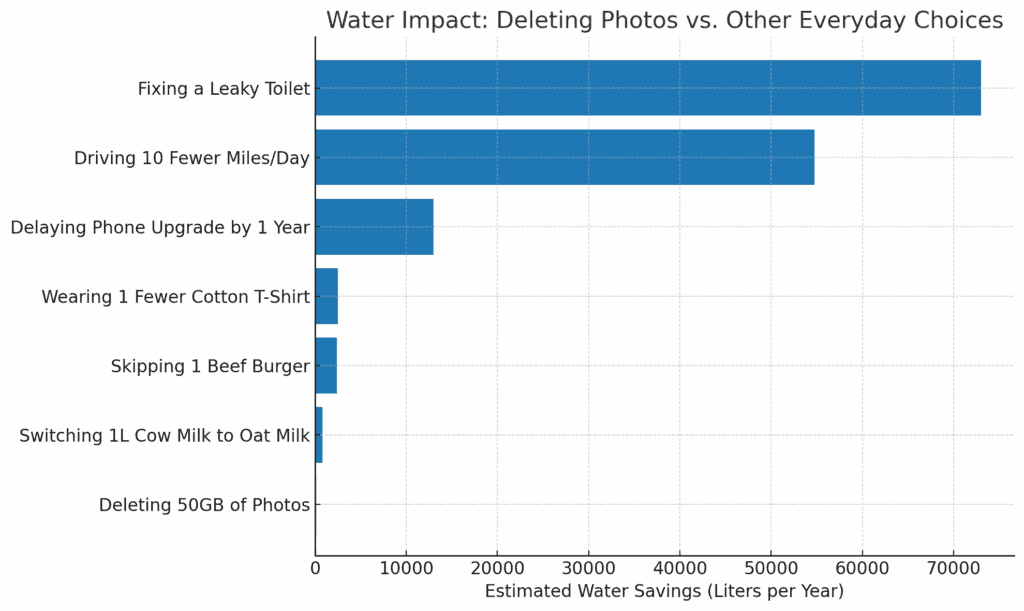
In comparison, skipping one hamburger saves approximately 2,400 liters of water — the quantity required to grow the grain, raise the livestock, and process the meat. Even opting for a plant-based meal once can save more water than deletingyour entire email inbox, and by one or two levels of magnitude.Replacing dairy milk with oat milksaves approximately 120 liters for every liter used, and one avocado requires more water to grow than the total data consumption of a full gigabyte in a year.
If the objective is to save water, what you eat has a far greater impact than what you store in the cloud.
Downloading data is somewhat more important. Utilizing approximately1 GB of dataApproximately 1 hour of non-stop TikTok use can consume about 200 liters of water.
But removing photos is just a virtual pat on the back. That’s also hypocritical from authorities.
It’s More Than Poor Guidance. It’s Loaded With Double Standards
The British government is placing responsibility on individuals to address an issue caused by years of persistent underinvestment. The actual causes (along with human-induced climate change) arechronic underinvestment in infrastructure, excessive water leakage, and the increasing needs of high-intensity computing — especially AI.
This year, water companies are experiencing the loss of billions of liters of water each day due to leaks. One company has managed to save an amount equivalent to 75 Olympic-sized swimming pools daily by addressing existing leaks, and numerous additional efforts are required. If you’re searching for digital causes, consider AI, which several governments—such as the UK—are actively promoting.

Several new, large, and water-intensive data centers are beingconstructed in the UK. All of this is led by thegovernment itself, which is even providing some major technology companiescompanies tax cuts. That’s where the true hypocrisy really takes effect.
At the same time that the government is encouraging people to remove old vacation photos, it is also increasing its support for AI and digital innovation as key drivers of economic growth. In 2024, the UK positioned itself as a leading center for AI development, attracting major technology companies to expand their data infrastructure across the country. Greater use of AI leads to more server farms. More server farms require more water. You don’t need a degree in environmental science to recognize the contradiction.
What Actually Works
Additional recommendations provided in the same publication include “a rain barrel to gather rainfall for use in the garden” and “utilize kitchen water to water your plants.”
That’s merely a temporary fix. If we are genuinely committed to reducing the environmental impact of digital infrastructure and alleviating strain on water resources, here are some factors that truly make a difference.
・Fix the leaks.It’s dull. It’s not digital. However, addressing infrastructure issues conserves more water than all the email deletions combined. This approach is also effective for individual homes. A dripping toilet can waste 200–400 liters per day.
・Go plant-based more often.The foods you choose are significant. Missing out on one beef burger can save much more than removing your photo backups. During a dry period, what you eat has a greater impact than what’s in your email.
・Target the big players.Data centers operated by Amazon, Google, and Microsoft are the ones consuming vast amounts of water. Public attention should be directed towards their water consumption, openness, and energy sources.
・Prolong the lifespan of your gadgets.The most water- and carbon-heavy aspect of your digital activities is typically not your data, but the device you use.Keeping your phone or computeronly one additional year can decrease its environmental impact by nearly one third.
・Promote efficient AI.Mandate transparency regarding energy and water consumption during AI training. Promote the development of models with minimal environmental impact.
・Stream smarter.Streaming one hour of high-definition video consumes as much energy — and thus, water — as keeping 50 gigabytes of data stored for an entire year. Viewing in standard definition or downloading content for later use can greatly reduce your digital impact.
・Support environmentally conscious policymakers. Let’s be honest, our individual choices won’t make much of an impact if those in power don’t care.
All the other mundane aspects, such as purchasing fewer unnecessary items, driving less, and utilizing renewable energy whenever feasible, are highly beneficial. These are practical choices that have an impact on supply chains, frequently resulting in savings of thousands of liters per action.
This narrative first was published onZME Science. Want to become wiser each day?Subscribe to our newsletterand keep up-to-date with the most recent scientific developments.